Mphasis CEO Nitin Rakesh Explains How the Company Is Reimagining Business Through AI
Mphasis CEO Nitin Rakesh spoke at Bloomberg: The Asia Trade, outlining the company's AI strategy. According to him, investments in AI are not an additional…
AI-processed from Bloomberg Tech; edited by Hamidun News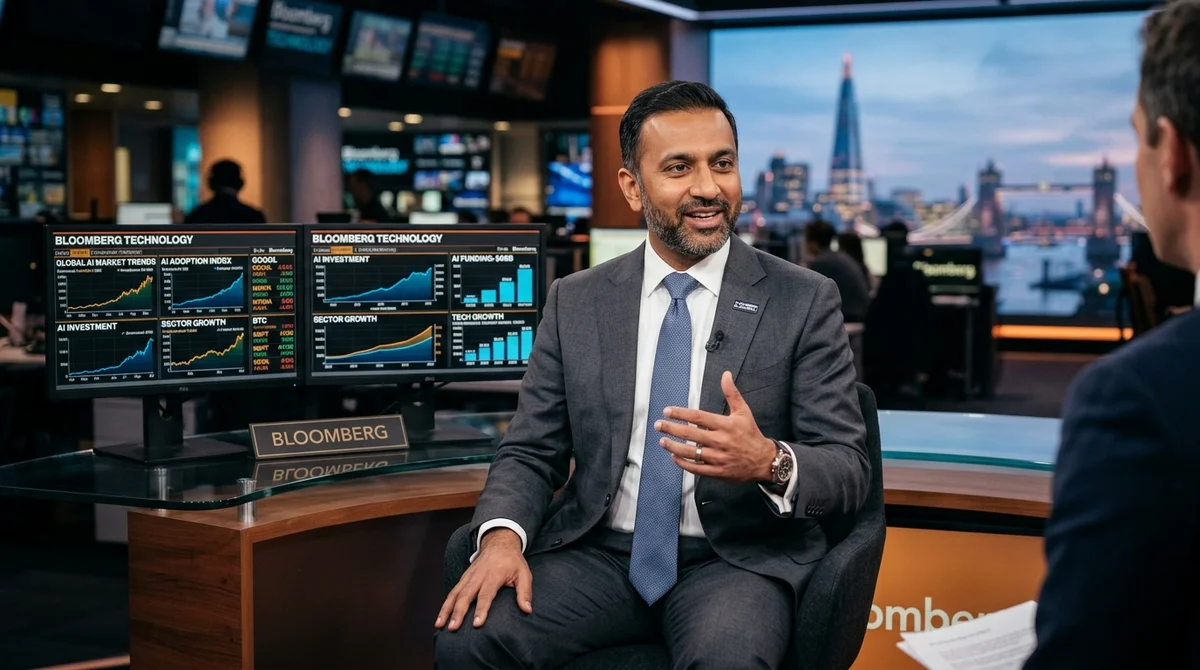
Nitin Rakesh, CEO of Indian IT company Mphasis, spoke at Bloomberg: The Asia Trade with an overview of business strategy and priorities in developing the AI direction.
Position in an Overheated Market
Mphasis is a mid-sized player in Indian IT outsourcing, specializing in the financial sector, insurance, and logistics. Unlike Infosys, TCS, or Wipro, the company deliberately maintains sectoral focus rather than pursuing scale. In the era of massive AI investments, this positioning works in Mphasis's favor: deep expertise in banking and insurance allows the company to create solutions that larger generalists implement more slowly and less precisely.
AI as Restructuring, Not Expenses
Rakesh views AI investments not as a separate budget line item, but as a rethinking of how an IT service is organized. In his interpretation, AI fundamentally changes the economics of outsourcing:
- Reducing development costs through AI assistants and test automation
- Accelerating time-to-market for client solutions
- Transitioning from a "pay-per-time" model to contracts with measurable outcomes
- Retraining engineers as AI operators and product analysts
- New services based on generative AI for clients in banking and insurance
Mid-sized companies are forced to make this transition faster than large ones — they lack the resources to wait for the market to fully take shape.
Asian Vector
The Bloomberg: The Asia Trade platform is not a random choice. Southeast Asia is becoming a priority market for Indian IT companies: financial organizations in the region are seeking partners for digital transformation who understand local regulations and can work with product logic rather than execution logic. Mphasis already has a presence in Singapore, Australia, and Japan. Rakesh sees Asian markets as points of accelerated growth against the backdrop of saturation in the American and European enterprise segments.
Personnel in the Age of Automation
The question of AI's impact on employment in IT outsourcing remains acute: the Indian industry employs millions of people. Rakesh's position is pragmatic — Mphasis does not plan mass layoffs, but the structure of roles is changing. Routine work goes to algorithms, people move to a higher level: managing models, client consulting, formulating AI strategy for the customer.
What This Means
Mphasis is an exemplary case for the entire Indian IT industry: how a mid-sized company can avoid losing in the age of AI by betting on depth instead of scale. For corporate clients, this means the emergence of a new class of technology partners — not just task executors, but co-authors of transformation.
Want to stop reading about AI and start using it?
AI News is a curated feed of AI/tech news. Hamidun Academy teaches you to use AI systematically in your work.