Google adds new Gemini features to Google TV with photo, video and Shorts generation
Google is updating Google TV with additional Gemini features. Compatible TCL televisions in the US are already rolling out Nano Banana for photo editing and…
AI-processed from TechCrunch; edited by Hamidun News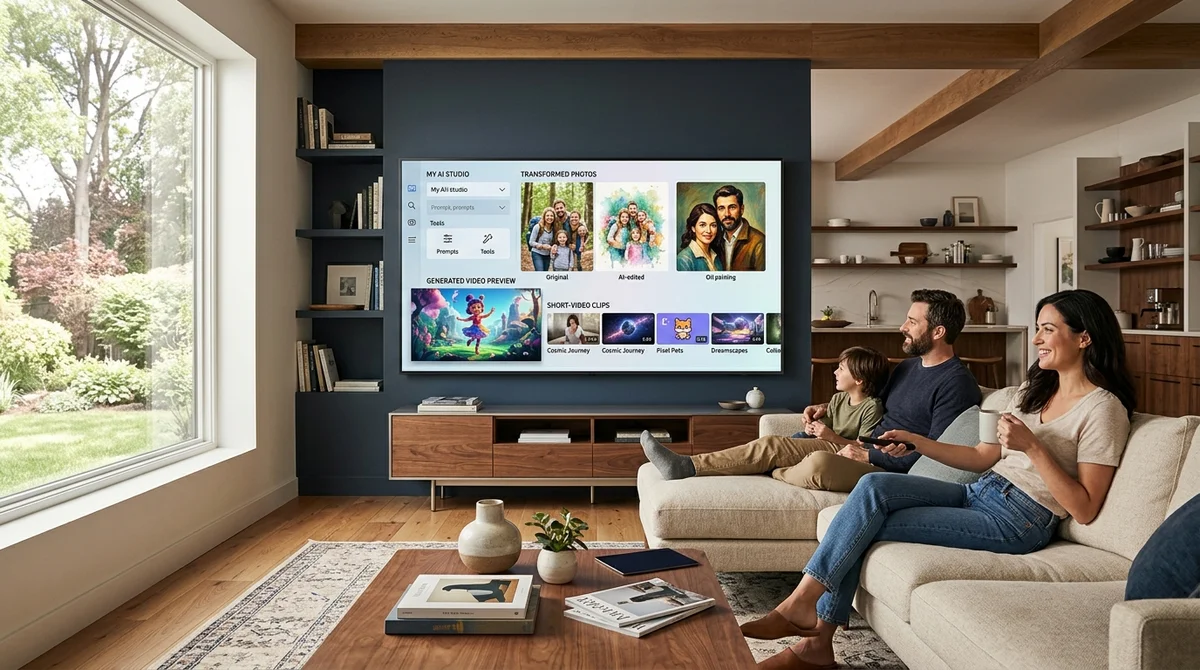
Google is expanding the set of Gemini features for Google TV and turning the television not just into a viewing screen, but into a platform for generating images, videos and working with personal photo archives. The update started rolling out on April 29, 2026, with compatible TCL models supporting Gemini in the United States being the first to receive it.
Generation on Screen
The main innovation is the Create button in the Gemini tab. Through it, you can launch Nano Banana on Google TV for generating and editing images, and Veo for creating short videos. The idea is simple: the television becomes a shared family screen where you can not only search for a movie or TV series, but also try out AI scenarios together using voice commands. Google is clearly promoting this as entertainment for the living room, rather than a professional editing tool.
- Nano Banana can change clothing in photos
- It can replace backgrounds and reconstruct scenes
- Veo creates videos from scratch based on text descriptions
- Veo also animates existing images
- All of this launches directly from the Gemini tab on TV
Google provides deliberately playful examples: you can ask the system to "dress dad in a ridiculous costume" or make grandpa walk like on the moon in space. The point is not the accuracy of editing, but to make generative AI part of everyday family entertainment. There is an important limitation: initially the features are available only on Gemini-enabled TCL Google TV in the United States, with a broader rollout for other devices promised later. This highlights that for now this is more of a pilot expansion than a mass release across the entire ecosystem.
Photos and Slideshows
The second part of the update concerns Google Photos. Now Gemini on the television can search for the right images by voice based on meaning, not just by date or album. If you say something like "show me photos from our recent vacation" or "find pictures from the birthday," the system displays a separate results page where you can quickly browse through frames, open them full screen, or immediately create a slideshow for the whole family.
Separately, Google is adding Remix — a photo styling tool right on the TV. For a found image, you can apply an artistic style like watercolor or oil painting, and then display the result on the big screen. At the same time, Dynamic Slideshows are being launched: these are more lively screensavers and collages for photo albums from Google Photos.
According to Google, photo search and Remix initially roll out on Gemini-compatible devices in the United States, while dynamic slideshows will be available on compatible Google TV devices worldwide. This mode requires a minimum of 2 GB of RAM.
"Make my grandpa walk like on the moon in space."
For Google, this is a logical step: the television has long been the main screen in the home, but the interfaces around personal photos remained quite passive. Now the company is trying to turn the photo archive into an interactive layer — with search, quick remixing, and a decorative mode that works even when you're not watching anything. If before the TV simply showed selected albums, now it begins to understand the context of a request and return results in a more lively, conversational scenario.
Shorts on the Home Screen
The third change is related not to generation, but to the distribution of short videos. Over the coming months, a separate row called Short videos for you will appear on the Google TV home screen. It will display a personalized feed of short videos, with YouTube Shorts as the first source.
In the United States, this row should start rolling out in summer 2026. From Google's wording, it's clear the company views this as a new permanent element of the home screen, not as a temporary experiment. This step is also important because short video has long been considered a format almost exclusively for smartphones.
Google, conversely, is trying to prove that it can be integrated into the television scenario: quickly turn on a couple of videos without selecting full-length content, then just as quickly return to a TV series or generation. Against this backdrop, it's particularly striking that the company is betting on blending consumption modes: long video, short clips, photo archives, and AI tools now live in one interface.
What This Means
Google is consistently transforming Google TV from a streaming wrapper into a home AI hub. If the rollout doesn't get stuck on just a few models, the television will become yet another entry point into the Gemini ecosystem — not for work, but for everyday scenarios: find family photos, quickly make a funny remix, generate a short video, and immediately show it to everyone in the room. For Google, this is also a way to embed Gemini in the most visible part of home electronics.
Want to stop reading about AI and start using it?
AI News is a curated feed of AI/tech news. Hamidun Academy teaches you to use AI systematically in your work.