SenseTime Opens SenseNova U1 Model for Chinese Chips, Betting on Speed
SenseTime released the open SenseNova U1 model, betting on speed over the race for size. The new model can understand images without intermediate text…
AI-processed from Wired; edited by Hamidun News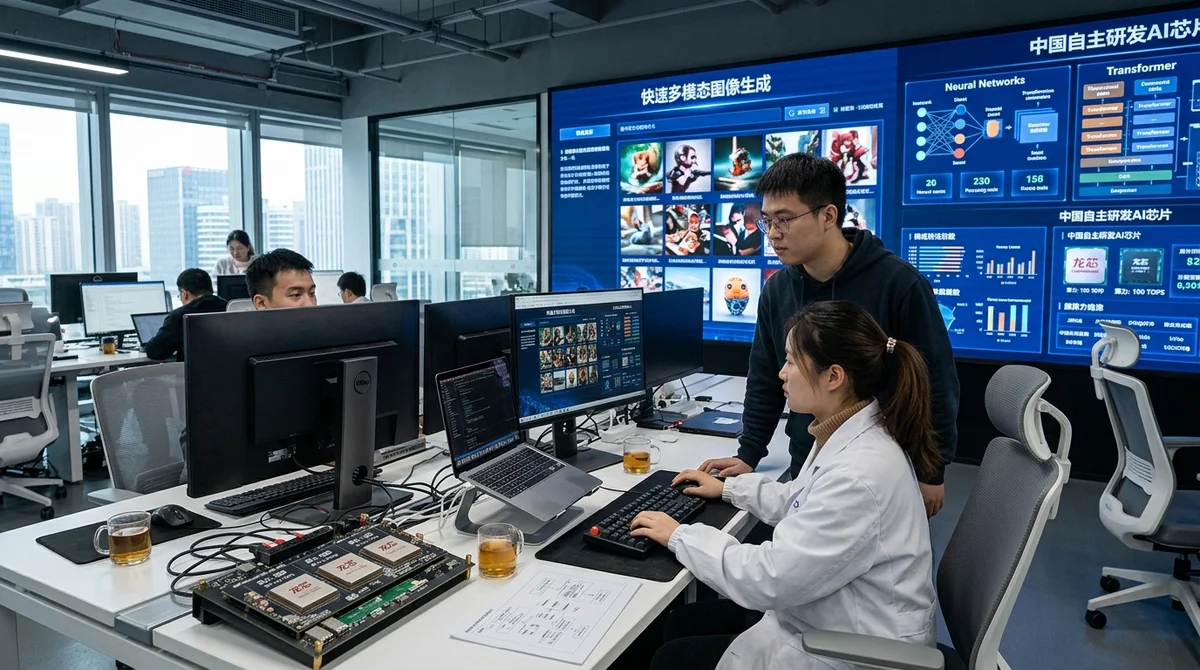
Chinese SenseTime has released an open multimodal model SenseNova U1 and is betting not on maximum size, but on speed. The main idea of the release is to teach the model to understand and generate images directly, with lower computational costs and relying on Chinese chips.
Faster Without Intermediaries
Typical multimodal systems are often structured as a pipeline: one block sees the image, another converts it into a text description, a third reasons with words, and then a separate module assembles the visual result again. SenseTime claims that U1 works differently. In the new NEO-Unify architecture, images and text are processed in a unified representation space, without unnecessary intermediate translations. Because of this, the model responds faster, uses fewer computations, and better preserves meaning and visual details.
For SenseTime, this is not just engineering optimization. The company directly states that the key advantage of U1 is inference speed. By its estimates, the model produces results noticeably faster than most open analogues, and in terms of quality in some scenarios approaches commercial Chinese systems like Qwen-Image 2.0 Pro and Seedream 4.5. Compared to leaders like GPT-Image-2.0, the new product falls short. But its compact size makes U1 potentially suitable not only for data centers, but also for PCs or even mobile devices.
- Natively understands images without mandatory conversion to text
- Accelerates generation and visual reasoning
- Reduces computational resource requirements
- Better preserves structure of complex infographics and on-screen text
- Suitable for more compact deployment
Betting on Local Chips
The most politically and commercially important moment in the release is compatibility with Chinese hardware. According to Dahua Lin, co-founder and chief scientist at SenseTime, several Chinese manufacturers have already optimized their accelerators for U1. On launch day, support for the model was also announced by ten local chip designers, including Cambricon and Biren Technology.
For the Chinese AI market, this is not a secondary detail but a matter of survival and scale: U.S. export restrictions continue to complicate access to the most powerful Western chips, especially Nvidia. SenseTime does not hide that for the fastest iteration, the best foreign accelerators remain useful. But the course is clear: the more models you can train and run on a local hardware base, the less dependence on external suppliers and political risks.
This is especially important for tasks that require fast visual interpretation of the world in real time. The company links U1 not only to image generation, but also to future robotic systems that need to see the scene, understand spatial relationships, and quickly make decisions.
Why Open the Model
For SenseTime, this launch is also an attempt to regain prominence in the new AI hierarchy. The company grew up on computer vision and facial recognition technologies, but in the era of large language models found itself overshadowed by younger players like DeepSeek and MiniMax. Now the bet is on open source: U1 is posted for free on GitHub and Hugging Face, and the official release emphasizes that the U1 Lite series comes in two configurations—a dense 8B-MoT and an A3B-MoT mixture of experts version.
"It's not openness itself that wins, but the speed of iteration,"
SenseTime explains the new course.
An open release immediately has several goals. First, it accelerates feedback from researchers and developers, which helps quickly fix weak points and expand use cases. Second, it allows the company to maintain international research connections even against the backdrop of sanctions pressure.
SenseTime has been under U.S. sanctions for several years due to allegations of its technologies being used in surveillance systems targeting Uyghurs and other minorities in Xinjiang; the company denies these allegations. Against this backdrop, an open model becomes not only a product but also a tool for technological and reputational reset.
What This Means
The SenseNova U1 release shows how Chinese AI companies are adapting to constraints not only through new models but also through different engineering logic. The focus shifts from simple parameter racing to efficiency, inference speed, ecosystem openness, and compatibility with local hardware. If such an approach works, the winners will not necessarily be the largest models, but those that deploy faster, run cheaper, and integrate better into real products—from image generation to robotics.
Want to stop reading about AI and start using it?
AI News is a curated feed of AI/tech news. Hamidun Academy teaches you to use AI systematically in your work.