US Emergency Services Complain That Waymo Robotaxis Increasingly Obstruct Emergency Response
US emergency services are growing more critical of Waymo: robotaxis, they say, increasingly freeze in place, obstruct traffic, and do not always understand…
AI-processed from Wired; edited by Hamidun News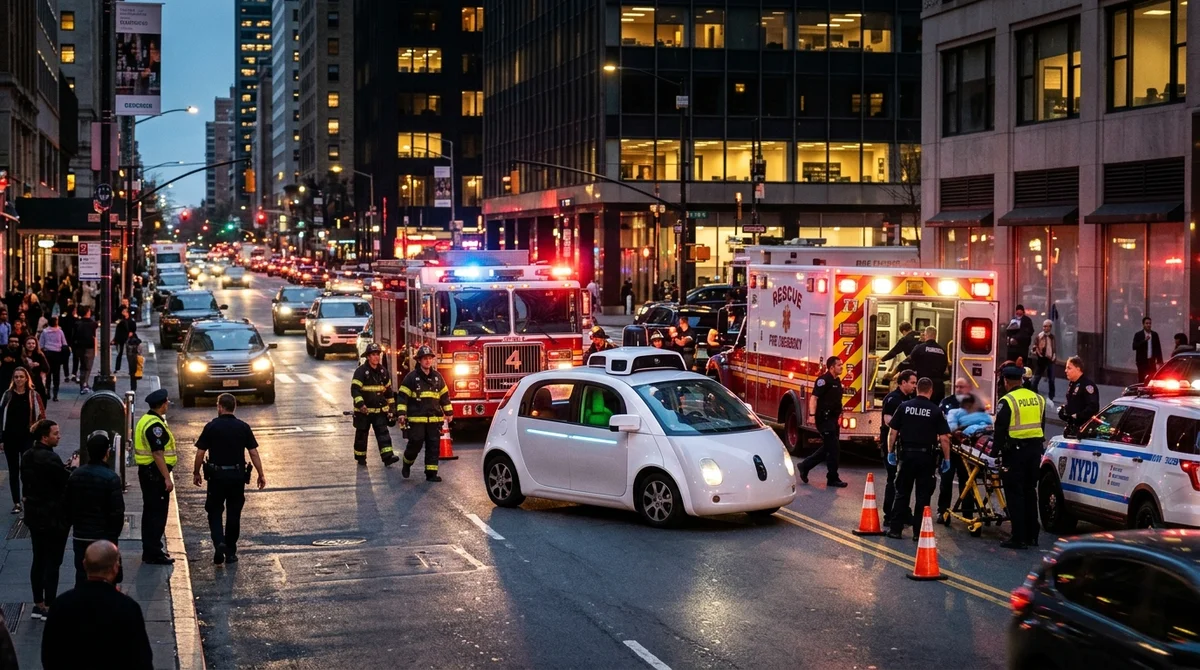
Emergency services in the USA have stated that Waymo autonomous taxis have become more frequent in creating problems during actual emergency calls. Firefighters, police, and paramedics are not complaining about isolated failures, but about a recurring pattern: vehicles freeze, fail to understand human signals, and waste time in situations where every minute counts.
Complaints are mounting
During a closed meeting with the federal regulator NHTSA in March 2026, representatives from San Francisco and Austin spoke not about childhood illnesses of the technology, but about a step backward. San Francisco Emergency Management Director Mary Ellen Carroll said the city is seeing "regression" in aspects that previously seemed to be improving. According to local services, Waymo vehicles are once again more frequently violating traffic rules, and in some scenarios behave worse than they did several years ago.
For firefighters, this is not an abstract debate about the future of transportation. San Francisco Fire Department Chief Patrick Rabbit stated that Waymo vehicles increasingly block exits from fire stations and prevent rapid dispatch of units to calls. In Austin, police traffic division commander William White added that the service was rolled out too quickly and too widely — with hundreds of vehicles when the technology was not yet ready for chaotic street conditions.
Street scenarios
The main complaint from emergency services is the behavior of vehicles in non-standard situations where there is no pre-mapped scenario. In Austin, police reported that robotaxis often "freeze" when motorcycle officers appear nearby, manual traffic control is in place, or roads are blocked following incidents. According to them, the vehicles don't always recognize traffic controller gestures, even though Waymo previously assured services that the system understands such signals. As a result, even a brief delay can trigger a cascade of delays around an emergency scene.
"Their default reaction is to freeze," is how the
San Francisco Fire Department chief described Waymo's behavior.
In April 2026, Austin discussed an incident where an autonomous vehicle blocked ambulance access for two minutes during a shooting in the city center where three people died and at least 14 were injured. In San Francisco, similar issues arose after a large-scale power outage in December 2025: at that time, over 60 Waymo vehicles had to be manually moved because they couldn't properly navigate intersections without traffic lights. In one instance, a 911 operator waited 53 minutes for a response on Waymo's hotline.
New rules
The problem is escalating against the backdrop of rapid service growth. As of April 2026, Waymo is already transporting passengers without a driver in parts of ten US cities and plans to open ten more routes by year's end, including London. The company claims it completes around 500,000 paid trips per week and cites its own safety data: according to its statistics, serious accidents with injuries for Waymo are significantly lower than for regular drivers covering comparable distances.
It is against this backdrop that authorities are beginning to translate accumulated complaints into formal requirements. California's DMV approved new rules for autonomous vehicles on April 28, 2026, and portions of law AB 1777 will take effect on July 1, 2026. The focus is no longer only on accident rates, but also on how vehicles and remote operators should behave during fires, road closures, and police operations. This is a direct response to cities' complaints that in critical moments, emergency services cannot reach the person who actually controls the situation for too long.
- remote operator response time for emergency services — no more than 30 seconds
- right to temporarily close zones to autonomous vehicles during emergencies
- obligation to remove vehicles from such zones within two minutes
- clearer communication procedures between emergency services and autonomous service operators
Waymo responds that it values feedback from emergency services and has already trained over 35,000 employees in person nationwide. The company also states that after the December blackout in San Francisco, it changed some internal procedures and strengthened coordination with city services. But the main criticism from police and firefighters remains the same: when a vehicle gets stuck, people on the scene have to resolve the situation too often, rather than the system itself.
What this means
The Waymo story reveals a weak point in robotaxis not in regular trips on a map, but in rare and tense scenarios where you need to quickly read context, understand gestures, and yield to humans. For the market, this signals that the scaling of autonomous vehicles will now be evaluated not only by accident statistics, but also by how they behave in real urban chaos.
Want to stop reading about AI and start using it?
AI News is a curated feed of AI/tech news. Hamidun Academy teaches you to use AI systematically in your work.