OpenAI Accelerates Stargate and Expands Data Center Network Amid Growing AI Demand
OpenAI stated that Stargate has already surpassed its AI computing infrastructure target in the USA ahead of schedule. In the past 90 days alone, the project…
AI-processed from OpenAI Blog; edited by Hamidun News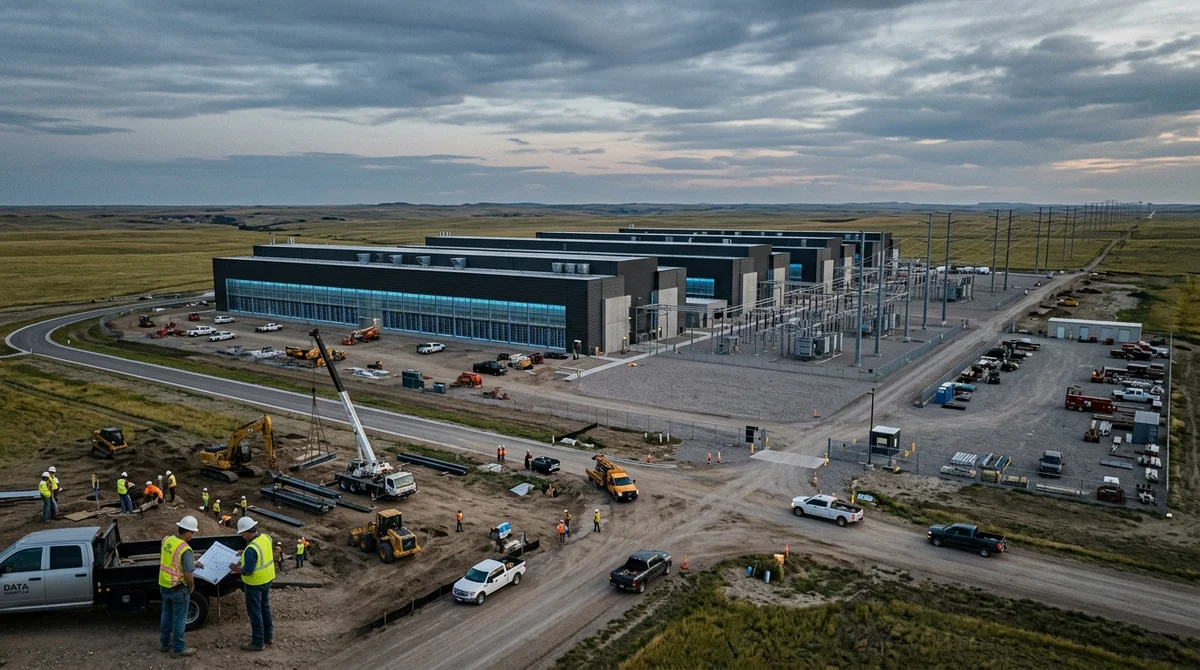
OpenAI announced that it has already exceeded a key target of the Stargate project for AI computing infrastructure in the United States ahead of schedule and is now accelerating the deployment of new capacity. The company views this network of data centers as the foundation for more powerful models and, in the long term, for AGI-level systems.
Timeline Accelerating
When OpenAI announced Stargate in January 2025, the plan called for 10 gigawatts of AI infrastructure in the United States by 2029. Now the company says it has already crossed that threshold: in just the last 90 days alone, more than 3 GW of new capacity has been added to the project. For the market, this is an important signal: demand for AI computing is growing so fast that even multi-year plans are compressing into a horizon of just a few quarters.
OpenAI directly identifies computing resources as the key input for advanced AI. More capacity means you can train more powerful models, serve them more reliably, improve performance, and gradually lower the cost of use. The company describes this as a closed loop: infrastructure improves models, better models drive demand, growth in demand brings revenue, and that flows back into building new facilities.
How the Network Is Expanding
OpenAI emphasizes that such infrastructure cannot be built alone. Stargate is developing as a partnership ecosystem: it includes cloud providers, chip manufacturers, energy companies, construction contractors, investors, local authorities, and data center operators. The logic is straightforward: the more participants that cover their part of the chain, the faster facilities can be launched and the lower the risk that the project will hit a bottleneck in a single scarce resource.
When selecting new sites, the company and its partners look at several conditions at once:
- access to electricity in the required volume
- land, permits, and approval timelines
- quality of network and transmission infrastructure
- availability of trained workforce
- support from local communities
OpenAI is already seeking additional locations across the country beyond the original 10 GW target. This means Stargate is ceasing to be a one-off construction project aimed at a single milestone and is becoming a long-term grid of facilities that can be expanded as demand grows. In this approach, funding is important, but so is flexibility: the company separately emphasizes that the partnership structure can change if it allows capacity to come online faster.
From Facilities to Models
OpenAI places particular emphasis on what such projects should look like for regions. The company promises not just to bring servers, but to create local benefits: jobs, new tax revenue, support for schools, more careful energy planning, and careful stewardship of water resources.
The first public example is the community engagement program in Wisconsin: together with Vantage Data Centers and Oracle, OpenAI directed funds to the Port Washington-Saukville Education Foundation, which supports students, teachers, and workforce development programs.
As a model, OpenAI points to the Stargate facility in Abilene, Texas. This is where, according to the company, the GPT-5.5 model was trained. The facility runs on Oracle Cloud Infrastructure and uses NVIDIA GB200 systems.
OpenAI also highlights the environmental side of the project: instead of traditional evaporative cooling towers, the center uses a closed-loop cooling system. After initial fill, water circulates through a sealed loop rather than being continuously consumed. For a single building, the startup volume is roughly comparable to two Olympic swimming pools, and then the annual consumption of the entire system at full scale should be comparable to an average office building or about four households.
"The age of intelligence will not arrive on its own.
It must be built."
What This Means
OpenAI is shifting the conversation about AI from the plane of models to the plane of industrial infrastructure. Competition is now not just about better algorithms, but about land, electricity, networks, construction, and regional partnerships. If Stargate continues to grow at this pace, the advantage will go to those companies that can faster than others turn computing capacity into accessible products and services.
Want to stop reading about AI and start using it?
AI News is a curated feed of AI/tech news. Hamidun Academy teaches you to use AI systematically in your work.