Canonical to embed local AI tools in Ubuntu 26.10 with one-click disable
Canonical is preparing built-in AI tools based on large language models for Ubuntu 26.10. The key difference is everything will run locally and remain fully…
AI-processed from 3DNews AI; edited by Hamidun News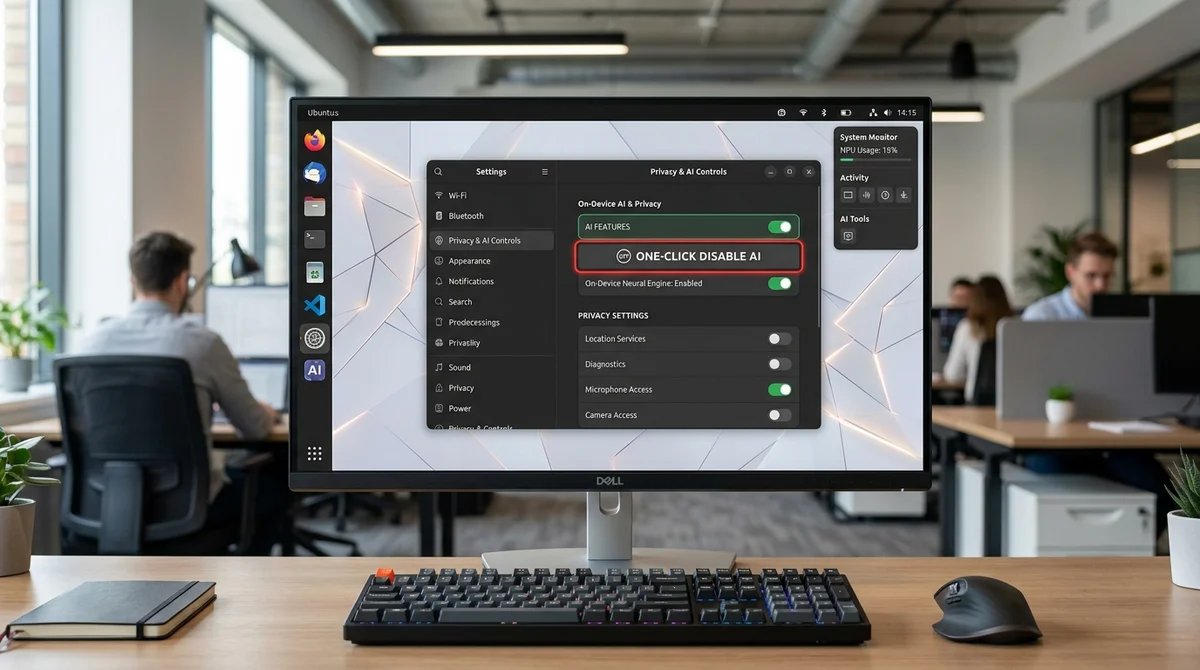
Canonical has decided to embed its own set of AI tools based on large language models into Ubuntu, but it's not doing this with an "everything included" approach. In Ubuntu 26.10, which is scheduled for release on October 15, 2026, these features will appear as optional modules: users can enable them when needed, disable them with one action, or remove them completely.
How it works
Canonical is talking not about a one-time demonstration, but about a systemic change in future Ubuntu releases. The idea is to give Linux users built-in LLM capabilities directly in the distribution, but without an imposed usage scenario. The first release with this architecture will be released under the name Ubuntu 26.
10 Stonking Stingray. For Canonical, this is an attempt to embed AI into the basic platform in the same careful way that drivers, container tools, or development tools were added to the system before. The key principle is modularity.
AI features won't be rigidly embedded in the system so that they can't be removed. The user will decide whether they need suggestions, local text generation, intelligent search, or other scenarios that Canonical will reveal closer to the release. If such features are not needed, they can simply not be activated.
If needed only partially, the system will allow you to keep only those components that are actually used in work.
What users will get
According to Canonical's description, the focus is not only on convenience, but also on control. For the Ubuntu audience, this is especially important: many choose Linux precisely because they want to understand what services are running on the machine, what packages are installed, and where data goes. Therefore, AI in Ubuntu is presented not as a mandatory assistant, but as a set of tools that should fit into the familiar philosophy of the system, rather than break it.
- Local model operation without sending data to the cloud by default
- Pluggable AI components instead of a mandatory set of features
- Ability to disable tools with one click
- Complete removal of AI modules if not needed
- First launch in Ubuntu 26.10 on October 15, 2026
This approach can be useful for both ordinary users and corporate environments. A home user gets built-in AI capabilities without subscribing to a separate cloud service, while companies get a more predictable security model and compliance with internal policies. For the Linux ecosystem, this is an important detail: AI stops being an external add-on and begins to become part of the standard user environment. For developers, it's also a way to get new tools without changing their familiar workflow.
Why the focus on local execution
The most important emphasis in the announcement is local inference. By default, data should not go to external servers, and processing will be performed on the user's device. For Ubuntu, this is a strong move because the privacy question here is not a marketing one, but a practical one. Developers, engineers, administrators, and companies often work with code, internal documents, and configurations that simply cannot be sent to the cloud for the sake of a convenient suggestion. This makes the choice of local architecture understandable even without a complete list of future features.
This approach also has a technical cost. Local models require resources: sufficient RAM, suitable CPU or GPU, and thoughtful integration into the system so that new features don't turn a workstation into a slow experimental test bed. Therefore, the success of the idea will depend not only on the fact of implementing AI itself, but also on how carefully Canonical selects models, interfaces, and the entry threshold for machines with different performance.
What it means
Canonical is trying to show that built-in AI in an operating system can be not an intrusive cloud service, but a managed local tool. If Canonical brings this scheme to a stable release, Ubuntu 26.10 could become one of the first mass-market Linux distributions where AI is built in by default, but remains completely under user control. If the model works, other distributions may follow Ubuntu in the coming release cycles.
Want to stop reading about AI and start using it?
AI News is a curated feed of AI/tech news. Hamidun Academy teaches you to use AI systematically in your work.