Bank of England warns that rapid AI growth in finance risks systemic failures
The Bank of England warned that AI in banks, funds, and credit platforms could quickly transform from an efficiency tool into a source of systemic risk. The…
AI-processed from Bloomberg Tech; edited by Hamidun News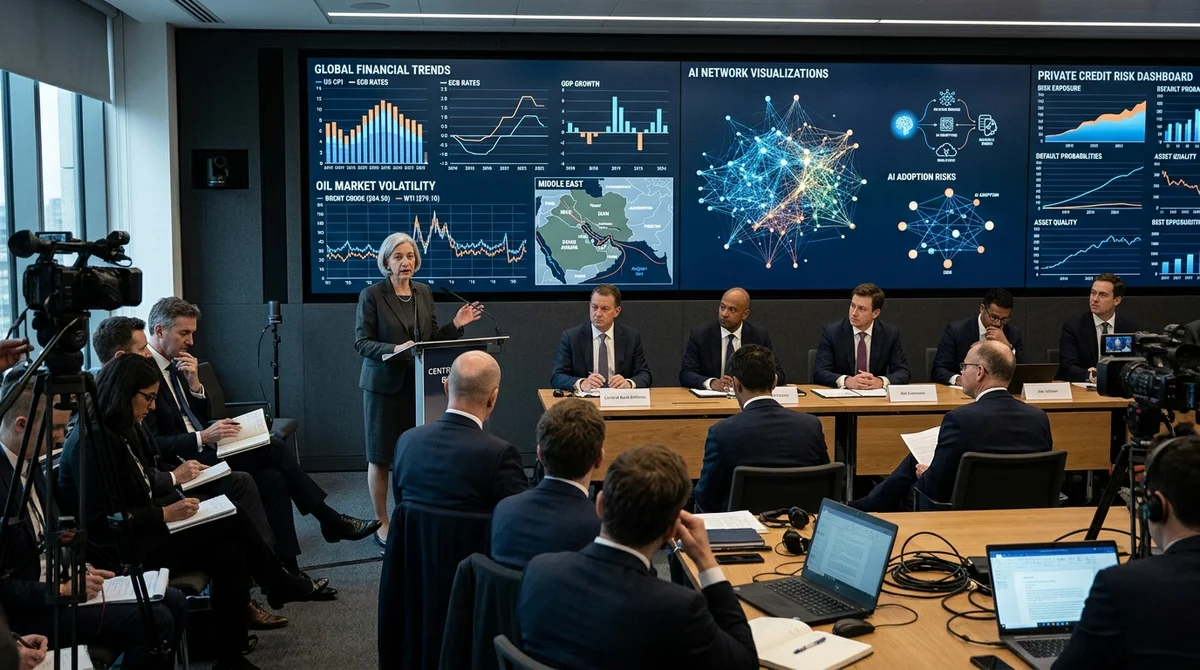
The Bank of England has warned that rapid adoption of AI in the financial sector could turn from an efficiency tool into a threat to the entire system. The regulator separately flagged the risk of broader shocks if technology failures coincide with stress in the private credit market and the consequences of war with Iran.
Why the regulator is concerned
The central bank's main concern is not the use of AI itself, but the speed of its spread. If banks, funds, brokers, and credit platforms simultaneously start relying on similar models, the same data, and identical external services, their decisions will become too synchronized. In normal circumstances, this accelerates operations and lowers costs, but in a stress scenario, such synchronization can amplify errors: a misaligned risk assessment, a model failure, or a false signal will begin to repeat throughout the chain almost instantly.
For financial stability this is dangerous for a simple reason: markets are held up not only by capital, but by the diversity of participant behavior. When everyone views the market through the same algorithmic filter, the very spread of assessments that often dampens volatility disappears.
The Bank of England is essentially warning of a new type of systemic risk — not from a single bank with a poor balance sheet, but from mass automation of decisions that could be wrong simultaneously.
Why private credit is vulnerable
The regulator gave special attention to private credit — the market for private lending outside the classical exchange circuit. This segment has grown amid high rates and caution from traditional banks, but it remains less transparent and less liquid than public debt markets. If AI models begin to be aggressively used for scoring, collateral assessment, borrower monitoring, and capital allocation, an error in these calculations may not become apparent immediately. This is precisely why a local failure can turn into a broader blow to the system.
- Inflated assessment of borrower quality
- Identical decisions on risk reassessment
- Sharp contraction in new financing issuance
- Transmission of the shock to banks, insurers, and funds
The danger here is not just defaults. In a non-transparent market, problems often manifest late: first the models paint a calm picture, then investors suddenly realize there is less liquidity than seemed, and portfolio quality is worse than expected. At such a moment, it is not a smooth correction that begins, but a sharp revaluation of assets. If private credit is linked to banks, pension funds, or insurance companies, the shock easily spreads beyond one segment and hits the entire financial ecosystem.
War intensifies the pressure
In the same assessment, the Bank of England linked technological risks to broader instability caused by the consequences of war with Iran. A geopolitical shock usually travels through familiar channels: energy prices, funding costs, risk appetite, and investor behavior. But in an environment where decisions are increasingly automated, such a reaction can be faster and harsher. Algorithms do not create a crisis from nothing, but are capable of accelerating its spread if they begin to react identically to external signals and reposition simultaneously.
It is precisely the combination of factors that makes the central bank's warning notable. This is not about AI itself having already triggered a financial crisis, but about it becoming an amplifier of existing vulnerabilities. When technological concentration overlaps with an opaque credit segment and geopolitical stress, the cost of error rises sharply. For regulators, this is a signal to look not at individual instruments, but at how new behavioral models affect the system as a whole.
What this means
For the market, this is a direct reminder: the adoption of AI in finance is now discussed not only as a matter of productivity, but as a matter of macroeconomic stability. Banks, credit platforms, and investors will have to prove that their models are manageable, verifiable, and do not lead to herding behavior. The deeper AI goes into financial decision-making, the more important stress tests, transparency, and control over dependence on the same technology vendors become.
Want to stop reading about AI and start using it?
AI News is a curated feed of AI/tech news. Hamidun Academy teaches you to use AI systematically in your work.