Interest in OpenAI shares on secondary market wanes as investors shift to Anthropic
OpenAI shares on the secondary market have notably cooled, with some trading at significant discounts. Investors are rapidly switching to Anthropic, a…
AI-processed from Bloomberg Tech; edited by Hamidun News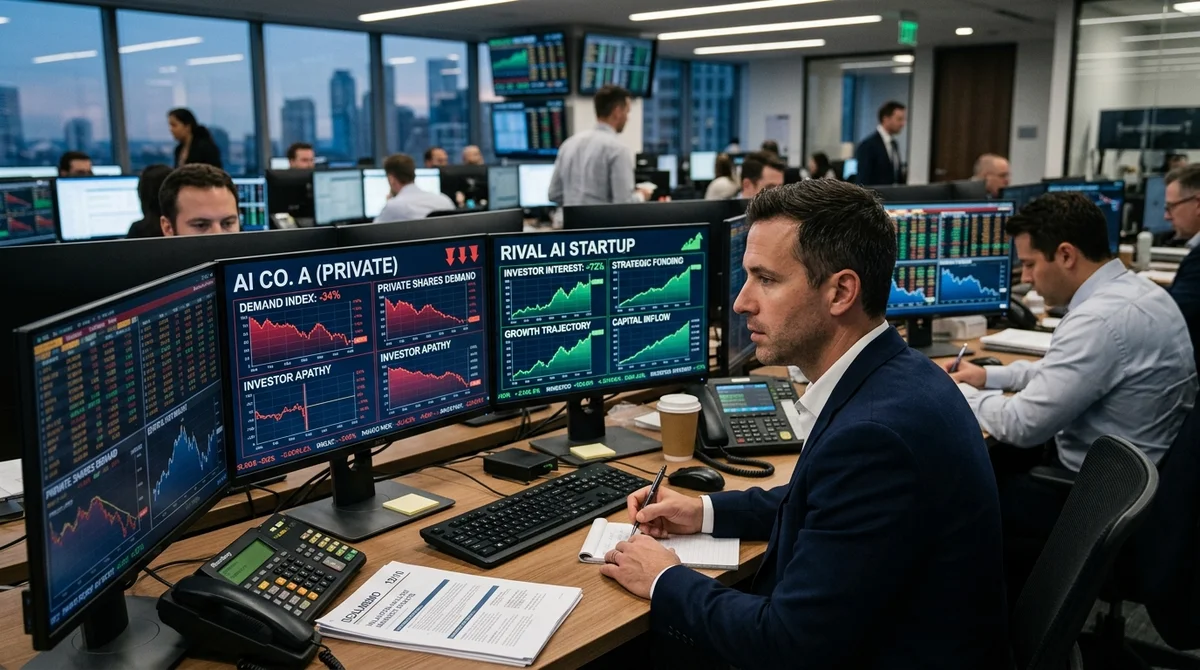
Interest in OpenAI shares on the secondary market is notably waning: some investors no longer want to hold these securities, and selling them has become harder. Against this backdrop, capital is rapidly flowing to Anthropic, which the market increasingly views as a hotter bet in the race among AI companies.
What Happened
On the secondary market, where shares of existing shareholders in private companies are traded, OpenAI papers have started losing appeal. The discussion here is not just about declining enthusiasm, but about situations where such shares are sometimes nearly impossible to quickly unload without a price concession. For the private capital market, this is a sensitive signal: even around the largest AI companies, demand is no longer considered unconditional, and investors have become noticeably more selective.
It is also important that the secondary market often shows sentiment before official funding rounds do. A new investment in a startup can come with a strong PR effect and a limited pool of participants, but resale of securities between existing and new holders typically better reflects the market's actual readiness to pay here and now. If buyers start hesitating, asking for discounts, or backing away from deals altogether, this means a cooling of liquid demand itself, not just a shift in news coverage.
Why Focus is Shifting
The main beneficiary of this turn is Anthropic. Investors who until recently were ready to snap up practically any share in leading AI players now compare companies much more rigorously and quickly pivot to whoever seems more promising at the current moment. In the private technology sector, this is typical logic: capital flows to where the sense of future growth is stronger, the negotiating position is better, and the chances of being at the center of the next wave of demand are greater.
- fewer willing to buy OpenAI stakes
- higher probability of a discount when selling
- more attention to Anthropic papers
- faster shifts in market sentiment assessment
This does not necessarily mean that OpenAI has a fundamentally weak business or that the company has lost strategic significance. Rather, the market is starting to distinguish between "largest player" and "most desired paper right now." For private AI companies, this is a principal difference. When a sector is overheated, money flows to almost all leaders at once. When the market matures, investors no longer buy the category as a whole—they pick a specific winner, and the rest, even with a strong brand, face tougher conditions.
How to Read This
For employees, early investors, and funds, the secondary market is not an abstract indicator but a practical liquidity tool. If a paper is in demand, it is easier to sell without lengthy negotiations and notable discounts. If interest falls, holders find themselves trapped: formally the asset is valuable, but turning it into cash becomes much harder. That is precisely why the cooling of demand for OpenAI matters in itself, even if the company remains one of the centers of the AI market.
History shows something else too: the race among major AI labs now affects not only products and corporate contracts but also the capital structure around them. Perception of technological leadership immediately translates into share valuation, and valuation into conditions for employees, secondary deals, and future rounds. The stronger the market believes that Anthropic specifically will better monetize the current moment, the more actively demand shifts there. For OpenAI, this is not a death sentence, but a clear reminder: flagship status no longer guarantees an automatic line of buyers.
What This Means
The market for private AI companies is entering a phase where a loud name alone is no longer enough: capital increasingly sorts leaders by current momentum. For founders, employees, and investors, this is a signal to look not only at model releases but also at where there is real demand for shares and liquidity today.
Want to stop reading about AI and start using it?
AI News is a curated feed of AI/tech news. Hamidun Academy teaches you to use AI systematically in your work.