OpenAI slows down, market punishes AMD, Oracle, and SoftBank for AI bet
News of weaker-than-expected OpenAI growth hit its stock market partners hard. SoftBank lost around 11%, while CoreWeave, Oracle, and AMD fell roughly 3%…
AI-processed from 3DNews AI; edited by Hamidun News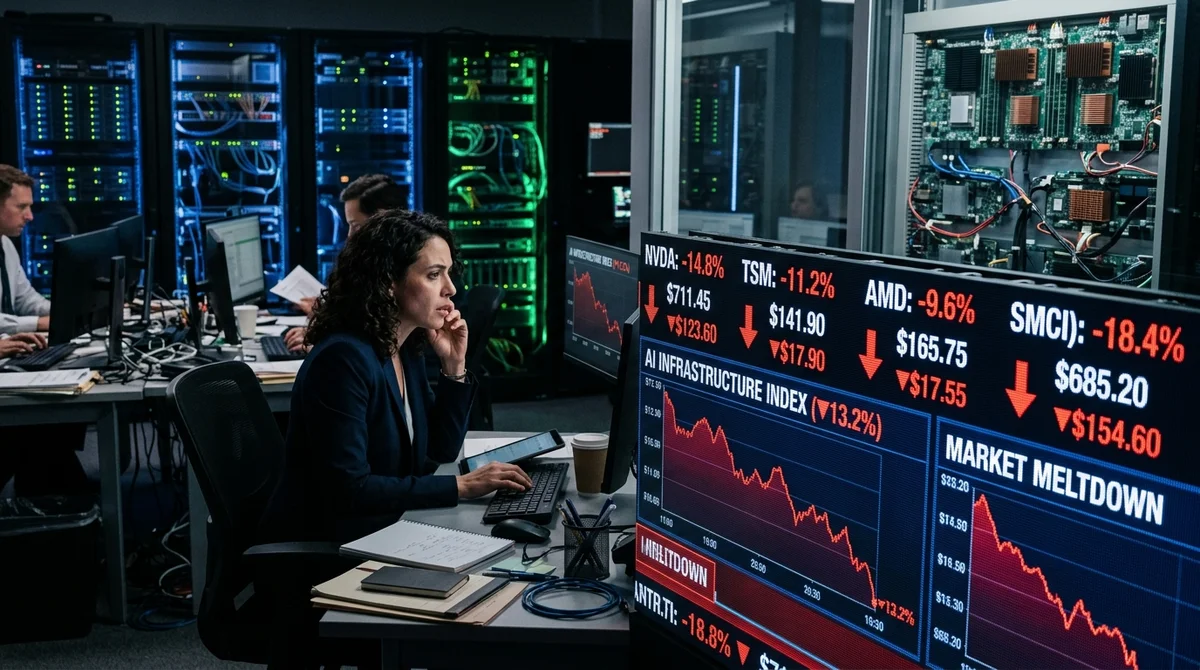
OpenAI found itself at the center of new market nervousness: reports of slower revenue and user base growth hit not OpenAI itself, but its public partners who are building AI infrastructure around it. On the premarket and in Asia, investors began selling off shares of companies linked to the generative AI boom.
Why the market shook
The reports that even OpenAI's CFO Sarah Friar began expressing concern about more moderate growth rates than the market expected became the trigger. Against the backdrop of aggressive expansion of computing power and the high cost of this race, even small doubt about the company's trajectory quickly turns into a problem for the entire supply chain of vendors and investors. Since OpenAI remains a private company, direct market revaluation of its business doesn't happen, but the stock exchange instantly recalculates expectations for those who earn from its infrastructure needs.
The logic of investors here is simple: if the main consumer of AI computing power can grow slower, then future orders for chips, servers, cloud resources, and data centers come into question. The market has already gotten used to evaluating an entire group of companies through the lens of demand from OpenAI. Therefore, even news without an official report or forecast revision can trigger a chain reaction.
Especially in a sector where over the past year and a half, valuations have largely grown on expectations rather than confirmed financial results.
Who was hit
The strongest reaction was visible in companies that investors perceive as direct beneficiaries of OpenAI's appetite for computing infrastructure. The decline affected both strategic investors and suppliers and cloud partners. For the market, this is a reminder: when one demand center becomes too important, any turbulence around it quickly spreads to neighboring stocks.
- SoftBank lost about 11% amid concerns over multibillion-dollar investments in OpenAI.
- CoreWeave, Oracle, and AMD fell approximately 3% each in premarket trading.
- Since the end of 2024, stocks of companies linked to OpenAI projects have risen approximately 75%.
- For comparison: papers of Alphabet's partners for the same period added more than 300%.
This gap is important not just as stock market statistics. It shows that the market began looking at OpenAI's ecosystem no longer as an unconditional leader of the AI cycle, but as a group of companies with elevated execution risk. If previously investors were ready to buy almost any story related to this company, now they demand proof that AI spending is actually being converted into sustainable business growth.
Weak points of strategy
OpenAI's problem does not come down to one failed trading session for its partners. The company simultaneously faces pressure from competitors, colossal scaling costs, and questions about how quickly the consumer market is able to cover such expenses. Against this background, management is trying to cut secondary directions and strengthen positions in the corporate segment, where AI startup revenue typically grows more predictably and is better monetized. Inside the company, they count on enterprise clients providing up to half of revenue by year-end.
A separate risk is that OpenAI has built relationships with infrastructure partners in such a way that it itself bears almost no public market damage from such failures in expectations. A private company has no quotations that investors could immediately punish. Instead, AMD, Oracle, CoreWeave, SoftBank, and other ecosystem participants take the hit. Therefore, any doubts about OpenAI's growth rates now automatically become a stress test for the entire AI sector, which is tied to its demand and ambitions.
What this means
History shows that the AI market is maturing and beginning to more harshly separate hype from economics. For OpenAI, this is a signal to prove growth efficiency faster, and for its partners—a dangerous reminder that betting on one large client can accelerate stocks as quickly as it can then crash them at the first signs of slowdown.
Want to stop reading about AI and start using it?
AI News is a curated feed of AI/tech news. Hamidun Academy teaches you to use AI systematically in your work.