Sber releases Kandinsky 6.0 Image Pro — unified model for image generation and editing
Sber updated the Kandinsky lineup and launched 6.0 Image Pro — a unified model for image generation and editing. According to the company, it performs at the…
AI-processed from Habr AI; edited by Hamidun News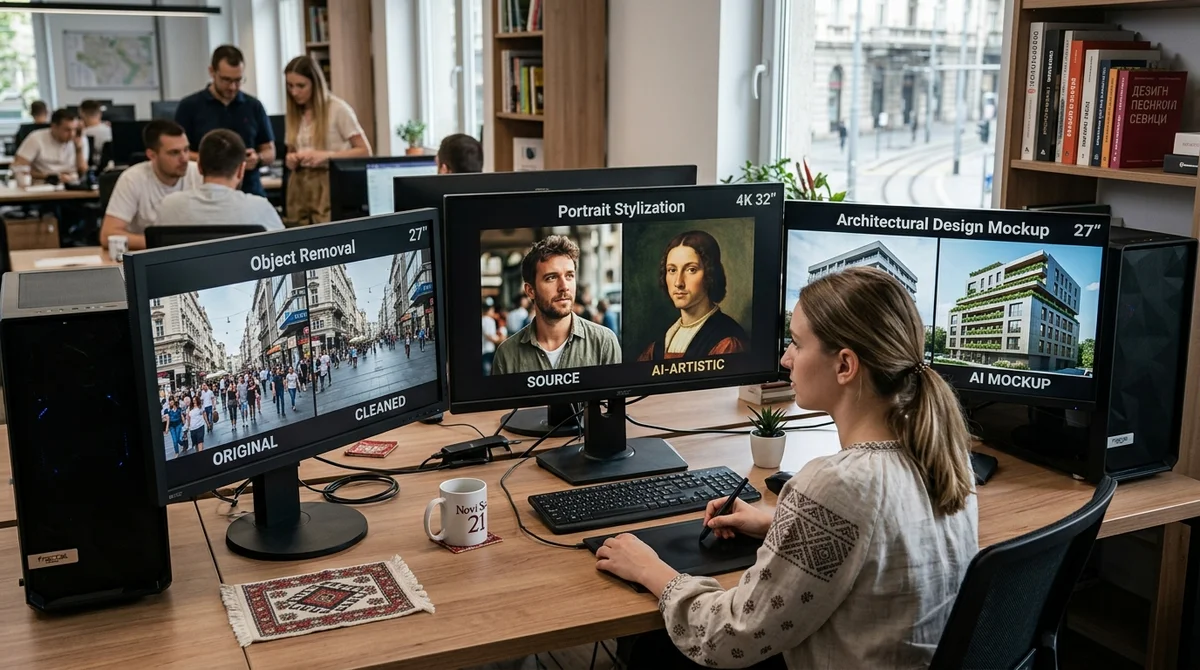
Sber has released Kandinsky 6.0 Image Pro — a new unified model that combines image generation and editing. The company emphasizes not only the quality of text-to-image generation, but above all on scenarios of precise and complex editing.
What was updated
The new version combines image generation from text and editing in a single model. This is an important shift compared to the previous Kandinsky 5 lineup, where the emphasis was distributed across several modes and separate model variants. The user scenario becomes shorter: the same tool can be used both for the first render and for subsequent scene adjustments.
Now Sber is promoting one main product for both tasks — from creating an image from scratch to replacing objects, stylizing photos, and local editing of a finished frame. According to the company's internal comparisons, Kandinsky 6.0 Image Pro shows a level comparable to Flux 2 Max, and outperforms GPT Image 1.
5. Sber separately emphasizes that the model became more stable in text-to-image generation, but the main focus of the release is editing. For this, the architecture was moved to MoE, inference was parallelized, and the attention mechanism was optimized.
As a result, according to the company, the new version works more than 40% faster than the previous one.
According to comparison results,
Kandinsky 6.0 Image Pro works at the level of Flux 2 Max and exceeds GPT Image 1.5.
Why Image RAG is needed
One of the key updates is the integration of Image RAG. To simplify, when a user makes a request, the system searches for suitable visual references in the knowledge base and adds them to the model's context if necessary. Due to this, the generator better understands not only general styles and objects, but also narrower cultural, historical, and local details, which are usually harder for universal models.
This approach should increase accuracy where ordinary generative models get confused by details or replace local characteristics with more template-like images. The practical benefit is that the model's knowledge can be expanded without full retraining. In the article, Sber provides examples with objects of Russian cultural code: the model correctly reproduces Mezenian painting, a kartuz (traditional Russian cap), and other specific visual details.
The same mechanism works in editing mode as well. For example, a user can insert themselves into a scene with their favorite movie character if the system finds relevant visual context and correctly embeds it in the image.
Where it will be useful
The use cases for Kandinsky 6.0 Image Pro are quite practical. It is no longer just about generating beautiful images from a prompt, but about editing finished images without manual fiddling in a graphics editor and without noticeable loss of scene integrity. That is, the model is being turned from a demonstration neural network into a working tool for designers, marketers, e-commerce teams, architects, and everyone who regularly makes quick visual edits.
- Removing objects, graffiti, and text while preserving the background
- Replacing objects with consideration of the original frame's style
- Stylizing portraits while preserving facial features
- Restoring and colorizing old photographs
- Generating exteriors and interiors from description or room layout
The article also shows cases where the model helps change lighting, background, hairstyle, makeup, clothing, and even facial expression. There is also a separate mention of integration with the "Immortal Regiment Online" service, where Kandinsky is used to restore archival photographs of veterans. This is already not just a showcase function for promotion, but a practical scenario where careful editing and predictable results are important.
For the local market, this is one of the most obvious examples of practical technology application. Currently, Kandinsky 6.0 Image Pro is available on GigaChat platforms: in Telegram, the Max messenger, on the giga.
chat website, and in the Android app. In upcoming updates, Sber promises to add editing with three references and a more detailed brush mode, where users will be able to literally point to a section of the image to specify exactly what needs to be added or removed. This brings the product closer to the more familiar logic of working in editors, but with a generative model under the hood.
What it means
Russian generative image models are increasingly moving from the category of "watch a demo" to the category of working tools. If Kandinsky 6.0 Image Pro truly maintains the claimed speed and quality in mass usage, the local market will have another strong tool for design, marketing, e-commerce, and restoration of archival photos — especially where Russian visual context is important.
Want to stop reading about AI and start using it?
AI News is a curated feed of AI/tech news. Hamidun Academy teaches you to use AI systematically in your work.