Wallmates: How projectors, drones, and AI are changing design and decoration of commercial spaces
Wallmates, with experience from over 3,500 projects, described a technological shift in interior decoration: projectors are already making graphic placement…
AI-processed from Habr AI; edited by Hamidun News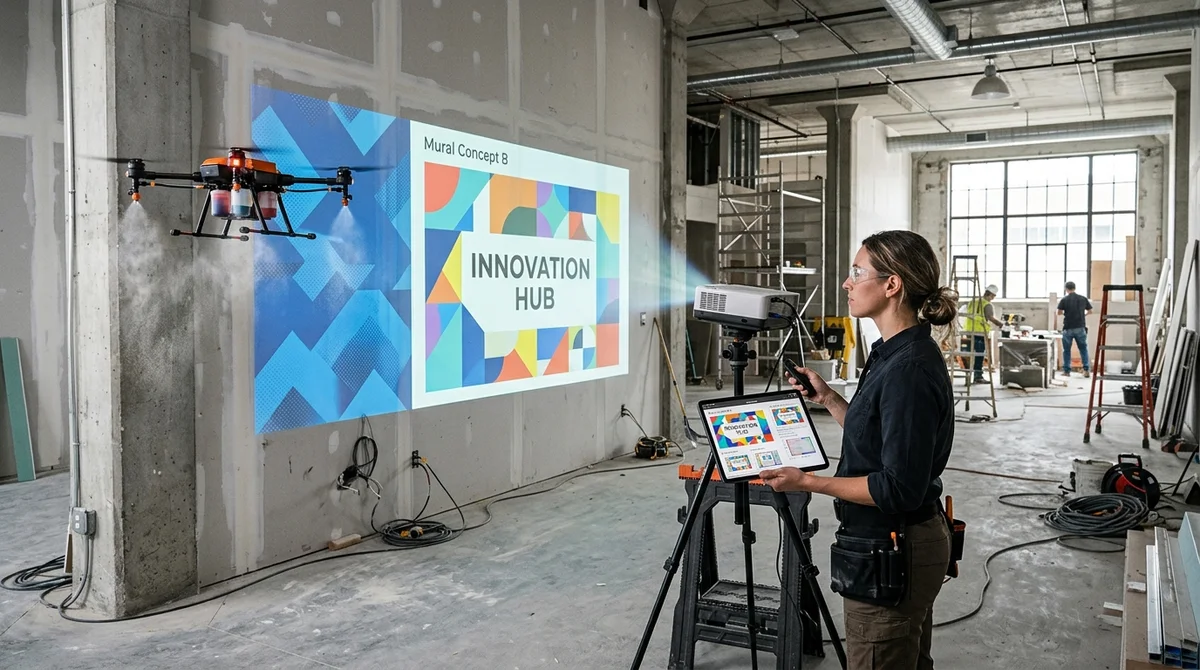
# How Technology Is Changing Commercial Interior Design
Wallmates is an agency specializing in commercial interior design and space decoration. We work with offices, restaurants, shops, warehouses, and other commercial spaces, helping clients transform their vision into reality.
Our main challenge isn't the lack of ideas or creative solutions. It's implementing them efficiently, especially when working with large surfaces and complex designs. Every meter of wall, every ceiling section, every floor—all of this requires precision, time, and specialized skills.
That's where technology comes in. Over the past few years, several innovations have begun to fundamentally change how we work.
Projectors: Precision Without Guesswork
Imagine having a designer's sketch appear directly on the wall you're working with. That's exactly what modern projectors do. Instead of manually transferring a design using grid methods or other time-consuming techniques, we now project the outline directly onto the surface.
This simple innovation cuts preparation time in half. The craftsperson sees exactly where lines should go, what size each element should be, and where colors transition. No more measuring tape errors, no more redoing sections because dimensions were off by a few centimeters.
AR and VR: Client Approval Before the First Brushstroke
Before technology, the design approval process was linear and risky: sketch → client feedback → revisions → implementation. If the client changed their mind halfway through—or if their expectations didn't match reality once work began—we'd be redoing entire sections.
Now we use AR (augmented reality) to show clients exactly how their space will look. They can see the design in real time, in their actual room, at actual scale. They can request changes before a single brushstroke is made.
VR adds another dimension: for especially complex projects, we create a virtual walkthrough of the finished space. Clients can "visit" their future design, experience the color scheme, check sight lines, and approve everything with confidence.
This eliminates surprises and rework. Implementation becomes straightforward—we already have client sign-off on the exact final result.
AI: From One Idea to Many
Designing a single color palette used to take hours. Sketching variations of a pattern? Even longer. Proposing multiple design directions? Each one required separate work.
AI changes this. Tools can now generate dozens of design options, color combinations, and seamless patterns in minutes. A designer reviews them, selects the strongest concepts, refines them, and presents the client with genuine alternatives—not variations on a single idea, but truly different creative directions.
This makes our process faster and gives clients real choice. Instead of "here's what we propose," we can say "here are five distinct directions—which resonates with you?"
Drones: Reaching the Unreachable
Large commercial spaces often have high walls, cathedral ceilings, or other hard-to-reach surfaces. Scaffolding is expensive, time-consuming to assemble, and keeps the space partially closed during work.
Drones with paint sprayers are beginning to change this. They can coat large ceiling areas or high walls without requiring crews on scaffolding. Safety improves, timeline compresses, and the space can remain more functional during the work.
In reality, this could be the next major shift in how we handle large-scale projects—not replacing craftspeople, but removing the need for dangerous, time-consuming setup work.
What This Means
These technologies don't eliminate the need for skilled professionals. If anything, they make skilled work even more valuable. Designers focus on creativity and strategy rather than mechanical tasks. Craftspeople concentrate on precision execution rather than setup and measurement.
Labor shifts from repetitive mechanical work to creative problem-solving. The agency doesn't shrink—it grows, because we can take on more projects and deliver them faster without sacrificing quality.
The commercial interior design industry is at an inflection point. Technology isn't replacing expertise—it's amplifying it. The agencies and professionals who embrace these tools will lead the market. Those who don't will struggle to compete on timeline, cost, and client satisfaction.
Wallmates is already using these tools. And we're just getting started.
Want to stop reading about AI and start using it?
AI News is a curated feed of AI/tech news. Hamidun Academy teaches you to use AI systematically in your work.