Cleveland-Cliffs launches three-year AI implementation project with Palantir
Cleveland-Cliffs is launching a three-year AI project with Palantir and plans to deploy artificial intelligence tools across its entire operational chain…
AI-processed from Bloomberg Tech; edited by Hamidun News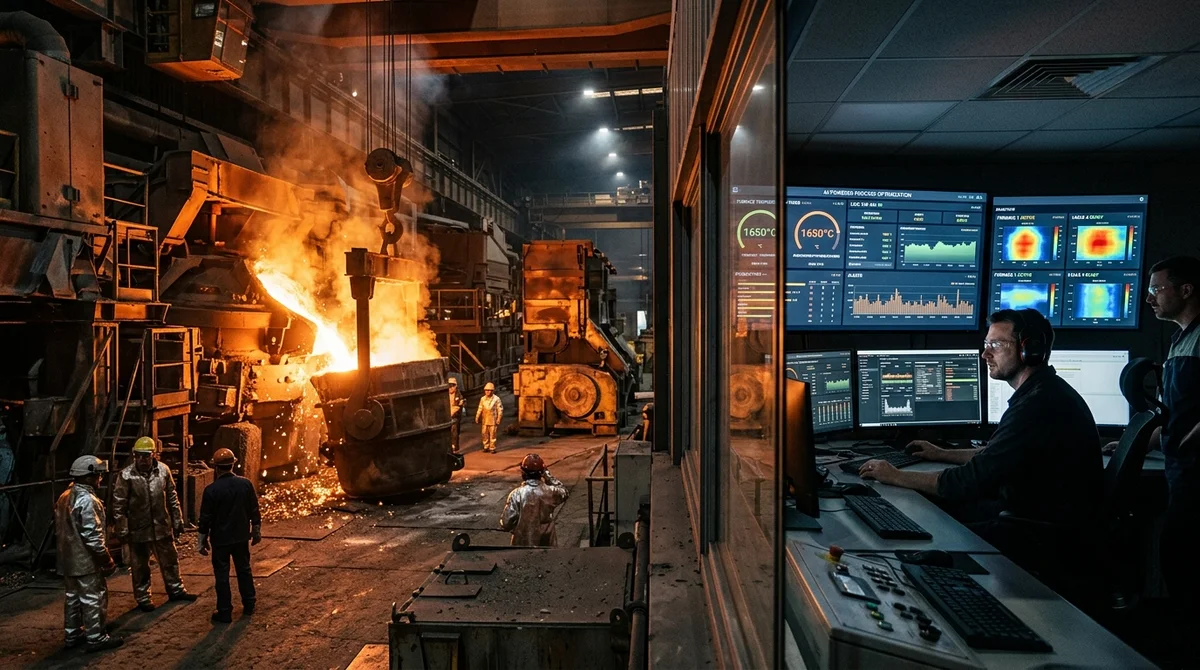
Cleveland-Cliffs has signed a three-year agreement with Palantir to deploy artificial intelligence across its entire operational chain. For the American steelmaker, this is not a point pilot, but an attempt to shift plant modernization into systematic mode.
Why the contract is needed
The deal is designed for three years, and the timeframe itself already shows the scale of the task. This is not about a one-off test on a single site, but about the gradual rollout of AI tools in production, planning, and daily operations. For Cleveland-Cliffs, this is a way to accelerate industrial modernization without building everything from scratch: companies typically get part of the benefit through better data handling, equipment utilization optimization, and faster decision-making.
For heavy industry, this is especially important at a time when margins depend not only on metal prices, but on how precisely plants operate on schedule, how quickly failures are eliminated, and how much raw material, energy, and time goes into producing each ton. In this context, AI is not a showcase for investors, but a tool that must deliver economic results on real operations.
Where to expect results
The companies did not disclose which scenarios would be included in the first phase. But in similar industrial projects, AI is typically deployed where there is plenty of historical data and a clear KPI that can be improved within the first few months. This reduces project risk: first, they identify areas where results are easier to quantify in money, time, and production stability. Such cases are then easier to scale across multiple sites.
- Planning equipment and shift loading to reduce downtime and bottlenecks
- Equipment monitoring for earlier failure detection and preventive maintenance
- Quality control and detection of deviations in process parameters
- Optimization of raw material, semi-finished goods, and finished product logistics
- Analysis of production losses, energy consumption, and other costly resources
If Cleveland-Cliffs and Palantir follow such a route, the main task will be not just to plug in models, but to embed them in solutions for supervisors, dispatchers, and site managers. In industry, AI delivers results only when recommendations reach the shop floor and change shift actions, rather than remaining as beautiful analytics in a separate panel. Otherwise, the system will remain an advisor with no noticeable impact on output.
Why bet now
The news is important not only because of the partnership itself, but also because of the timing. American industrial companies are increasingly looking for ways to modernize existing capacity faster and cheaper than through lengthy capital projects. Against this backdrop, AI becomes a way to squeeze more from already operational assets: improve predictability, reduce losses, and accelerate the decision-making cycle.
After the wave of interest in AI, business is increasingly demanding not presentations, but concrete results on operating lines. For Palantir, such agreements are also telling. The market is increasingly less interested in abstract promises around generative AI and more in projects where technology can be tied to operational efficiency, product output, and financial impact.
That is why deals with industrial groups today function as a test of AI platform maturity: if results are measurable at the plant, they are much easier to defend before the board of directors and replicate across other sites. This is where platform viability is tested. So far, the companies have not disclosed the specific tools, geography of deployment, and target metrics that investors and management will track.
But it is already clear that Cleveland-Cliffs views AI as part of broader production modernization, not as a separate experiment within the IT function. This raises the stakes: the project will be evaluated on whether it improves output, reliability, and the company's economics. It is by these metrics that we will see whether AI has been successfully translated from presentations into production practice.
What this means
For the market, this is another signal that AI is finally leaving the status of office assistant and taking root in heavy industry. If Cleveland-Cliffs can demonstrate measurable results over a three-year cycle, similar programs will accelerate at other manufacturers, because the question is no longer about AI trends, but about plant competitiveness. For technology suppliers, this means growing demand for solutions that can work with shop floor data, not just office tasks.
Want to stop reading about AI and start using it?
AI News is a curated feed of AI/tech news. Hamidun Academy teaches you to use AI systematically in your work.