China attempts to block Manus AI acquisition: can Meta preserve the $2 billion deal?
China demanded Meta cancel its Manus acquisition, despite the deal already being closed. The issue extends beyond the $2 billion price tag: Beijing made clear it views the Chinese origin of the team and technology as more significant than Singapore incorporation. For Meta, this undermines its AI-agents strategy; for the market, it signals the end of the "Singapore washing" era.
AI-processed from Bloomberg Tech; edited by Hamidun News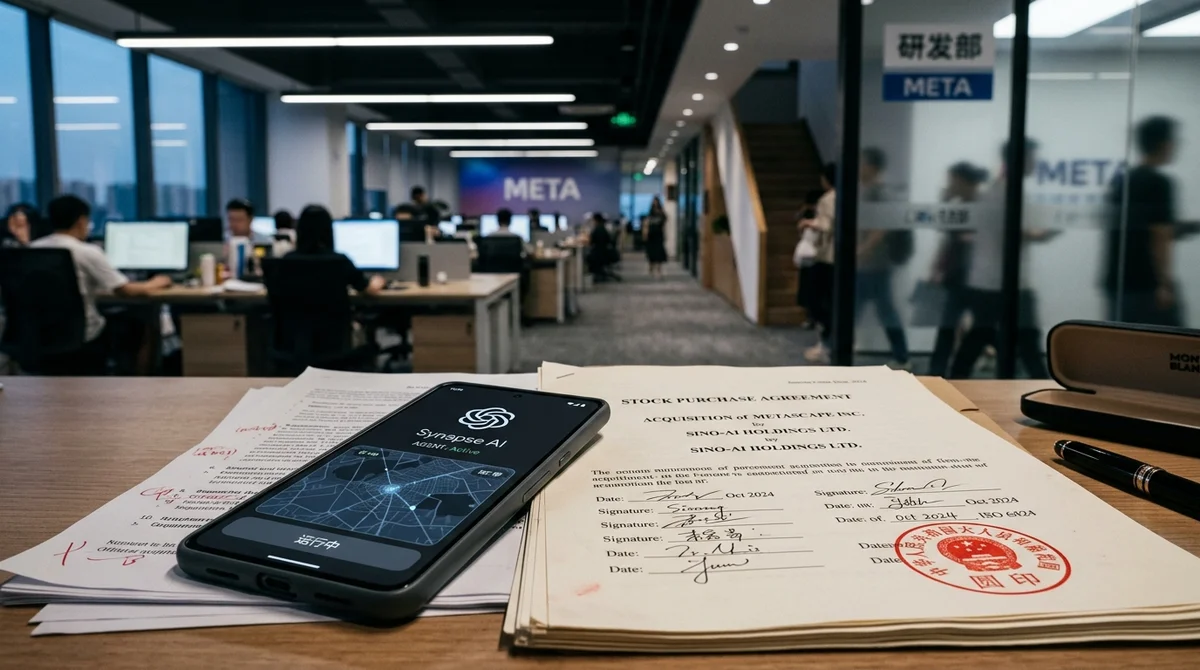
China demands cancellation of Manus acquisition by Meta, despite the deal worth over $2 billion being closed back in December 2025. The story quickly transformed from an ordinary M&A news into a test of who controls AI technologies if a startup was born in China but legally relocated to Singapore.
Why Manus is important
Manus is not just a chatbot, but an agentic AI service that takes a high-level goal and breaks it down into steps on its own. It can search for data on the internet, write and run code, analyze files and gather results without constant prompts from humans. Exactly such systems are now considered the next major market after regular conversational assistants.
When Manus launched in early 2025, the project quickly became notable far beyond China. Meta agreed to acquire it in December 2025 because it wanted to accelerate in the AI agents race and embed the technology into Meta AI, advertising products and corporate tools. For the company, this was a chance not to catch up with competitors piece by piece, but to buy a ready-made team and working stack.
- Web search and information gathering
- Code writing and execution for specific tasks
- Analysis of spreadsheets, documents and data
- Execution of multi-step office scenarios
Why China intervened
Formally Manus was already a Singapore company, but the project has Chinese roots: the team and part of the technology grew out of structures created in Beijing. After the deal was announced, Beijing began an investigation into whether the parties violated rules on technology export, cross-border data transfer and foreign involvement in sensitive AI business. In January 2026, Chinese authorities confirmed the investigation, and on April 27, 2026, demanded the cancellation of the acquisition.
The main signal here is not just about the fate of one deal. China is showing that what matters to it is not so much the legal address and holding structure, but the origin of the team, intellectual property and key developments. A model where a startup moves to Singapore, receives international capital and then is sold to an American corporation no longer looks like a safe workaround.
"The deal fully complied with applicable legislation.
We expect the investigation to be resolved appropriately."
Can it all be reversed
From a practical perspective, this is the most complex part of the story. By the time of the ban, the deal was already living as completed: more than 100 Manus employees moved to Meta offices in Singapore back in March 2026, startup leaders received roles within Meta, and investors, including early Chinese backers, already received payments. If code, processes and team are partially embedded in Meta's infrastructure, "reversing" this on paper is easier than in reality.
At the same time, Beijing still has leverage. Meta hardly depends on the Chinese market because its main services are already blocked there anyway. But China can pressure founders, local investors and any assets or rights that still remain in its jurisdiction.
Therefore, the ban looks not only like an attempt to recover a specific asset, but also as a warning to the entire market: strategic AI companies will not be able to simply change flags and escape from control. For Meta, this is an unpleasant blow, but not a business catastrophe. For the ecosystem – on the contrary, a very important precedent.
It shows that in the era of AI agents, a company's value is determined not only by the quality of the model or revenue, but also by where the technology was created, who controls the team and which states consider this code part of their own security.
What this means
The Manus story shows that the AI agents market is entering a phase where deals will be evaluated not only by investment bankers and lawyers, but also by national security regulators. For startups, this is bad news: even after relocation and deal closure, the state of origin may try to regain control over the technology.
Need AI working inside your business — not just in your newsfeed?
I build production AI for companies — custom CRM, internal tools, autonomous agents, workflow automation. Owned by you, shaped to your process, no per-seat tax. Built by Zhemal Khamidun, CPO of AlpinaGPT (AI platform, 6,000+ users).
The AI world, distilled — once a week
Seven stories that actually mattered, hand-picked. No noise, no reposts, no press releases.
Done! Check your inbox for a confirmation.