Smart Service Group tests voice control for pallet transport robot
Smart Service Group conducted the first test of voice control for a pallet transport robot. The experiment confirmed that such an interface works for short…
AI-processed from Habr AI; edited by Hamidun News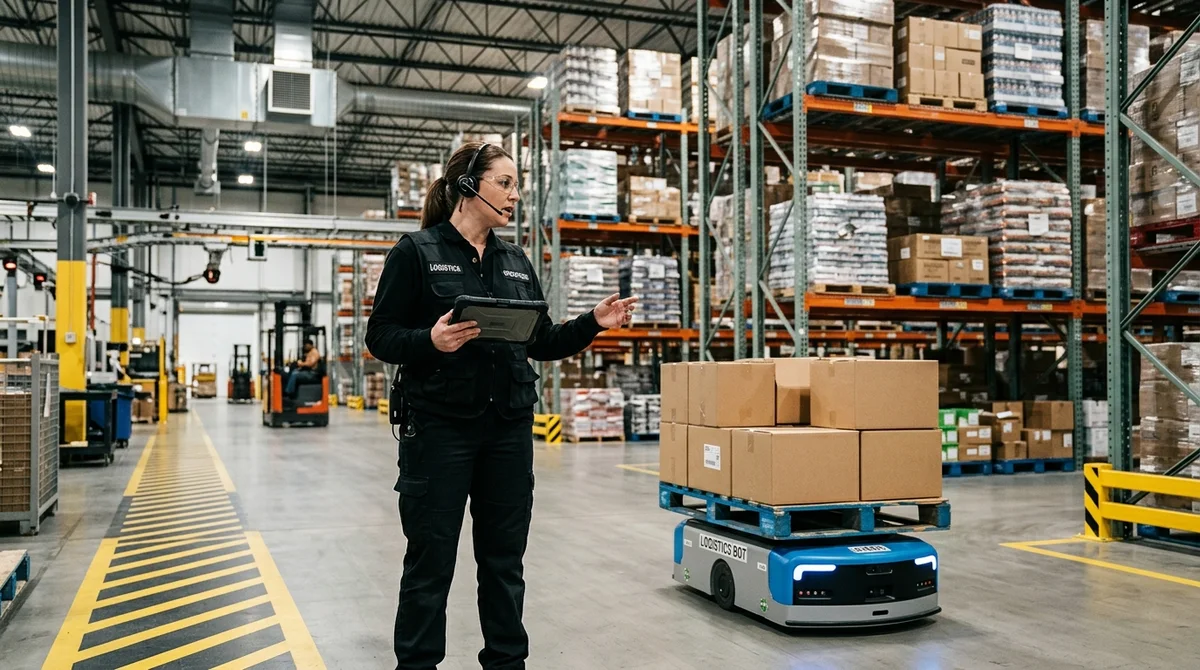
Smart Service Group Tested Voice Control for Pallet Transport Robot
Smart Service Group conducted the first test of voice control for a pallet transport robot and reached a practical conclusion: voice in a warehouse can work, but only as a narrow interface for pre-described actions. The experiment is not about "talking to a robot," but about quick and safe launch of an understandable scenario without a panel or application.
How the Test Proceeded
In the test, they checked a basic chain: operator says a command, the system recognizes the phrase, matches it to a pre-set action, after which the robot gets permission and begins moving. Essentially, the team tested not the machine's "intelligence" in a broad sense, but the quality of the interface between human and warehouse equipment. The main question sounded simple: can voice become a convenient way to launch an action on a pallet robot when the operator is nearby and wants to avoid extra taps.
The answer turned out positive, but with caveats. Such a scenario works if the set of commands is pre-limited, and the robot itself doesn't try to guess human intention from free speech. For a warehouse environment this is critical: here an error means not just a failed assistant response, but a risk to the route, cargo, neighboring equipment and people nearby.
That's why the first test focused on one clear action, rather than an attempt to build a full voice interface for the entire warehouse.
Where Voice is Useful
The test authors believe that voice should not become the primary way to control a warehouse robot. Its real value shows itself in short and repeating actions, when the operator is nearby, their hands are busy or they need to quickly initiate an already prepared scenario without a panel, application or switching to the dispatch system. In such a mode, voice doesn't replace familiar interfaces, but reduces the number of manual steps where speed, clarity and minimal number of actions matter.
- launching a pre-prepared route or action
- confirming the robot's readiness to move
- switching the machine to standby mode
- requesting current status
- stopping an active scenario
That's why the first test was limited to one action. This approach allows checking the mechanic "heard — recognized — checked — executed," without creating a false impression that voice is already ready to replace the dispatch system or WMS. For a pallet robot this is especially important: it works not with an abstract task, but with cargo, route and space, where any wrong action can affect the entire warehouse process. It's on such limited scenarios that it makes sense to increase the accuracy of the system.
Main Limitations
A warehouse is a much harsher environment than an apartment or office where voice assistants have long been the norm. A robot cannot start moving just because a command sounded similar to the right one: the system must still check the route, obstacles, machine condition and safety of the surrounding environment. Voice here is only an input signal, not final permission to act.
No less important is feedback: the operator must understand whether the command was heard, whether it was recognized correctly, accepted for execution or rejected by the system. There are other practical limitations too. An industrial environment is noisy: conversations, forklifts, signals, ventilation and opening gates significantly complicate speech recognition compared to a demonstration area.
Plus there remains the question of access rights: in a real warehouse it's not enough to simply recognize a voice command — you need to understand who exactly gave it and whether that person has the right to control the machine. So the next stage of such systems is not to expand the command dictionary, but to test one scenario in more complex conditions: at a distance, in noise, near people and other equipment.
"Voice control makes sense if you treat it as a narrow tool"
What This Means
The first test showed a sober picture: voice for a pallet robot is not a replacement for a classic interface, but an additional control layer for quick and safe operations. If developers can combine a limited set of commands, safety checks, reliable feedback and access control, such an approach could well become a useful part of warehouse automation, rather than just a demonstration of an impressive feature. In such a form, it has a chance to move from pilot to working tool.
Want to stop reading about AI and start using it?
AI News is a curated feed of AI/tech news. Hamidun Academy teaches you to use AI systematically in your work.