Canonical Makes AI in Ubuntu Optional: Focusing on Local Models and User Control
Canonical is taking a rare approach to AI in Ubuntu: not forcing features, but giving users choice. Important timing note: Ubuntu 26.04 LTS, released April…
AI-processed from ZDNet AI; edited by Hamidun News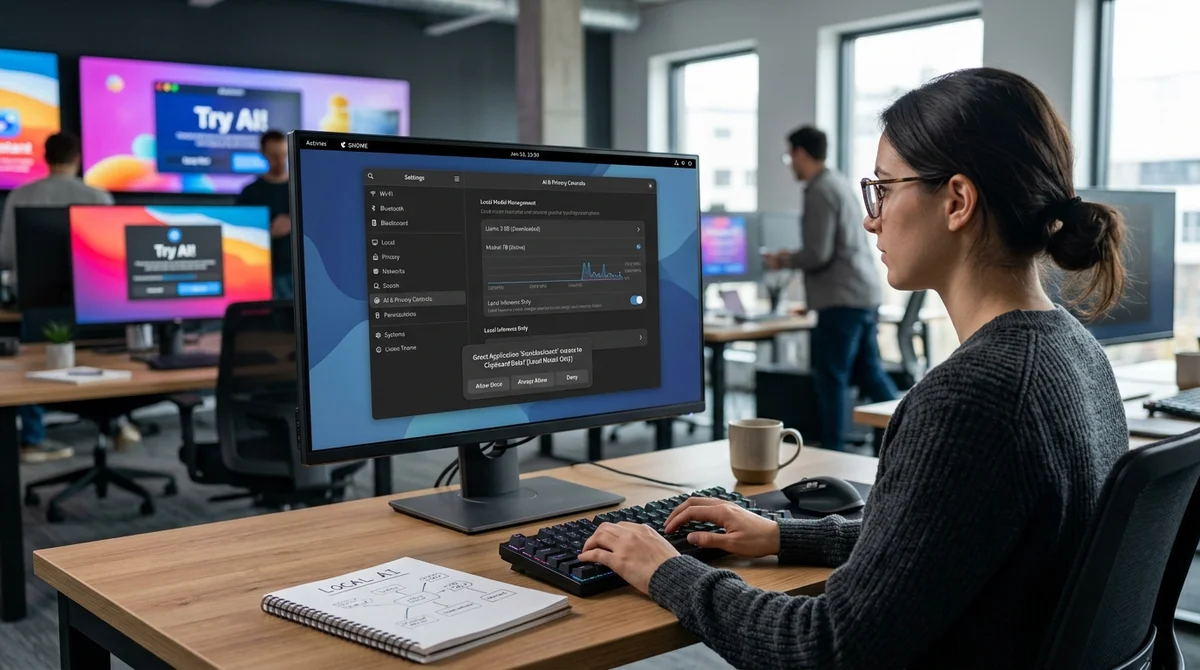
Canonical has chosen a rare path for 2026: rather than embedding AI in Ubuntu on a "enabled by default" principle, it gives users and administrators the right to decide whether they need it at all. Against the backdrop of Windows and other mass-market platforms, this looks almost like a countercultural move.
Not Like Windows
The discussion was sparked by Canonical's position on Ubuntu development following the release of Ubuntu 26.04 LTS, which came out on April 23, 2026. A few days later, on April 27, Vice President of Ubuntu Engineering John Seeger detailed how the company plans to add AI features: carefully, incrementally, and with a priority on user control.
By April 28, Canonical clarified an important detail: Ubuntu 26.04 LTS itself does not ship with these new AI capabilities out of the box. This is about a roadmap for the coming months and previews planned to start with Ubuntu 26.
10. This is what sets Canonical's approach apart from how major vendors push AI in consumer operating systems. Microsoft is increasingly embedding Copilot into Windows, and the discussion around Recall showed how painful user reaction can be when AI features arrive before clear privacy settings and management are available.
Canonical, on the other hand, builds the thesis in reverse: first boundaries, then features. For the Linux community and enterprise clients, this sounds like respect for the administrator rather than marketing diktat.
Locally and by Choice
At the heart of Canonical's strategy is local inference by default, open-weight models, and packaging AI components in Snaps with Ubuntu's familiar isolation mechanisms. The company explicitly states it has no intention of running models in the background just for the sake of having AI. If a feature is not enabled, the model should not consume resources, network, or user attention. Moreover, the models themselves don't have to appear in the system until the needed functionality is explicitly enabled.
- AI features are planned to be introduced as opt-in, and first previews will be strictly with explicit user consent
- Local models and local inference are assumed by default, without mandatory cloud data transmission
- Components will be delivered as separate Snap packages that can be removed if needed
- To manage risks, Canonical wants to use sandboxing and targeted permissions, not a "magical" global mode
Canonical separately clarified the controversial aspect of a "global AI switch." Formally, the company has no intention of creating a single master switch, but the explanation is quite pragmatic: in the Linux ecosystem, there are too many different installation and software consumption scenarios for such a switch to be honest and universal. Instead, the bet is on modularity: if you don't want AI features, you don't enable them or you delete the corresponding packages. For IT teams, this is also a convenient way to roll out new features selectively rather than across the entire machine fleet.
Where AI Will Appear
Seeger divides future Ubuntu AI capabilities into two groups. The first is hidden support for already familiar OS functions: for example, improvements to speech-to-text, text-to-speech, accessibility, and other system scenarios where the model works in the background but doesn't impose a chat interface on the user. The second is more explicit AI-native scenarios and agentic workflows for those who actually need them. Examples include help with problem diagnosis, automating routine tasks, and more convenient work with Linux capabilities that remain too complex for many today.
"Ubuntu is not becoming an AI product, but can become stronger through
thoughtful AI integration."
This is particularly interesting for the corporate audience. Canonical explicitly talks not only about desktops but also about server and SRE scenarios: log analysis during incidents, limited agentic actions within existing access rights, full auditability of decisions. For companies, this sounds much closer to actual security requirements than the model of "let's embed AI everywhere first, then figure out the consequences." Plus, Ubuntu 26.04 itself already takes a step toward AI infrastructure: the release natively added CUDA and AMD ROCm to the repositories, meaning the platform is ready for AI workloads even without mandatory AI features in the interface.
What This Means
Canonical is attempting to occupy a rare position between AI skepticism and AI hype. The company doesn't reject models and agentic scenarios, but doesn't pretend that all users need the same set of "smart" features. If this approach works, Ubuntu could become an example of how to embed AI in an operating system without coercion: locally, modularly, and with clear consent at every step. And that would truly be a lesson Microsoft should study carefully.
Want to stop reading about AI and start using it?
AI News is a curated feed of AI/tech news. Hamidun Academy teaches you to use AI systematically in your work.