Google Translate marks 20 years with pronunciation training and new service metrics
Google celebrated Translate's 20th anniversary with both numbers and a new feature: the Android app now includes pronunciation training with instant…
AI-processed from Google AI Blog; edited by Hamidun News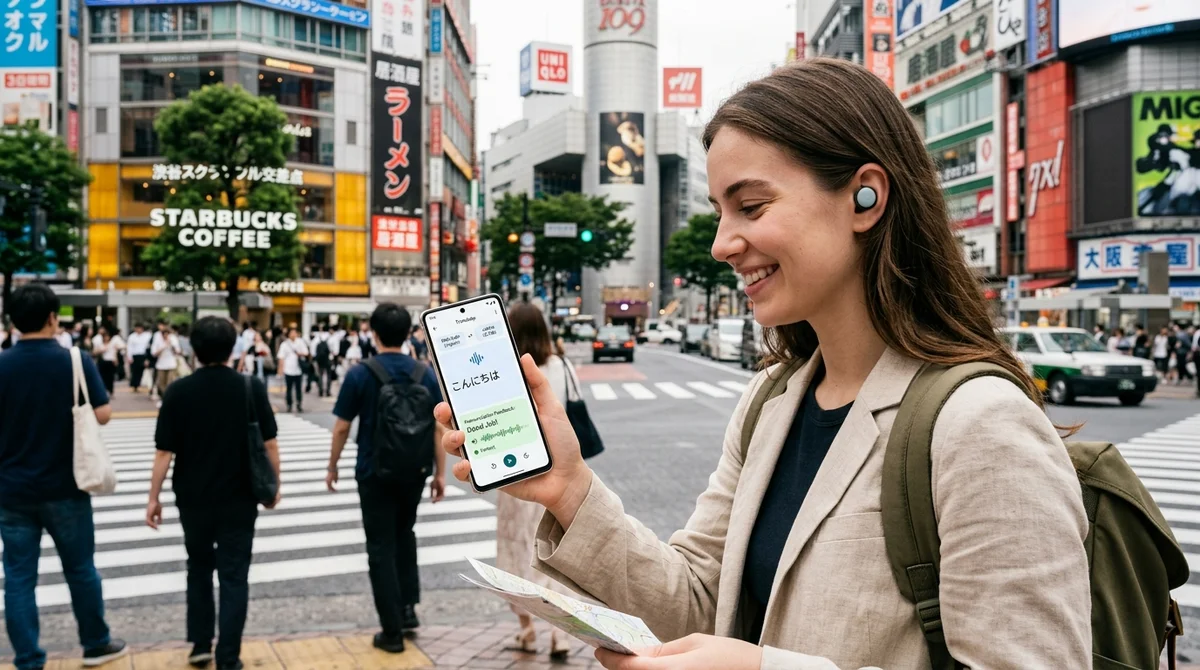
On April 28, 2026, Google celebrated the 20th anniversary of Translate by launching a new pronunciation training feature on Android. The anniversary post turned out not to be about nostalgia, but about a shift in the service's role: from a standalone translator it is transforming into a layer of understanding speech, text, and images across Google's entire ecosystem.
From Experiment to Platform
The product's history shows well how the company's entire AI stack has evolved. In 2006, Translate started as a Google Research experiment based on statistical machine learning. Back then, the task was to find the most probable word combinations across massive text datasets. In 2016, the service became one of Google's first to transition to neural machine translation, and now the company directly states that it relies on Gemini models and new generations of TPU to make translation not literal, but contextual and natural.
The scale has long since exceeded the boundaries of an ordinary web tool. According to Google, Translate works with almost 250 languages, covers 95% of the world's population, and supports over 60 thousand potential language pairs. More than 1 billion users turn to Translate for help each month, and through Translate, Search, Lens, and Circle to Search, approximately 1 trillion words are translated monthly. Google specifically emphasizes support for endangered and indigenous languages — a significant signal that the company views translation not only as convenience, but as infrastructure for knowledge access.
Betting on Live Speech
The main new announcement is the pronunciation practice mode in the Translate app for Android. The feature analyzes the user's speech, provides instant AI feedback, and helps perfect pronunciation before a real conversation. At launch, it is available in the United States and India for English, Spanish, and Hindi.
This is a logical continuation of existing ask and understand buttons, which provide additional context and translation options: Google is increasingly moving away from the "enter text — get equivalent" model toward a language assistant model that explains, corrects, and teaches. The same vector is visible in live translation. Google writes that Translate already works as a personal interpreter in earbuds, preserving the tone and rhythm of the interlocutor's speech, and fresh audio-to-audio Gemini models allow for smoother real-time dialogues.
A telling statistic: more than a third of Live Translate sessions last longer than five minutes. That is, people use the service not for one-off transcription of a single phrase, but for actual conversations — on trips, during family video calls, on tours, and even during job interviews.
- Pronunciation training with instant speech assessment
- Live Translate in earbuds for real-time dialogues
- More natural translation of idioms, slang, and local context
- Offline language packs for trips without internet
- Translation through the camera in Lens and through Circle to Search on Android
Translation Became Background
The anniversary text well illustrates where Translate lives in 2026. Roughly a third of mobile app users use it not only on trips, but also for learning a new language. Almost half of those who access the Practice feature weekly choose exercises focused on conversation and scenarios that resemble real situations.
At the same time, offline mode remains an important option: the most frequently downloaded languages worldwide are English, Arabic, Spanish, French, Japanese, German, Hindi, Chinese, Russian, and Italian. Even more interesting is how translation dissolves into other Google products. Lens has long been transforming menus, signs, and directions into a readable layer overlaid on images.
On Android, translation is one of the most popular use cases for Circle to Search. In Search, people ask AI Mode to explain Gen Alpha slang, translate text into emojis, and even help with American Sign Language. Google also revealed the most common language pairs: English → Spanish leads, but the top already includes English → Indonesian, Portuguese, Arabic, Turkish, as well as English → Hindi, Bengali, and Malayalam.
This is no longer a tourist helper, but an everyday interface to the global internet.
"Thank you" remains the most frequently translated phrase in Google Translate.
On the list of popular queries alongside it are "How are you?", "I love you", "Hello", and "Please". The set is telling: despite AI assistants, cameras, and earbuds, people most often translate not business terms, but basic contact phrases. Technology grows more complex, but the main demand remains very human: to understand, to thank, to greet, to explain.
What This Means
Google is gradually restructuring Translate from a standalone service into a multimodal language layer for its entire ecosystem. If this course succeeds, translation will increasingly not be perceived as a separate action: it will become an invisible part of conversation, search, learning, and navigation. For competitors, this is bad news, because they will have to fight not with an application, but with Google's systemic advantage in devices, AI models, and distribution.
Want to stop reading about AI and start using it?
AI News is a curated feed of AI/tech news. Hamidun Academy teaches you to use AI systematically in your work.