British graduates pursue master's degrees to weather hiring crisis and AI pressure
Britain is seeing rising demand for master's degrees among recent graduates, with many viewing it not as academic advancement but as a pause before a harsh…
AI-processed from Bloomberg Tech; edited by Hamidun News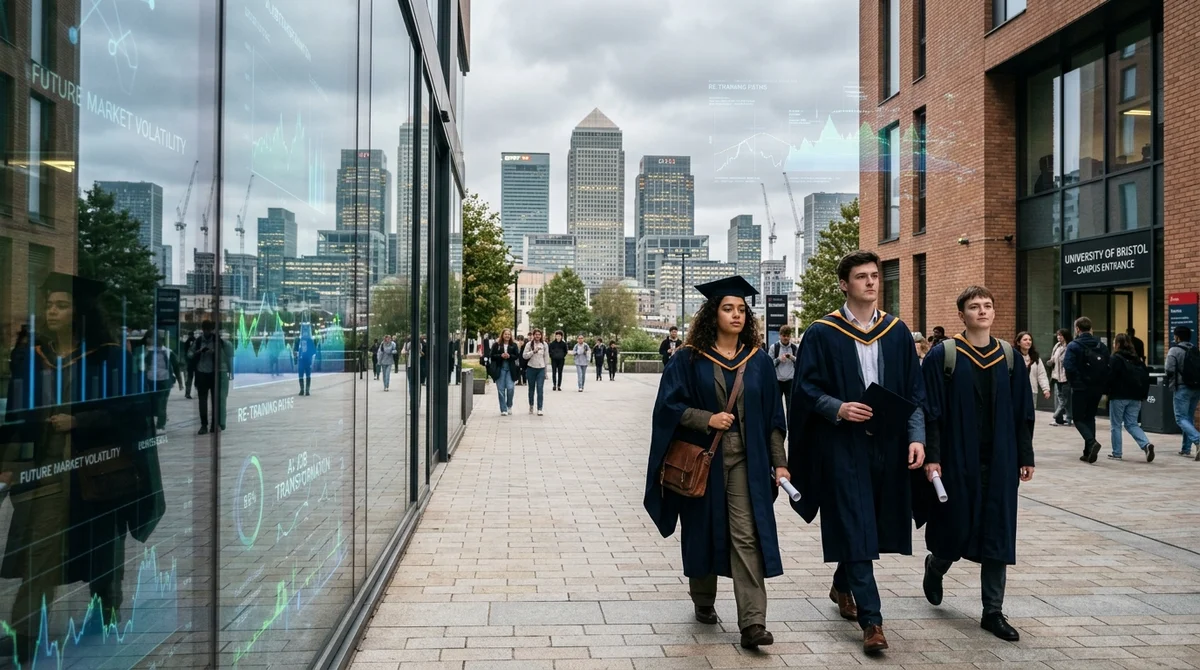
British graduates are increasingly pursuing master's degrees not out of academic interest, but as a strategic shelter from a weak labor market. An additional degree is perceived simultaneously as a postponement from a failed career start and as protection from the pressure of AI on entry-level positions.
Why demand has grown
For many 2026 graduates, entering the job market turned out to be noticeably harder than expected just a year ago. Companies are more cautious about hiring junior specialists, keep vacancies open longer, and more often require experience even for entry-level roles on teams. Against this backdrop, master's degrees become an understandable and socially acceptable scenario: another year in the education system looks less risky than months without an offer after university.
A separate factor is the fear that generative AI is changing precisely the entry-level layer of office work the fastest. If previously a graduate could count on positions with plenty of routine analysis, material preparation, and administrative tasks, then now part of that workload is taken on by software. Because of this, additional specialization seems like a way to increase one's own value and delay entering the market until a more understandable moment.
How the "emergency" degree works
This choice is called an emergency degree not because studying became easier or more formal, but because master's degrees are used as an emergency pause. It gives time, a new set of skills, and a chance to repackage oneself for employers. For some students, this is not an attempt to change careers, but a way to avoid entering the market during the weakest hiring cycle.
In the eyes of students, this looks quite rational. Most often graduates expect to gain several benefits at once:
- postpone entry to the market by 1–2 years
- add more narrow specialization to resume
- gain access to internships through the university
- wait out the moment when companies cut junior hiring
- show the employer investment in additional skills
There is also a more pragmatic calculation. The university provides not only a course but also infrastructure: career services, job fairs, instructors with industry contacts, and the right to again apply for graduate programs, where the filter goes by current student status.
For those who did not get a strong offer after their bachelor's degree, this is a way to restart the search funnel and approach employers no longer as "just yesterday's graduate," but as a candidate with new specialization and a fresh academic track.
What graduates fear
The main fear here is not just unemployment, but a poor start that drags on afterward. If the first year after a bachelor's degree goes in random side gigs or a prolonged search, it affects both income and career trajectory. Therefore, even an expensive master's degree for some students looks not like an expense, but as insurance against a more expensive mistake—premature entry into the market without clear demand for their skills.
But such a strategy has its weak points. An additional degree does not by itself guarantee employment, and competition may simply shift to a higher level: instead of fighting for junior roles, there will be competition among master's graduates for the same limited positions.
If during studies the market does not recover, the graduate risks coming out with a large debt and the same question: how to prove practical value in the era of AI tools.
What it means
The signal here is quite direct: the labor market for young specialists is changing faster than university expectations. If graduates use master's degrees as shelter, it means the problem is not a love of studying, but a lack of confident starting routes into the profession.
For universities, this is a chance to rebuild programs around applied skills, and for employers, a reminder that too sharp a reduction in junior hiring creates a personnel shortage already in the next cycle.
Want to stop reading about AI and start using it?
AI News is a curated feed of AI/tech news. Hamidun Academy teaches you to use AI systematically in your work.