South Africa Withdraws AI Policy Draft After Finding Fabricated Scientific References
South Africa withdrew the draft national AI policy after finding at least six fabricated scientific references out of 67 in the 86-page document. The draft…
AI-processed from TNW; edited by Hamidun News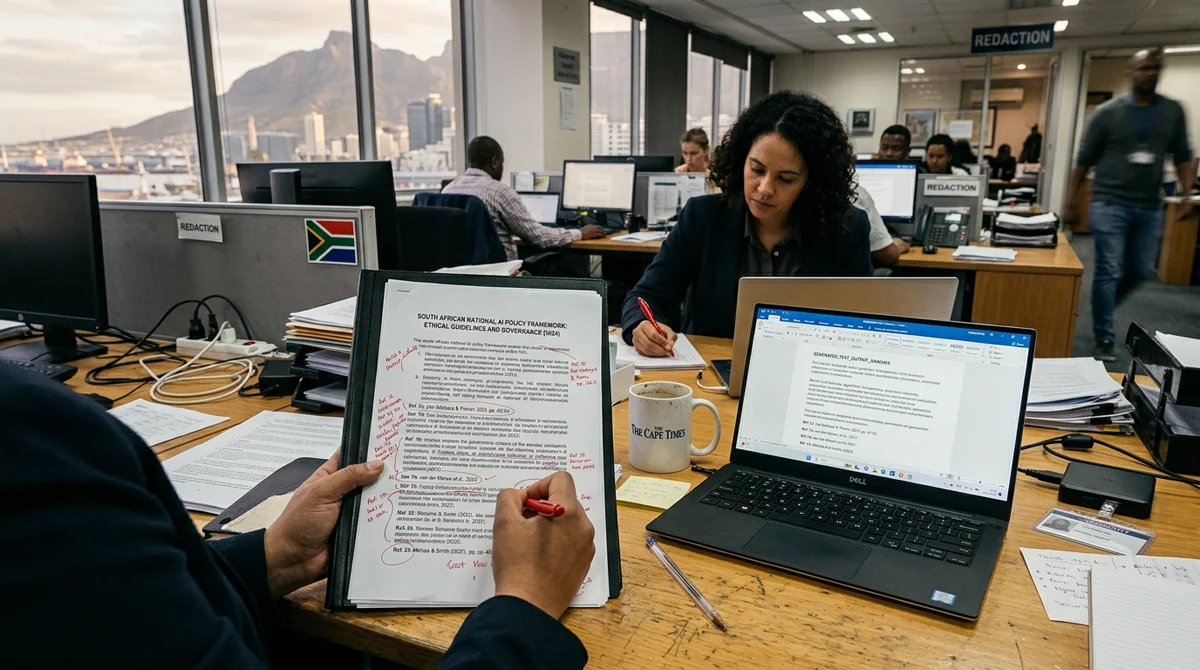
South Africa withdrew its national AI policy draft after discovering fabricated scientific references in the document. The irony is that the document about AI regulation was likely partially prepared using generative AI — and the results were not verified before publication.
What Happened
South Africa's Minister of Communications and Digital Technologies Solly Malatsi withdrew the policy draft on April 27 following an internal review. The trigger was an investigation by News24: journalists discovered that at least six of the 67 academic references in the 86-page document pointed to works that do not exist. The journal names were real, but the articles themselves were not. The draft had previously passed through the cabinet on March 25 and was published in the government gazette on April 10 for public discussion. Comments were to be accepted until June 10.
According to Malatsi, the most likely explanation is that AI-generated references ended up in the text without proper verification. The minister promised action against those responsible for preparation and quality control, because the error affected not a draft, but an official government document.
What Was in the Draft
The document was conceived as a framework for the state's AI strategy. It was based on a risk-oriented approach, partly inspired by the European AI Act, and proposed rolling out regulation in stages: from basic rules and recommendations to sectoral strategies and separate institutions. The text also discussed grants, subsidies, and tax incentives for the private sector.
The draft featured several new structures and mechanisms:
- National AI Commission
- AI ethics council and separate regulator
- AI ombudsman
- National AI Safety Institute
- Insurance superfund for disputed liability cases
Additionally, the official draft outlined six strategic directions: workforce development, AI for inclusive growth and employment, responsible governance, ethical and inclusive AI, cultural preservation and international integration, and AI implementation with human interests as a priority.
For the African context, this was an ambitious framework: the state clearly wanted to simultaneously stimulate the market and create its own oversight model, rather than simply copy European rules.
Where the Process Failed
The problem turned out to be not only the fake references themselves, but also that the document went through multiple levels of approval. Editors of the South African Journal of Philosophy, AI & Society, and Journal of Ethics and Social Philosophy confirmed that the cited articles had never been published in their journals. In other words, this was not a single careless mistake, but plausible yet fabricated sources that looked convincing enough to pass cabinet review.
"This is an unacceptable failure that shows why strict human oversight
is necessary when using AI."
This story illustrates the typical weakness of generative models. They excel at assembling coherent, confident text and formatting references as if you're looking at a normal academic bibliography. But the model is not obligated to verify whether the article actually exists. If a team uses AI as a draft, and then does not manually validate each reference, the error easily reaches the final document. In the case of a government document, the cost of such an oversight is higher than usual: not only the text is at stake, but also the trust in the institution that is about to regulate the technology itself.
What This Means
The scandal has set back South Africa's AI agenda: the draft will need to be rewritten, re-submitted for consultation, and re-legitimized. For other states and companies, the conclusion is simple: AI can be used in document preparation, but references, quotes, and facts must be verified manually before publication, not after a scandal.
South Africa's story shows that the most painful risk of generative AI is not a loud failure, but a confidently formatted error discovered too late.
Want to stop reading about AI and start using it?
AI News is a curated feed of AI/tech news. Hamidun Academy teaches you to use AI systematically in your work.