AWS explained how to convert a text-based AI agent into a voice assistant on Nova 2 Sonic
AWS released a detailed breakdown of migrating a text-based AI agent to a voice assistant on Amazon Nova 2 Sonic. The key takeaway: it's not enough to add…
AI-processed from AWS Machine Learning Blog; edited by Hamidun News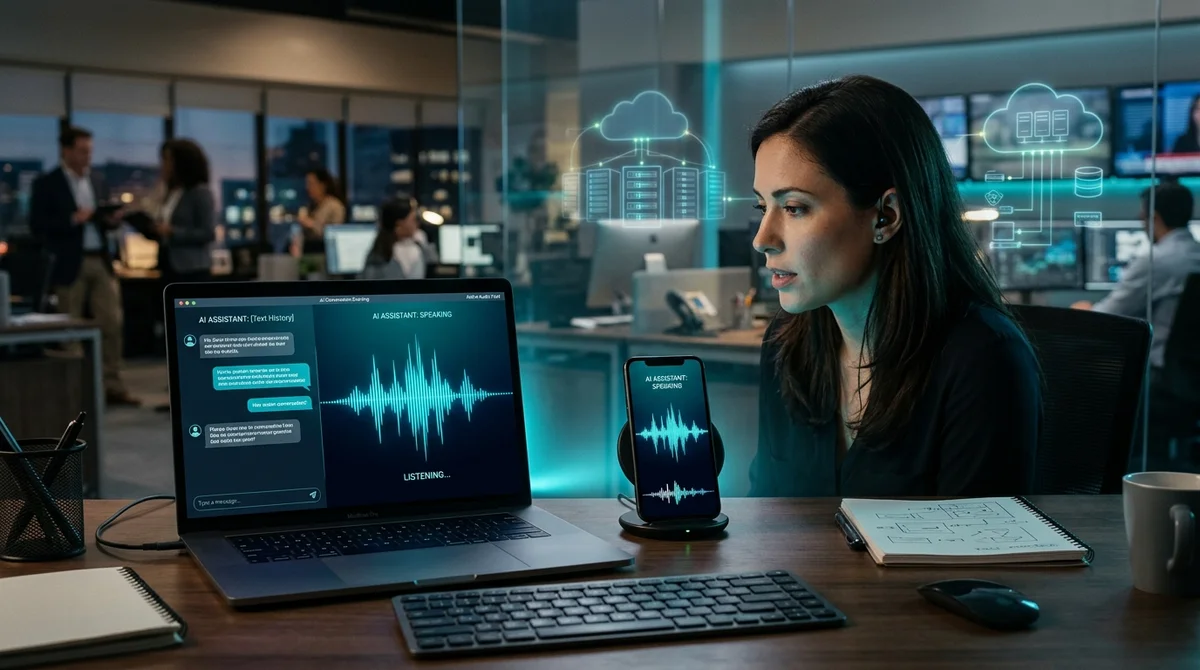
AWS showed that transitioning from a text AI-agent to a voice assistant is not just a change of interface, but a redesign of the entire dialogue logic. In a breakdown about Amazon Nova 2 Sonic, the company explains which parts can be reused and which must be redesigned from scratch to make the conversation sound natural and not break under real-world scenarios.
Why Voice Is More Complex
A text agent has the luxury of pausing: a user types a request, the model responds with a paragraph, then you have time to think about the next step. Voice doesn't work that way. Here, pace, phrase length, the ability not to interrupt, quick response to clarifications, and maintaining context without the feeling that the interlocutor has "frozen" are all important. So migrating to voice is not cosmetics on top of an already-built bot, but a shift toward conversational UX, where each extra word affects perception almost as strongly as the quality of the model itself.
There's another difference — the goal of interaction. For a text agent, a long, detailed answer often looks useful. For a voice assistant, that same answer can be tiring. AWS points out that when designing, you need to immediately understand the scenario: is this customer support, task execution, an internal assistant for employees, or service navigation. In each case, the priority between speed, accuracy, naturalness of speech, and the number of steps the system can take without additional confirmation changes.
What to Change in Architecture
The key idea of the post is that the existing text agent doesn't necessarily need to be thrown away. Decision-making logic, tools, and even some of the subagents can be preserved if they're moved into separate modules and a voice layer is added on top. Amazon Nova 2 Sonic in this scheme becomes the interface of live conversation: it helps organize a more natural exchange of dialogue, while the base agent continues to call the necessary functions and business rules. But to achieve this, the architecture has to be more event-driven and sensitive to response time.
- Reuse tools and business logic if they already work stably in the text agent
- Keep subagents for narrow tasks, but reduce their latency and the volume of intermediate responses
- Rewrite the system prompt for spoken speech, rather than copying the text style one-to-one
- Add management of confirmations, pauses, and user interruptions
- Explicitly separate the agent's internal reasoning and the short external voice line
A separate question is system prompt adaptation. In text, the model can be asked to answer expansively, list options, and provide full context immediately. In voice mode, such instructions often get in the way. It's more useful for the assistant to speak briefly, confirm understanding, ask a clarifying question at the right moment, and not read service details to the user. Otherwise, even a strong agent starts to sound like a chat that's just being read aloud, not like an interlocutor who knows how to conduct a dialogue.
Main Migration Pitfalls
The main mistake when migrating is thinking that a voice assistant is the same text agent plus speech synthesis. In practice, problems appear in places that were never critical before: long delays before responding, overly formal wording, inability to handle interruptions, and confusion during multi-step tasks. If in chat a user tolerates an extra two or three seconds and can reread a long answer, then in voice that same delay quickly destroys the feeling of natural conversation and reduces trust in the system.
AWS also addresses concerns related to tools and subagents. If they work in an opaque way, the user hears either prolonged silence or too verbose a recounting of internal steps. So it's important to think in advance about when the assistant should say "let me check now," when it's better to silently perform an action, and when it's safer to stop and ask for confirmation. Such control is especially needed in scenarios where the agent orders a service, changes user data, or goes through several dependent steps in a row.
What This Means
For teams that already have a text AI-agent, the AWS article is useful as a practical migration map, not as an abstract demonstration of a model. The main conclusion is simple: a voice product wins not from a new model alone, but from how carefully you've separated the logic, tools, prompts, and behavior in dialogue. If this boundary is set up correctly, the path from chat to assistant becomes noticeably shorter.
Want to stop reading about AI and start using it?
AI News is a curated feed of AI/tech news. Hamidun Academy teaches you to use AI systematically in your work.