Top 10 Physical AI Models Controlling Real Robots in 2026
A new class of physical AI models is already controlling robots in factories and warehouses — systems trained to act in the physical world rather than…
AI-processed from MarkTechPost; edited by Hamidun News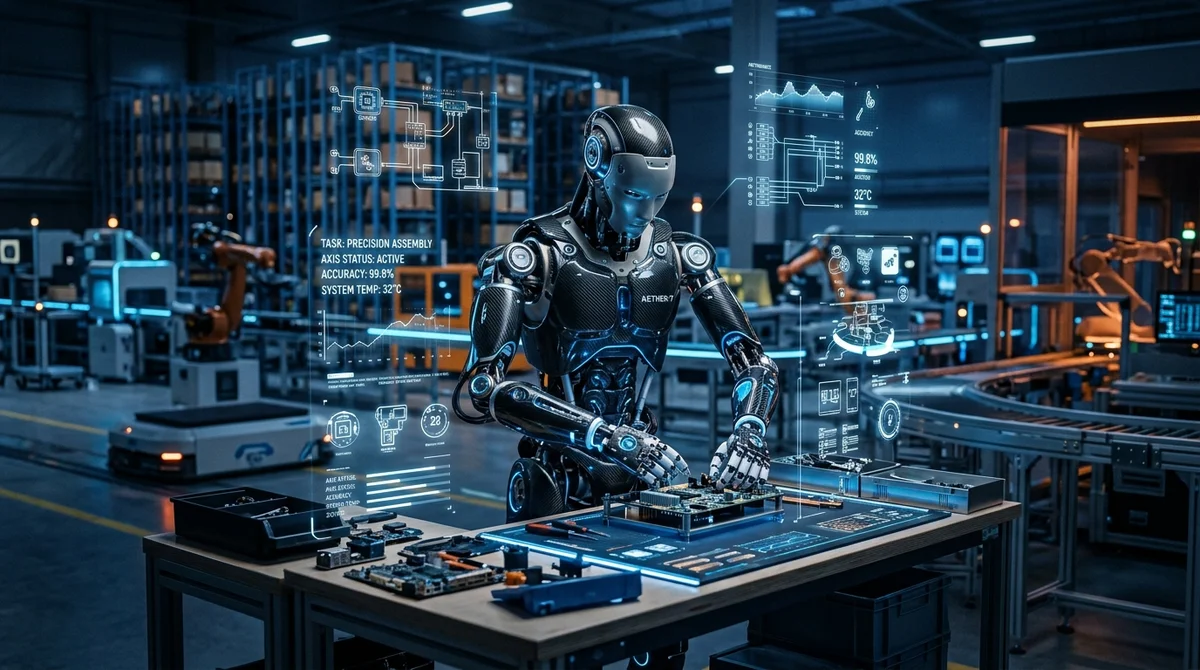
A new class of foundational models — trained not on text but on physical actions — is already working on real hardware in factory floors, logistics centers, and research laboratories around the world. Over 18 months, the gap between the capabilities of language models and actual robotic deployment has narrowed dramatically.
What is Physical AI
Physical AI models (Policy Models) are fundamentally different from conventional LLMs: they accept input streams from cameras, inertial sensor data, and joint positions — and output specific motor commands in real time. The task is not to "answer a question" but to "pick up an object and place it in the right location" or "assemble a component on a conveyor line."
Three major architectural directions in 2026:
- VLA (Vision-Language-Action) — understand language instructions and convert them into physical actions
- Diffusion policies — generative approach to planning movement trajectories
- Transformers for sensors — unified processing of camera, lidar, and tactile sensor data
Ten systems at work right now
Pi0 (Physical Intelligence) — the first universal policy with pretraining on heterogeneous robot fleets. The startup collected tens of thousands of hours of teleoperation data across different platforms. The resulting model is fine-tuned for a specific platform in just a few hours — unlike traditional control systems requiring months of development.
RT-2 (Google DeepMind) demonstrated that the VLA approach transfers "common sense" from internet data to physical tasks: clearing tables, navigating unfamiliar spaces, manipulating objects by verbal instruction. The model understands abstract commands like "bring me something to quench my thirst."
Isaac GR00T (NVIDIA) — a foundational model for humanoid robots. It trains in the photorealistic Omniverse simulator with synthetic data, then transfers to physical platforms through domain randomization.
OpenVLA — an open-source VLA from a consortium of academic laboratories that became the standard baseline for research. The weights are open, and an active community publishes fine-tuned versions for various tasks — from warehouse operations to medical manipulators.
Octo — a lightweight fine-tunable architecture for custom tasks, compact enough to run on onboard GPUs without constant cloud connectivity. Rounding out the list are models from Figure AI and 1X Technologies for humanoid platforms, RoboFlamingo (an extension of OpenFlamingo for object manipulation), CrossFormer (a policy for robots with varying degrees of freedom), and UniSim — pretrained on synthetic data without a single real demonstration.
Data became the main bottleneck
All successful physical models share one thing: millions of hours of teleoperation in the training dataset. Pi0 and similar systems are actively expanding their fleets of operator robots precisely to collect data — each new demonstration increases policy accuracy. Synthetic data from simulators helps, but doesn't fully replace real recordings yet. Unlike LLMs, compute scaling works differently here: the key resource is diversity of physical scenarios. This opens opportunities for players with unique access to production data.
What this means
Physical AI has moved from proof-of-concept to real production. Companies working on industrial automation now have ready-made foundational models — much like pretrained weights changed computer vision a decade ago. The question is no longer whether robots will be controlled by foundational models — the question is who will be first to adapt them to their own tasks.
Want to stop reading about AI and start using it?
AI News is a curated feed of AI/tech news. Hamidun Academy teaches you to use AI systematically in your work.