Bloomberg Restructures Terminal for AI: ASKB Chat to Become New Primary Interface
Bloomberg is embedding the ASKB chat interface in Terminal and positioning it not as an add-on but as the future primary way to work with the platform. The…
AI-processed from Wired; edited by Hamidun News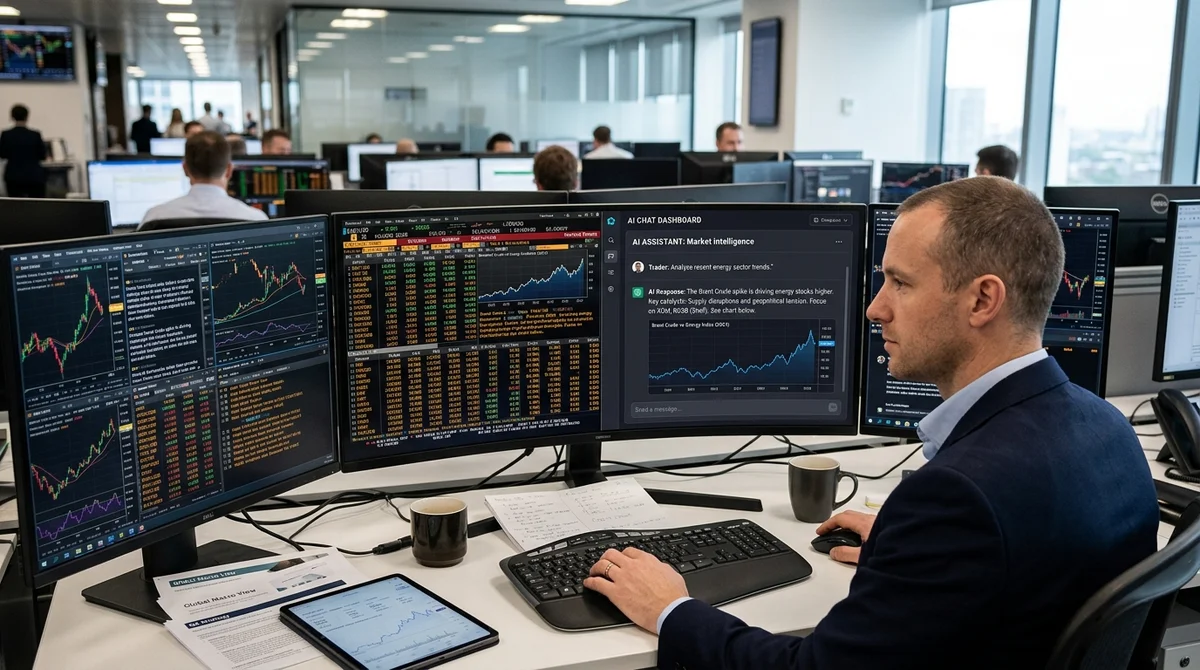
Bloomberg is preparing the most significant Terminal update in years: the legendary platform for traders and analysts is getting embedded with the ASKB chat interface. The idea is that users no longer navigate through layers of commands, screens, and monitor notes, but ask questions in natural language and immediately get a compiled answer about markets, companies, and documents.
Why Terminal is Changing
The strength of Bloomberg Terminal has always been its data density and functionality, but over time this became the problem itself. The platform accumulated new information layers over decades: beyond quotes and reports, weather forecasts, logistics data, factory information, consumer spending, and private lending data have all been added. As a result, even experienced users find it increasingly difficult to quickly locate the needed signal in this mass of data.
According to Bloomberg's CTO Shoan Edwards, the main task of generative AI here is not to "think" on behalf of the analyst, but to find key insights faster and assemble a complete picture around an investment idea. Currently, the ASKB beta is open to roughly one-third of Terminal's 375,000 users, but Bloomberg has not yet announced dates for full release.
Most importantly, ASKB is conceived not as a side function, but as the new primary way to enter the system. Bloomberg explicitly states that the graphical interface will not disappear, but the start of most scenarios will go through dialogue. For Terminal, this is almost a cultural revolution: instead of memorizing commands and screen routes, users formulate a thesis and receive a compiled answer.
"This will be the new
Terminal: most interactions will start with ASKB."
How ASKB Works
From the outside, ASKB looks like a chat, but internally it's not a single universal bot. Bloomberg describes the system as a network of AI agents that simultaneously traverse data, news, research, documents, and analytics, then assemble a contextual answer. For finance professionals this matters: the question can be asked not in the language of tickers and commands, but in the language of hypothesis—for example, how a geopolitical conflict and oil price movements might affect a portfolio.
In practice, Bloomberg positions ASKB as an accelerator for research work, especially during periods like earnings season, when analysts must review massive amounts of documents and benchmark companies against competitors in a short time.
- Natural language search across data and documents
- Summaries of bullish and bearish scenarios around a company
- Workflow templates for earnings prep and recurring tasks
- Transparent links to source fragments and verifiable citations
- BQL code output for continued analysis in Excel and BQuant
Edwards emphasizes that such tools do not automatically make an average analyst great. But they allow experts to test more ideas in the same amount of time: not one hypothesis a day, but ten at once. That is, competitive advantage shifts not to those who best remember Terminal's internal functions, but to those who formulate stronger questions and interpret answers faster.
Risks and Resistance
For financial software, the main risk is obvious: a confidently formulated error can be too costly. That's why Bloomberg emphasizes not flashy chat, but protective mechanisms. According to the company, the system verifies whether facts from the summary are contained in the source paragraphs, separately tracks semantic inversions that language models like to make, and validates citations. The approach is described as conservative: better to underanswer than deliver a convincing hallucination.
From this follows another principle: ASKB should guide users to sources rather than hide them behind a polished paragraph. This is an important difference from mass-market AI chats. In the investment community, speed of response matters, but so does the ability to quickly open the original document, verify the wording, and understand what exactly the conclusion is based on. Bloomberg also promises transparent attribution and in some scenarios displays fragments of the original text alongside the answer.
There is also an organizational question. If AI begins to automate the routine that junior analysts used to do, then the very logic of training within the industry changes. Edwards acknowledges that the market has not yet given a clear answer on how to grow newcomers if a significant portion of "rough" research work will shift to agents. Plus, Bloomberg is clearly preparing for discontent from the old guard, for whom knowledge of Terminal functions was part of professional identity.
What This Means
Bloomberg shows that generative AI in finance is moving out of experimental mode and becoming an interface for a mission-critical system. If ASKB takes hold, the market will get a new standard: it's not enough to simply provide data access—you need to be able to quickly compile conclusions, show their origin, and automate research routine without loss of control.
Want to stop reading about AI and start using it?
AI News is a curated feed of AI/tech news. Hamidun Academy teaches you to use AI systematically in your work.