Anthropic and OpenClaude: why 'free' Claude Code in 2026 isn't really free
After Claude Code's source code leaked on npm, OpenClaude appeared almost immediately — a fork with an OpenAI-compatible shim that can connect to GPT-4o…
AI-processed from Habr AI; edited by Hamidun News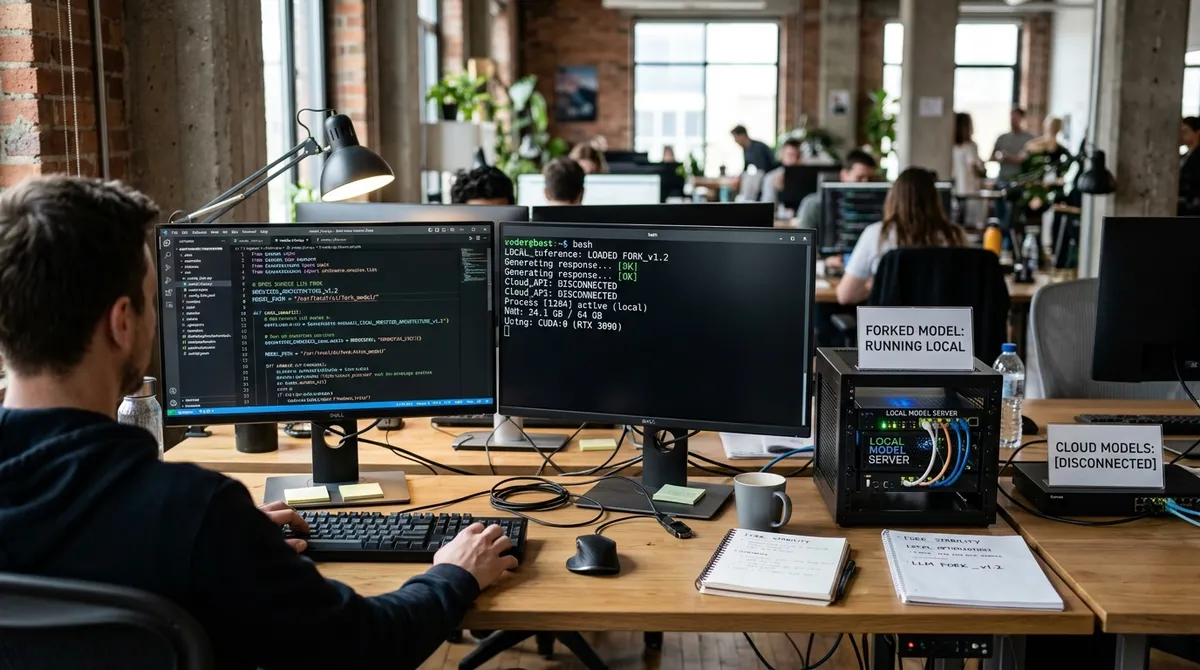
The story of "free Claude Code" didn't begin with an official release, but with a leak: on March 31st, the source code of Anthropic's AI development tool ended up in npm source maps. Almost immediately, OpenClaude emerged around it—a fork that substitutes the native backend with an OpenAI-compatible layer and allows you to run the same interface on top of other models. On paper, this looks like an ideal scenario: you take the Claude Code shell, plug in GPT-4o, DeepSeek, local Llama via Ollama—and you get a powerful agent for programming without an Anthropic subscription. In practice, it's more complicated: some scenarios actually work, but the promise of being "free" rests on caveats about compatibility, infrastructure, and model quality.
From a technical perspective, OpenClaude solves a clear problem. The original Claude Code client expects a specific response format, tool invocations, and data streaming. The fork adds an intermediate shim that accepts these requests and translates them into a more universal API compatible with the OpenAI ecosystem. Thanks to this, instead of one provider, you can substitute almost anything: cloud models from OpenAI and DeepSeek, local builds via Ollama, and in theory any server that can respond in the right format. This is precisely why the project went viral so quickly: people saw not just a code leak, but a chance to turn a closed product into a more flexible interface for different LLMs.
However, API-level compatibility does not mean full behavioral compatibility. Claude Code is not just a chat with a model, but a set of expectations about how the model plans steps, edits files, invokes commands, maintains context, and responds to errors. If a different model is under the hood, it might formally accept the same requests but act differently.
In some cases, everything will be acceptable for simple tasks like code generation, refactoring small modules, and explaining changes. But in others, discrepancies will emerge: the tool invocation format is worse, long agent cycles break, the quality of edits in large repositories drops, or extra commands appear that the original workflow didn't anticipate. Therefore, the thesis that "Claude Code works with any model" is true only in the basic sense of launching it, but doesn't guarantee identical results.
Another important point is the word "free." The fork itself may be open, and local execution might be formally without an Anthropic subscription, but someone still pays for the computation. If you use GPT-4o or DeepSeek through an API, the free-ness ends the moment real requests start. If you choose local models via Ollama, you have to pay in hardware: you need memory, a GPU, time to configure, and willingness to accept that smaller models with open weights underperform top closed systems in stability and code quality. Even when everything runs without direct subscription costs, it's not equivalent to "I got Claude Code for free"—rather, the user is exchanging one type of cost for another.
A separate layer of risk is tied to the origin of this whole story. When a tool emerges in the wake of a source code leak, a gray zone almost inevitably forms around it: legal, ethical, and operational. Developers get a rare opportunity to look inside a popular AI coder and quickly assemble an alternative, but along with this come questions about security, support, and the future of such forks.
How long will the project survive without claims from the copyright holder? Which parts of the code are truly reproducible from scratch, and which repeat the original logic too closely? Can you trust a tool that was assembled yesterday on the wave of hype if it gets access to your repository, terminal, and local files?
For experimenters, this is an acceptable risk; for team development, it's a completely different conversation.
The main conclusion here is not that OpenClaude is useless. On the contrary, the story showed how much demand there is for a good interface for agent-driven development, not tied to a single model provider. If the community can separate Claude Code's successful ideas from the noise around the leak, the market might get a proper open compatibility layer for AI editors and CLI agents.
But at the current stage, "free Claude Code" is more of an eye-catching headline than an accurate description. More realistically, look at OpenClaude as an experimental bridge: it provides access to a familiar UX and expands model choice, but doesn't eliminate costs, doesn't guarantee identical quality, and doesn't resolve reliability questions. For personal testing and local experiments, it's interesting; for production, it's still a tool that needs to be evaluated very soberly.
Want to stop reading about AI and start using it?
AI News is a curated feed of AI/tech news. Hamidun Academy teaches you to use AI systematically in your work.