Z.ai releases GLM-5V-Turbo — native multimodal model for visual programming
Z.ai (Zhipu AI) has released GLM-5V-Turbo — a multimodal model that translates images directly into program code. Unlike conventional VLMs, it doesn't merely…
AI-processed from MarkTechPost; edited by Hamidun News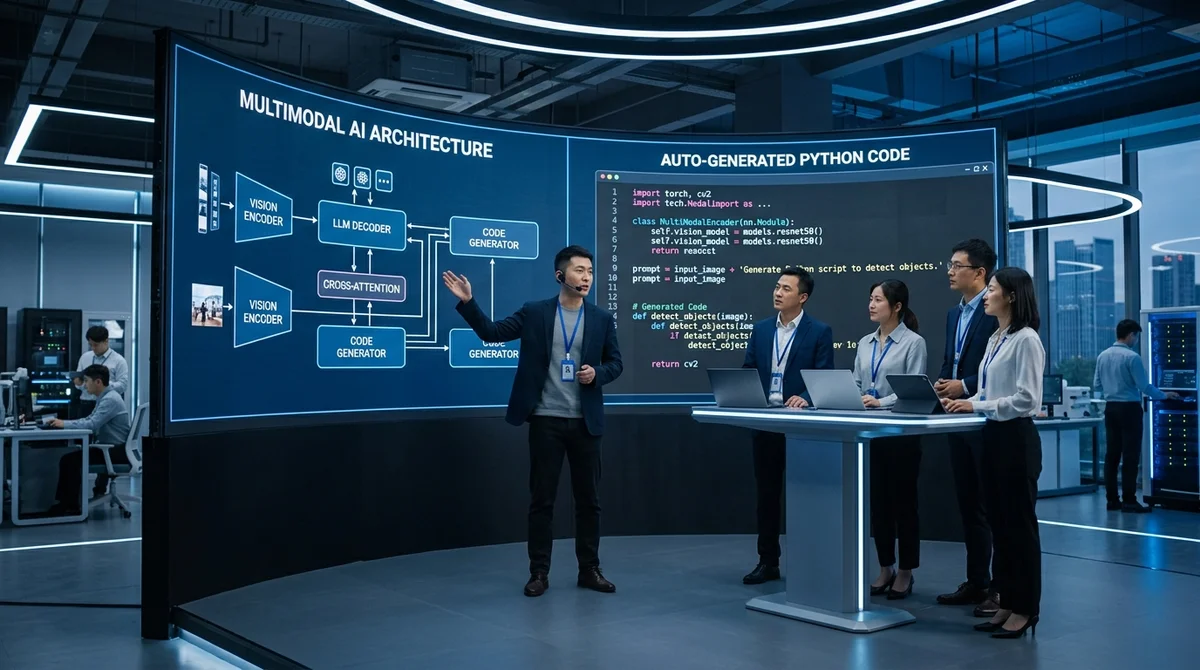
Zhipu AI, operating under the Z.ai brand, has released GLM-5V-Turbo — a model of a new class that unites computer vision and software engineering in a single native architecture. Unlike most multimodal systems, GLM-5V-Turbo does not simply describe images: it is capable of translating visual information directly into working code.
The model is optimized for the OpenClaw platform and oriented toward high-load agent workflows in software engineering. The traditional problem of vision-language models (VLMs) lies in the gap between perception and execution. Most such systems handle describing image content well, but struggle when it comes to transforming visual context into strict programming syntax.
This is a serious barrier to practical AI application in development: an engineer cannot simply show the model a screenshot of a user interface, an ERD database schema, or an architectural diagram and get working code in return. The intermediate step — manual translation of visual into textual — remained with the human, which substantially reduced the value of multimodal systems in real engineering scenarios. GLM-5V-Turbo attacks this problem directly.
Architecturally, the model is designed as natively multimodal: visual and textual contexts are processed jointly, without intermediate decoding steps. This allows the system to see a diagram, UI mockup, or data schema and immediately generate corresponding code — be it Python, TypeScript, SQL, or another language. The gap between "what is depicted" and "how to implement it" is substantially narrowed, and the quality of generated code is maintained at a level applicable to real projects.
The key application scenario for GLM-5V-Turbo is agent engineering pipelines. In such systems, an AI agent performs a series of interdependent tasks: analyzes requirements, designs architecture, writes and verifies code, iterates based on test results. Multimodal input radically expands the space of tasks an agent can handle autonomously: instead of textual descriptions, an engineer passes screenshots, wireframe prototypes, ERD schemas, or data charts — and receives code in return, not a retelling.
GLM-5V-Turbo is positioned exactly as a component of such pipelines, not as a standalone chat assistant for one-off requests. Optimization for the OpenClaw platform is another significant point. OpenClaw is an infrastructure solution for running large language models in a production environment, in demand among teams for whom low latency and high throughput are critical.
The fact that Zhipu AI specifically adapted GLM-5V-Turbo for this platform speaks to a focus on enterprise deployment, not academic benchmarks. For practicing engineers, this means the model was developed with consideration for the operational constraints of real systems — requirements for speed, stability, and scalability. The release of GLM-5V-Turbo fits into a broader race for multimodal coding models.
In 2025–2026, leading laboratories — American, European, and Chinese — have announced multimodal coding as a priority for the next frontier in AI capabilities. Chinese players, in particular Zhipu AI, are steadily expanding their presence in this segment, offering models tightly integrated with their own infrastructure platforms. This approach creates an ecosystem-level competitive advantage: a model optimized for a specific stack shows better results than a universal solution deployed on the same hardware.
For engineering teams, the release of GLM-5V-Turbo is another signal that the boundary between "seeing" and "doing" in the AI world is rapidly blurring. Systems capable of taking an architectural scheme as input and returning production-ready code are changing the very process of software product design. This is not simply an improvement in user experience — it is a potential rethinking of the developer workflow at every stage of the product lifecycle: from initial conception to deployment.
Want to stop reading about AI and start using it?
AI News is a curated feed of AI/tech news. Hamidun Academy teaches you to use AI systematically in your work.