GolangConf 2026 and Ontiko: Why Go Teams Need to Fix Architecture, Not Code Speed
AI accelerated development, but did not resolve the core pain point for Go teams — architecture and operations cannot keep pace with development velocity…
AI-processed from Habr AI; edited by Hamidun News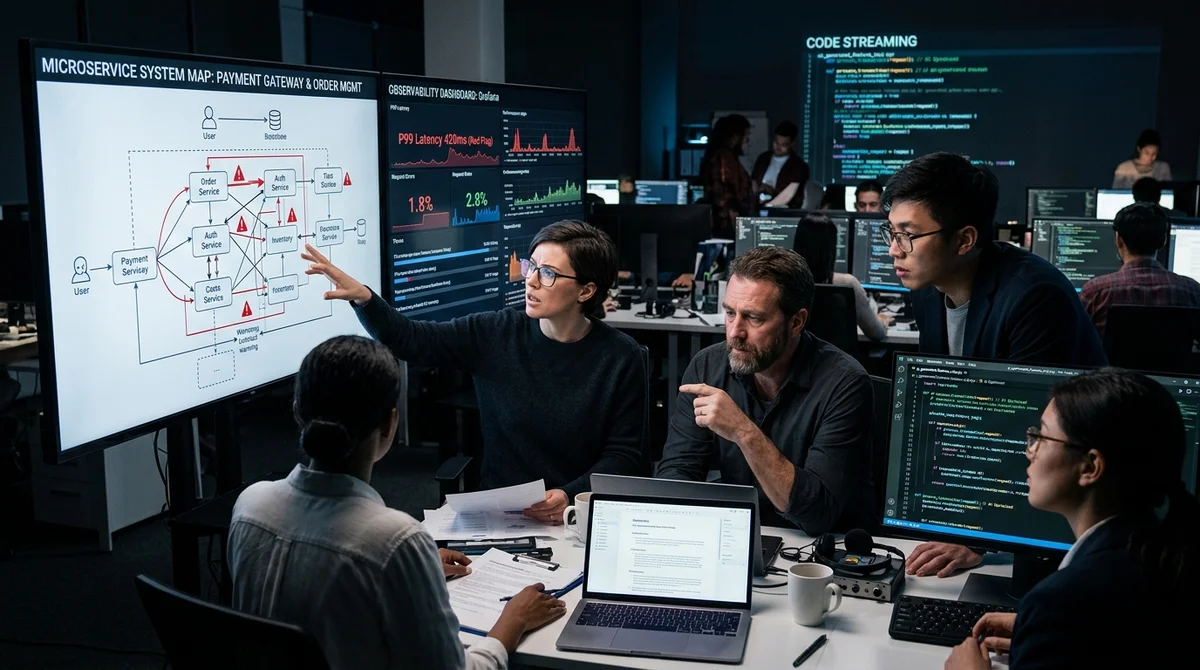
AI has rapidly accelerated code production, but for Go teams this has not simplified life: the faster new services and features appear, the more architectural decisions, agreements, and system boundaries lag behind. It is precisely this gap between development speed and the ability to maintain platform integrity that becomes one of the main engineering challenges of 2026. Against this backdrop, the Ontiko team is shifting the focus of GolangConf 2026.
The conference is no longer presented as a collection of disparate talks about technology in general. Organizers propose discussing what teams encounter daily: how to design services amid constant growth, how not to be overwhelmed by complexity after another wave of automation, and how to reshape engineering practice so that fast code does not turn into slow business. Over recent years, the industry has indeed learned to assemble microservices quickly, shift load, and try new tools relatively painlessly.
But along with this, the illusion has disappeared that growth automatically makes a team mature. The cheaper and faster implementation becomes, the more expensive mistakes at the platform level are. The first direction for Go teams is architecture.
Generative tools help write handlers, integrations, and internal utilities faster, but they do not make for the team key decisions about domain boundaries, contracts between services, migration rules, and acceptable component coupling. As a result, code can appear faster than system interaction schemas and technical principles can be updated. For teams this means growth in hidden dependencies, release complexity, and more costly errors in later stages.
Where weeks of discussion used to be spent on one service, now in the same days you can get a ready-made framework, API, and wrapper. But if these pieces are built without a unified data model and clear boundaries of responsibility, the team gets not acceleration but accumulation of debt. Later this comes back as painful refactorings, service conflicts, and complex incidents where no one can quickly identify the source of the problem.
The second direction is scaling and operational resilience. Go has long been established as a language for high-load systems, infrastructure services, and internal platforms, but today scaling is not limited to traffic alone. Requirements for observability, predictability of service behavior, and support costs are growing.
When there are more products and changes come more often, weak points show up faster: non-obvious contention points, fragile queues, failed retries, sprawling configs, complex dependency chains between teams. This is especially noticeable in distributed systems, where even a small change in one area can unexpectedly hit latencies, queues, or infrastructure costs in another. At this stage, a simple answer of "let's just write faster" is no longer enough.
The third direction is the organization of engineering work itself. If AI reduces time on routine implementation, then value shifts toward architecture review, context exchange, unified standards, and strong technical communication. Teams need not just adopt new tools, but learn to live in a mode where code is generated easily, and responsibility for solution quality remains with people.
Hence the interest in a new format of professional meetings: not to retell slides, but to jointly analyze real cases, compromises, and failures that prevent teams from moving forward. This also changes requirements for developers: what is valued is not someone who simply writes new code the fastest, but someone who sees the system as a whole, knows how to set constraints, and stops dangerous complexity in time. This is why professional communities are also forced to reconsider their communication format.
For the Go ecosystem this is an important signal. The industry has entered a stage where competitive advantage comes not from code writing speed alone, but from the ability to maintain architecture in working order amid constant development acceleration. If GolangConf 2026 truly focuses on these pains, the conversation about Go will become noticeably more mature: less abstract discussion about AI hype and more practice on how to build systems that survive growth, automation, and complexity without losing manageability.
Want to stop reading about AI and start using it?
AI News is a curated feed of AI/tech news. Hamidun Academy teaches you to use AI systematically in your work.