Sova AI Released Android Assistant That Controls Phone Without PC and Root
Sova AI unveiled an Android assistant that controls applications directly on a smartphone without ADB, USB, root, or computer connection. The agent operates…
AI-processed from Habr AI; edited by Hamidun News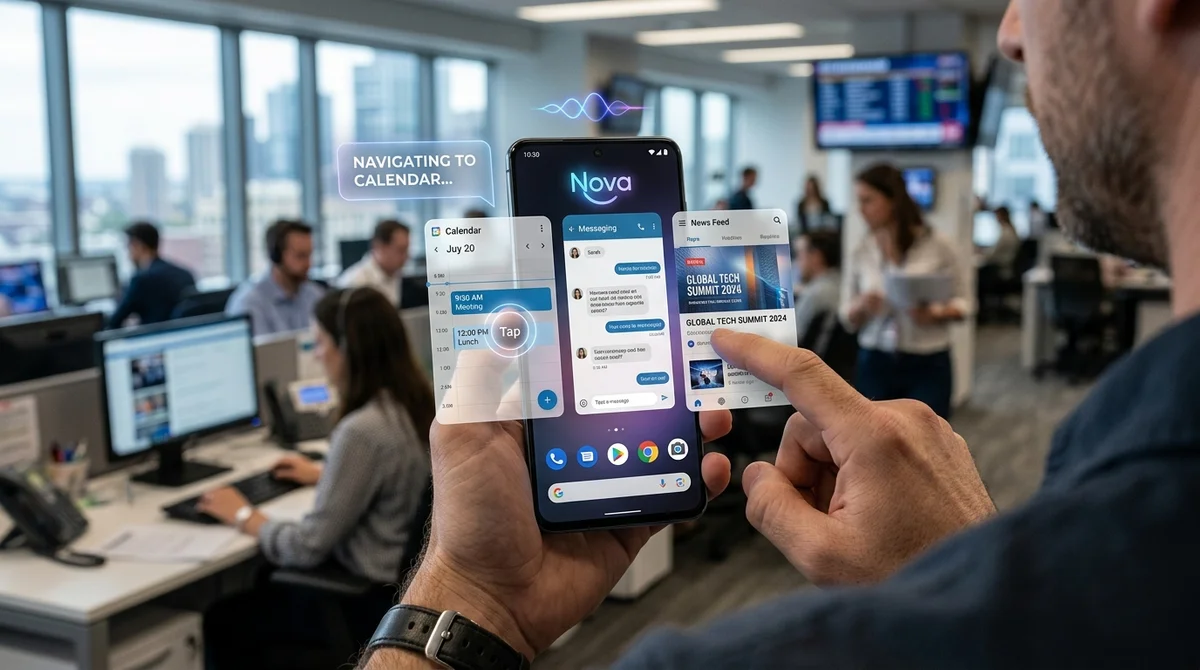
Sova AI is trying to occupy a niche that major players have not yet properly addressed: creating an AI assistant that does not just answer requests but actually operates within Android applications directly on a smartphone. The project is positioned as the first mobile agent of this type that requires neither ADB, nor USB connection, nor root, nor a link to a PC. The user installs a regular application, optionally assigns it as a system assistant, and can issue voice or text commands, after which the agent itself opens the necessary services, clicks buttons, scrolls screens, and performs steps the way a human would.
Sova AI's main bet is not on yet another chat interface, but on the idea of constant presence in a mobile device. There are already solutions in the mobile-use category on the market, but many of them still require connecting the phone to a computer, debugging via cable, or other technical workarounds. For a regular user this is inconvenient: if a PC is already available nearby, it makes more sense to delegate the task to a classic computer-use or browser-use.
The project's authors proceed from a different scenario: the phone should remain an independent environment where an assistant can perform routine actions at any moment—on the way, in line, between meetings, or in a situation where a laptop is simply not at hand. Technically, the agent relies on the Android Accessibility API. This allows it to see the screen structure through the interface tree, find controls, and reproduce user actions: clicks, scrolling, navigation between applications, and other basic steps.
However, the developers specifically emphasize that screenshots alone are not sufficient for such a task. Models do not always stably interpret interface images, process image quality differently, and can make mistakes on small elements. Therefore, in Sova AI they created a hybrid approach: data from the screen tree is combined with visual context to increase accuracy while simultaneously not inflating the token consumption per operation.
This economic aspect is no less important for the product than the automation magic itself. If a mobile agent is to be capable of performing many steps within applications, the cost of each scenario quickly becomes critical. The creators of Sova AI directly state that they tried to avoid a situation where the user spends too many resources on a trivial action like ordering food or completing a short everyday task.
Hence the focus on combining structural data with images rather than a pure vision approach. Additionally, the agent can be assigned as the default assistant to launch it by voice and immediately translate the command into action rather than into yet another response in the style of "I cannot interact with applications." There is particular interest here in the fact that Sova AI offers a more strict definition of the word "assistant."
Over the past two years, the market has been filled with services that do a good job of summarizing, searching, advising, and supporting dialogue, but stop at the boundary of real action. Sova AI is trying to shift that boundary and turn the smartphone into a platform for an agentic interface, where AI not only explains what needs to be done but itself performs the necessary sequence of steps. For now, the project is available on Android, with an iOS version in development, which makes sense: Android today provides more space for such integration.
The conclusion is simple: Sova AI demonstrates where the next wave of consumer AI products can move—from conversational assistants to execution agents. If such an approach proves sufficiently reliable, fast, and affordable, mobile-use will have a chance to become a separate mass market segment rather than a demonstration for developers. But along with convenience, requirements for accuracy, privacy, and control over permissions will inevitably grow.
For the user, this is no longer just chat, but software that gains access to the phone's interface and acts on its behalf.
Want to stop reading about AI and start using it?
AI News is a curated feed of AI/tech news. Hamidun Academy teaches you to use AI systematically in your work.