US Justice Department to Appeal Court Decision Blocking Anthropic Ban in Federal Agencies
The Trump administration continues to pursue a ban on Anthropic technology in federal agencies. After a court temporarily blocked this restriction, the US…
AI-processed from Bloomberg Tech; edited by Hamidun News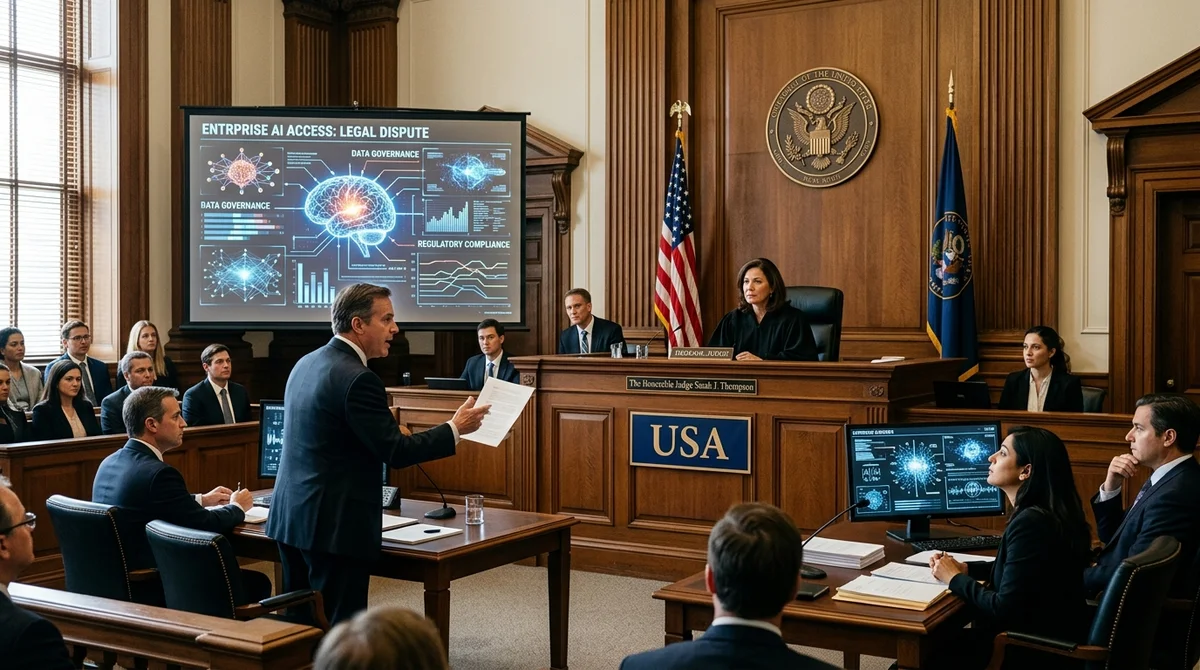
The Donald Trump administration is not backing away from its attempt to block federal agencies' access to Anthropic technologies: after a court decision that suspended this ban, the U.S. Department of Justice is preparing to file an appeal. This means that the dispute surrounding one of the largest generative AI developers in the United States has not ended, but is moving to the next stage of litigation. While the restriction is currently blocked, the White House's position remains unchanged—to push for a revision of the rules governing federal agencies' use of Anthropic's solutions.
It is known that a federal court previously stopped the administration's ban on the use of Anthropic AI in the government sector. Now the Department of Justice, representing the government's interests in court, will challenge this decision. In essence, this is not about a private corporate conflict, but about the question of whether executive power can unilaterally restrict government agencies' access to a specific AI supplier if the court sees legal problems with such a move.
Pending the appeal hearing, the interim court order preserves Anthropic's ability to remain in the field of government contracts and pilot projects. In practical terms, such disputes rarely stop at a single formulation in a court document: they affect tenders, pilot project approvals, internal security regulations, and officials' willingness to take responsibility for launching new systems. Therefore, the dispute surrounding Anthropic matters even to agencies that have not directly worked with the company's products: the court's decision could determine the overall approach to admitting external AI services to the government sector.
The stakes are high for Anthropic: the company is among the most prominent players in the generative AI market and is competing for corporate and institutional clients who prioritize security, model manageability, and regulatory compliance. The use of such systems in the government sector typically involves not only chatbots, but also document analysis, draft preparation, search across large data arrays, internal process automation, and employee support. Therefore, any formal ban from Washington affects not only the supplier's reputation but also the procurement market, where solutions from major AI companies are gradually becoming part of everyday infrastructure.
The available information does not reveal either the specific motives behind the administration's ban or the judge's reasoning for temporarily stopping it. But the very fact of the appeal shows that the dispute likely touches on principles important to the government—from AI deployment control to government procurement procedures and risk assessment when working with external models. For agencies, this creates a period of uncertainty: legally, the immediate ban is not in effect, but the final framework has not yet been determined.
For Anthropic's competitors, the signal is also notable: relations between the state and AI platforms in the United States may be shaped not only through contracts and regulatory recommendations, but also through direct legal conflicts. It is also important that such cases typically extend far beyond a single company. If the appeals court supports the administration, it will strengthen the federal government's ability to selectively restrict the use of individual AI suppliers in government agencies. If the first instance decision holds, developers will have stronger legal ground to challenge such bans.
In both scenarios, we are talking about a precedent that will be carefully studied not only at Anthropic, but also at OpenAI, Google, Microsoft, and other market participants working with government customers. The main conclusion is simple: the Anthropic story is no longer a dispute about a specific product, but a test of who and by what rules will decide the fate of AI in the American government sector.
For now, the court has temporarily stopped the ban, and Anthropic retains a window for working with the government. But the Department of Justice's appeal shows that the White House is ready to escalate this dispute to a higher court, which means the ultimate decision could affect the entire U.S. government AI procurement market.
Want to stop reading about AI and start using it?
AI News is a curated feed of AI/tech news. Hamidun Academy teaches you to use AI systematically in your work.