Talkie-1930: Researchers released a 13B model with no knowledge of the internet and World War II
Researchers released Talkie-1930, a 13B open-weight model trained only on English texts through the end of 1930. It has no knowledge of the internet or World…
AI-processed from MarkTechPost; edited by Hamidun News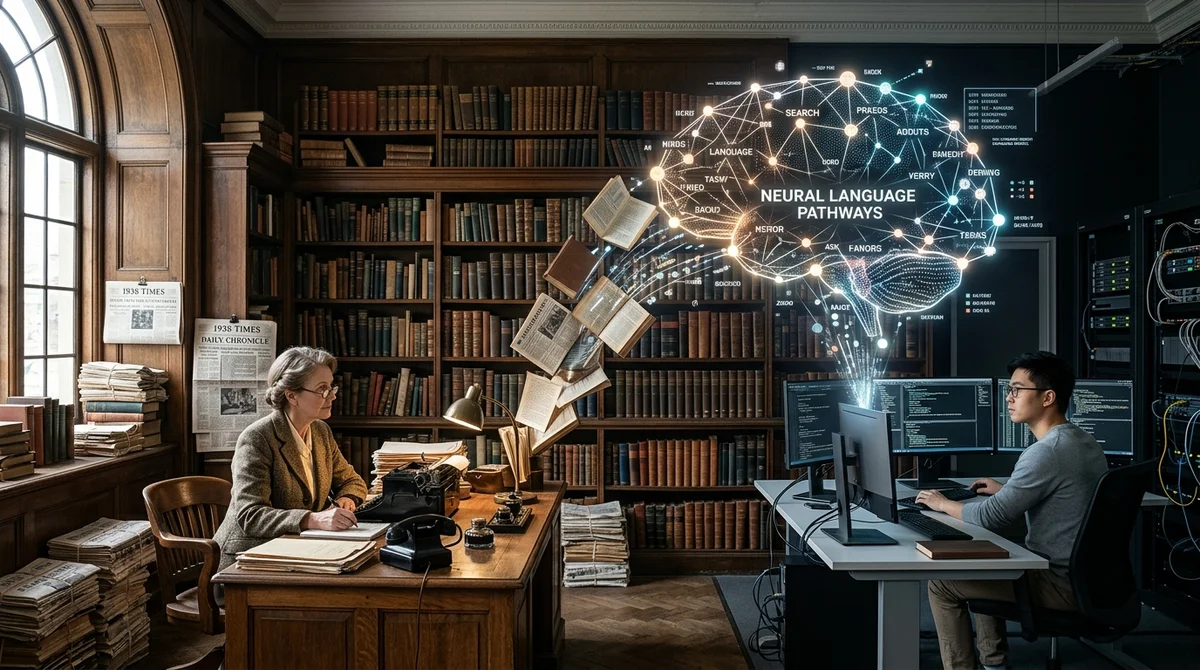
Talkie-1930 — a rare experiment that attempts to roll back a language model to the intellectual context of the early 20th century. This open 13-billion-parameter model was trained solely on English-language texts published before December 31, 1930, so it knows nothing about the internet, smartphones, or World War II as an accomplished fact. Instead of yet another all-knowing chatbot, researchers created a clean testbed to verify how a model reasons, predicts, and generalizes when its worldview is strictly fixed at a single historical point.
The project was presented by a team led by Nick Levin, David Duvenaud, and Alec Radford. The base version talkie-1930-13b-base was trained on 260 billion tokens from books, newspapers, magazines, scientific articles, patents, and legal documents. A separate conversational checkpoint talkie-1930-13b-it is also available, fine-tuned for dialogue.
Both versions are released with open weights under the Apache 2.0 license. The authors additionally collected a "contemporary twin" with the same architecture and computational budget but trained on the FineWeb corpus, allowing them to compare not abstract models from different eras, but nearly identical systems on different types of data.
The primary value of Talkie-1930 lies not in retro style but in research purity. Modern LLMs almost inevitably suffer from contamination — when test tasks, benchmark fragments, or closely related data have already seeped into training. A vintage model by definition has less of this problem: if a benchmark describes events or technologies after 1930, Talkie could not have seen them in advance.
This makes it convenient to test how far a model can genuinely generalize beyond its corpus. The authors, for example, tested whether it could write Python code from a few examples in context, even though Python and digital computers were absent from its training data. The results so far are weak, but the very fact of occasional correct answers shows that the model can borrow solution structure rather than merely copying learned templates.
The team also uses Talkie-1930 as a tool for temporal and historical assessments. In one experiment, the model measured the "surprisingness" of brief descriptions of real events from The New York Times archive: after the 1930 cutoff point, stories become noticeably less predictable for it, especially events from the 1950s and 1960s. This provides a neat way to study how models "see" the future from the past and how their forecasting ability changes over long time distances.
Another intriguing question is what exactly shapes a model's personality. Nearly all modern LLMs stem in some way from web data; Talkie breaks this lineage and allows separation of properties inherent to the language model itself from the peculiarities of the internet as a training environment.
From a technical standpoint, the project proved far more complex than simple date filtering. The most dangerous risk is temporal leaks: misdated documents, contemporary editorial introductions to old books, or late footnotes can surreptitiously introduce knowledge from the future into the corpus. The authors built an anachronism classifier at the document level, but acknowledge it is imperfect: early versions of the model knew about Franklin Roosevelt's presidency and New Deal reforms, and the 13B checkpoint retains scattered knowledge about World War II, the UN, and postwar German reconstruction.
Equally painful is the quality of text recognition. Since digital publishing infrastructure did not exist in 1930, the entire corpus had to be assembled through OCR. In controlled tests, standard OCR yielded only about 30% training efficiency compared to human transcription of the same texts; simple regex-based cleaning raised this to roughly 70%, but a large gap remained.
To prevent the conversational version from picking up modern habits, post-training also had to be built from scratch. Instead of typical instruction datasets, the team extracted "instruction-answer" pairs from historical references: etiquette manuals, letter-writing guides, cookbooks, dictionaries, encyclopedias, fable and poetry collections. The model was then improved through online DPO using a modern LLM as judge; by internal assessment, instruction-following improved from 2.0 to 3.4 out of 5 points.
The authors plan to scale the corpus to over 1 trillion tokens, expand it beyond English, and release a vintage-model equivalent to GPT-3 by summer 2026.
In the final analysis, Talkie-1930 matters not as a nostalgic chatbot but as a laboratory for testing fundamental questions about AI: what the model genuinely understands, what it merely memorized, how far it can generalize without hints from the future, and how much the web has shaped the character of modern LLMs. If the project can reduce leaks and OCR noise, researchers will gain one of the cleanest tools for studying the boundaries of generalization in language models.
Want to stop reading about AI and start using it?
AI News is a curated feed of AI/tech news. Hamidun Academy teaches you to use AI systematically in your work.