MarkTechPost Demonstrates How to Build a Lightweight VLA Agent with Latent World Model and MPC
MarkTechPost released a practical tutorial on building a lightweight embodied agent in the spirit of VLA. In the example, the agent observes not symbolic…
AI-processed from MarkTechPost; edited by Hamidun News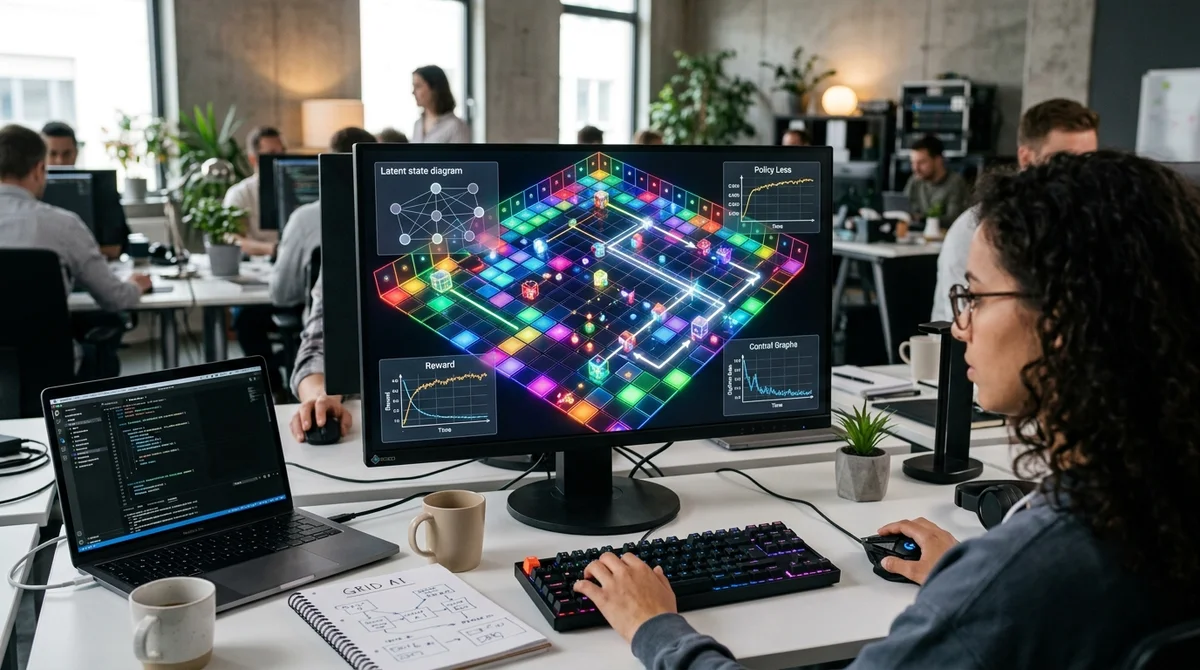
MarkTechPost published a detailed tutorial on how to build a compact embodied agent that perceives the environment through images, constructs an internal world model, and plans actions using model predictive control. The analysis focuses not on a ready-made industrial robot, but on a simulation where you can clearly see how a cycle of perception, prediction, planning, and replanning emerges from raw pixels. This format is particularly valuable now, when there is a lot of noise around Vision-Language-Action systems, but few short and transparent examples showing how these ideas work at the architecture level.
The basis of the example is a completely rendered grid world in NumPy. Instead of symbolic state variables, such as agent coordinates or obstacle maps, the system receives regular RGB frames. This brings the task closer to real embodied scenarios, where an agent cannot simply read an ideal description of the world, but must extract structure from a visual stream.
Even in a simple environment, such a transition changes the very problem statement: now the model must not only choose an action, but first understand what exactly it sees. Because of this, the tutorial clearly shows how pixel agents differ from classical systems that work with pre-prepared environment state. For the reader, this is also a convenient entry point to the topic: you can trace the entire path from a frame at the input to a decision at the output without complex mathematics and cumbersome infrastructure.
The next layer is a lightweight latent world model. The observation is first encoded into a compact internal representation, after which the model learns to predict how this state will change under the action of the chosen command. This allows planning not in pixel space, where everything is too cumbersome and noisy, but in a more compressed latent space.
In practical terms, the agent gains the ability to quickly simulate several possible future trajectories and compare them without direct enumeration of images frame by frame. This is where the key idea of a world model becomes clear: the system first learns to internally "imagine" how the environment will unfold, and then uses this imagination to choose the next step. Such an approach also makes agent behavior more interpretable: an engineer can separately examine encoding quality, accuracy of dynamics prediction, and overall planning.
For action selection, the authors incorporate model predictive control, or MPC. The logic is simple: the agent does not fix one long plan in advance, but at each step evaluates several candidates, predicts their consequences through the world model, and selects the best short-term scenario. After a new observation, the calculation is performed anew, so behavior can be adjusted as the situation changes.
The result is a simplified, but very demonstrative cycle of perception, prediction, and replanning.
The practical value of such material lies in the fact that it breaks embodied AI into understandable blocks without heavy simulators, robotics frameworks, or large multimodal models. This is especially useful for researchers, students, and engineers who want not just to run ready-made demos, but to understand how perception, world modeling, and control are connected in a single system. At the same time, the authors do not hide the limitations of the approach: this is an educational environment, not a ready system for the physical world, and precisely because of this, the architectural logic is clearly visible, which can later be transferred to more complex scenarios.
The main conclusion from MarkTechPost's analysis is simple: you can understand embodied agents without a giant stack if you build a small, but honest system where visual perception, latent world model, and MPC work together. For engineers, this is a useful way to quickly test basic ideas of world modeling and planning, and for the AI market—another reminder that progress in agent systems depends not only on model size, but on how well they can predict the environment and make decisions in a closed loop.
Want to stop reading about AI and start using it?
AI News is a curated feed of AI/tech news. Hamidun Academy teaches you to use AI systematically in your work.