Habr: How synthetic data helps train models, and why self-training leads to collapse
The AI industry is leaning ever more on synthetic data as a substitute for expensive, scarce human data. It speeds up training, helps cover rare scenarios and lets teams scale experiments. But if a model trains too long on its own generations, it risks model collapse: the distribution narrows, rare cases disappear, answers grow monotonous, and transfer to new tasks gradually worsens.
AI-processed from Habr AI; edited by Hamidun News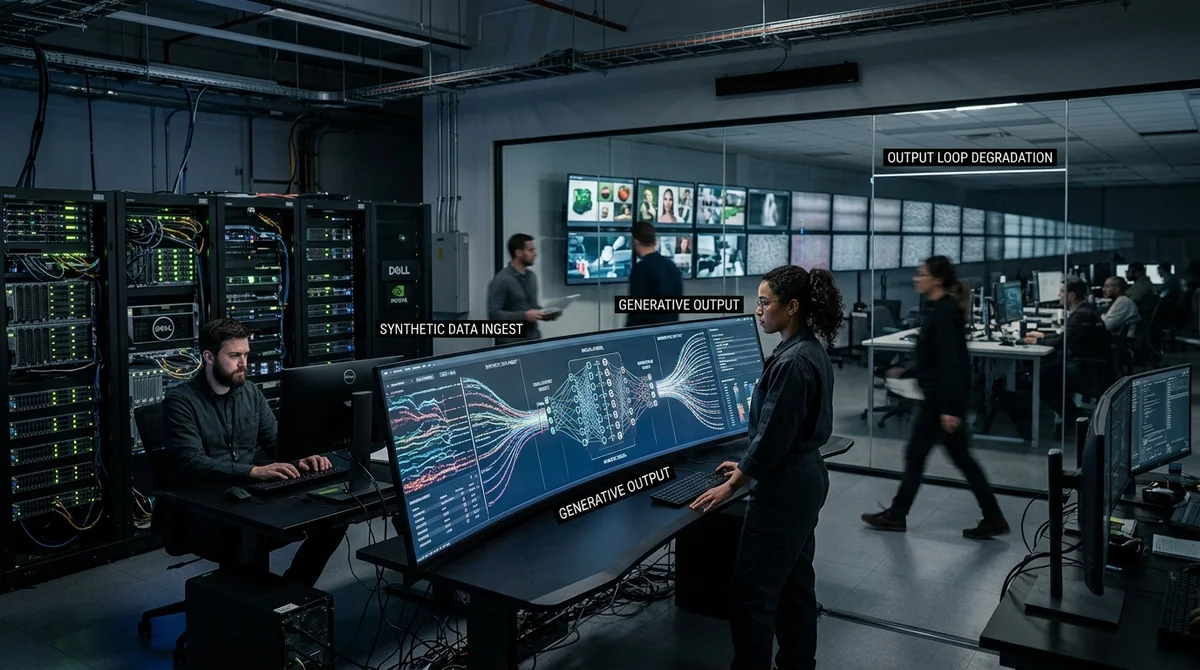
For the AI industry, synthetic data is not a fashionable trick but a way to keep models growing despite a shortage of high-quality human data. Compute can be bought, but good data keeps getting more expensive, is cleaned slowly, and often runs into limits on privacy, copyright and availability. So companies increasingly create data themselves: they generate texts, dialogues, images, annotations and scenarios, then use them for further training. This does work, but only up to the point where the model starts to close in on its own outputs and gradually loses touch with the real distribution of the world.
The reason is clear: most of the open internet has already been drained, new datasets are expensive, and quality requirements keep rising. For a strong model, it is not enough to simply collect billions of tokens; you also have to remove junk, duplicates, errors, legally questionable fragments and incidental toxicity. Against this backdrop, synthetic data looks like nearly ideal fuel. It can be produced quickly, for a specific task and with the desired class balance. If a system lacks examples of rare refusals, long dialogues, specialized instructions or edge cases, synthetic data can fill those gaps much faster than manual collection and labeling.
This is where self-training comes in: a model is trained on answers that it, or another model of the same family, generated earlier. In moderate form, the approach is useful. First a strong system creates draft examples, then a stricter filter, a rule or a human weeds out the weak ones, and the final set goes into training. This makes it possible to scale instructions, synthesize rare combinations of features and obtain extra data where humans cannot keep up with the pace of experiments. In applied work it is especially valuable for testing assistants, training systems on formal rules and balancing datasets where real observations are skewed from the start.
Problems begin when the recursion stops being controlled. If a model learns from its own generations many times in a row, it amplifies not only useful patterns but also its own distortions. The most common answers become even more probable, while rare, noisy and nonstandard cases are washed out.
This is what is called model collapse: the data distribution collapses, diversity falls, and the system sees the boundaries of reality less well. From the outside the degradation may not look dramatic, since the model still writes smoothly and confidently, but inside it loses depth. It encounters unexpected examples less often, transfers knowledge to new domains worse and more often reproduces an averaged version of the world in which everything complex has been erased.
That is why synthetic data is useful not as a full replacement for human data but as a layer on top of it. A working scheme usually looks like this: the real corpus sets the reference distribution, synthetic data expands coverage, and quality control keeps the model from sliding into a closed loop. This requires validation on independent sets, admixtures of fresh human data, checks on rare cases and filters that discard overly formulaic generations.
The higher the share of synthetic data, the more important it is to remember that quality here is determined not by volume but by diversity and closeness to reality. Otherwise a quick gain in cost and speed turns into hidden degradation, which may be noticed only when the product has already started performing worse for real users.
The main takeaway is that synthetic data and self-training do not eliminate the data problem; they only change how it is handled. They are a powerful accelerator if used in measured doses and under control. But if generation becomes an endless mirror, the model will start learning not from the world but from its own statistical shadow. In the next stage of AI development, the winners will not be those who simply synthesize more, but those who manage to keep contact with reality and with the diversity of the source data.
Test Frontier LLMs & Autonomous Agents in One Workspace
Run Claude Opus 5.5, GPT-6, Gemini 3.1, and DeepSeek side-by-side in Nomad AI (nomadnet.ai) — unified model routing, deep research, and multimodal workflows under one subscription.
The AI world, distilled — once a week
Seven stories that actually mattered, hand-picked. No noise, no reposts, no press releases.
Done! Check your inbox for a confirmation.