Why AI in UI Design Matters Not for Production, but as a Source of Visual Mutations
AI-generated UI doesn't need to become a production-ready mockup immediately. Its real value lies elsewhere: the neural network rapidly generates rare visual…
AI-processed from Habr AI; edited by Hamidun News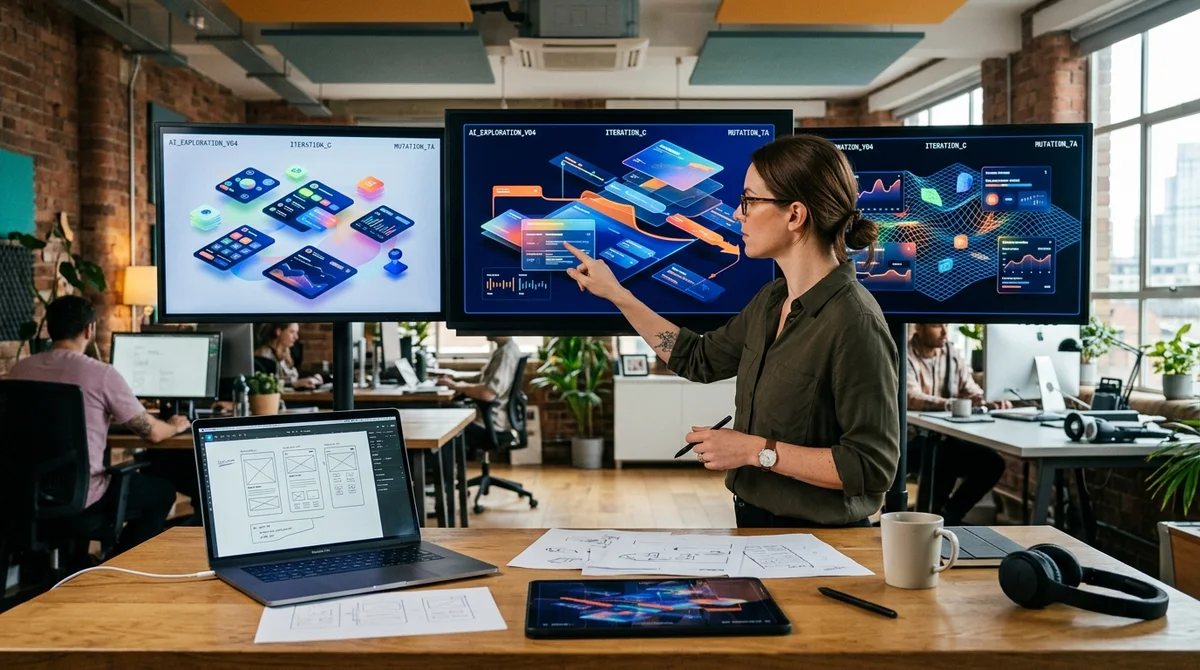
AI-generated UI should be viewed not as an almost-ready interface, but as a machine for finding unexpected visual moves. Its main value often lies not in immediately handing the screen over to development, but in quickly showing combinations of forms, rhythms, and accents that a designer might otherwise reach only after considerably more time. Usually, the conversation about interfaces created by neural networks falls into two extremes.
The first is whether the result can go straight to production. The second is how closely it resembles familiar systems like Apple Human Interface Guidelines or Material Design. Both perspectives are too narrow.
They force us to view the AI image as a semi-finished product, when it's often raw, unstable, and unpredictable research material. Its strength lies not in reproducibility, but in the ability to quickly generate variations that break habitual thought patterns. Even failed generations are useful: they show which visual solutions look too cluttered, where hierarchy breaks down, and which effects work only as a singular attraction.
This is precisely why AI-generated UI is worth studying as a source of visual mutations. By mutations, we can mean rare combinations of grids, density, contrast, decorative layers, microforms, and compositional accents that may not be good in themselves, but can illuminate a new direction. A person working manually usually moves through familiar patterns, past references, and internal team or product constraints.
The model, however, massively produces intermediate forms and sometimes lands in an unexpected spot—strange, uneven, but visually alive. From ten or hundred such deviations, one result can deliver a stronger impulse than a carefully assembled moodboard. For product teams, this is especially important at stages when they need not to choose the best pixel variant, but to notice altogether that a different type of interface character is possible.
From this emerges a more important shift in the designer's role. Previously, a strong initial image usually arose inside the author's head: they themselves sought the idea, developed it, and then turned it into a system. With generative tools, the entry point shifts outward.
The machine increasingly offers the initial visual impulse, and the human already works as an editor and systematizer: selecting successful deviations, cutting away excess, normalizing composition, checking applicability, and translating a striking image into the language of the product. In essence, the designer competes less and less with the machine in the speed of the first sketch and increasingly wins through interpretation, editing, and the ability to turn a random form into a consistent rule. This does not diminish design qualifications; on the contrary, it raises requirements for taste, visual literacy, and the ability to distinguish a one-time visual trick from the seed of a sustainable system.
The practical meaning of this approach is that AI-generated UI is better integrated not into the final assembly of layouts, but into early stages of exploration. It can accelerate the search for options, expand the range of solutions, and help the team move beyond overly safe moves. But then human work is still needed: to check scenarios, accessibility, consistency, technical feasibility, and brand alignment.
Otherwise, the mutation remains just a beautiful anomaly. Value emerges when the designer does not copy the model's result, but extracts a principle from it: an unusual rhythm, contrast, navigation structure, work with depth, or a new logic of grouping elements. Herein lies the main conclusion: the value of AI-generated UI today lies not so much in the automatic production of screens, but in the delivery of external visual deviations from which new interface solutions can grow.
The sooner teams stop measuring such results only by production-readiness and similarity to existing design languages, the sooner they will see in AI not a replacement for the designer, but a tool for the directed evolution of the visual system.
Want to stop reading about AI and start using it?
AI News is a curated feed of AI/tech news. Hamidun Academy teaches you to use AI systematically in your work.