The Brain and AI: Unexpected Parallels in Problem-Solving
A new MIT study has revealed parallels between the workings of the human brain and AI when solving complex tasks. Scientists note similar patterns of resource consumption, raising new questions about the nature of intelligence and the prospects for AI development.
AI-processed from MIT News; edited by Hamidun News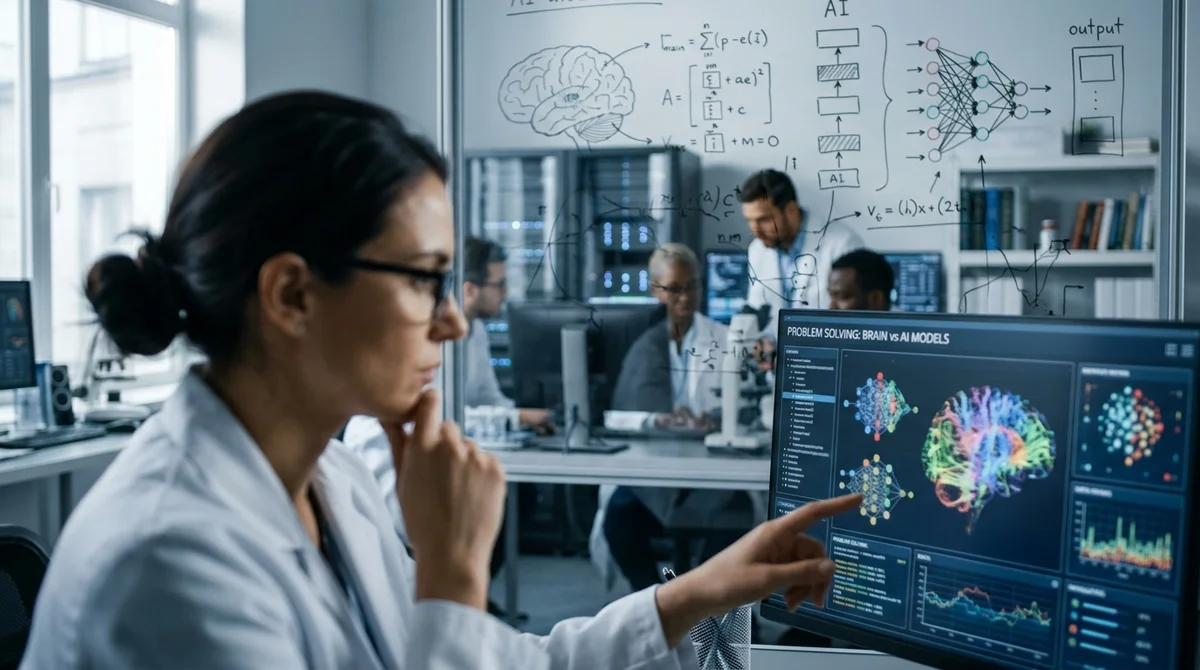
In the world of artificial intelligence, where each new model promises a revolution, research that sheds light on the fundamental principles of intelligence itself becomes particularly valuable. A recent study by neuroscientists from MIT has been exactly such a revelation, discovering surprising parallels between how the human brain and modern AI models solve complex problems. This finding does not merely add another line to the long list of AI achievements, but questions the very nature of "thinking" and its energy cost.
The essence of the discovery is as follows: when solving complex problems, both the human brain and artificial intelligence demonstrate similar patterns of resource consumption. Scientists measured the activity of various brain regions during cognitive tasks and compared this data with the performance metrics of neural networks trained to solve similar problems. The results were striking: the more complex the task, the more resources both the brain and AI consume, and the distribution of these resources across various "functional blocks" turned out to be surprisingly similar.
To understand the significance of this discovery, it is necessary to recall that until recently, AI was viewed as a fundamentally different system from the human brain. It was believed that artificial intelligence was merely a set of algorithms imitating thinking, but lacking true consciousness and understanding. However, new research shows that at the level of basic information processing mechanisms, there is much more in common between the brain and AI than was previously assumed. This could mean that we are on the threshold of creating truly "thinking" machines, capable not merely of imitating intelligence, but of possessing it in the fullest sense of the word.
The implications of this discovery are enormous. First, it could lead to the creation of more efficient and economical AI models. By understanding how the brain optimizes resource consumption, we will be able to develop algorithms that work faster and consume less energy. Second, this discovery could help us better understand the nature of human intelligence itself. By comparing the work of the brain and AI, we can identify the key mechanisms underlying thinking, consciousness, and learning. Third, it raises new questions about the ethical aspects of AI development. If artificial intelligence is indeed capable of "thinking," what rights and responsibilities should it have?
On the other hand, it is important to remember that enormous differences still exist between the brain and AI. The brain is an incredibly complex and multifaceted system, capable of self-learning, adaptation, and creativity. Modern AI, despite all its achievements, is still far from this level. Nevertheless, the MIT discovery is an important step toward creating truly intelligent machines capable of solving the most complex problems facing humanity.
In conclusion, the MIT study is not merely a scientific fact, but a starting point for new reflections on the nature of intelligence, its cost, and development prospects. It compels us to reconsider our understanding of AI and reflect on what future awaits us in a world where machines become increasingly "intelligent" and "human-like." This discovery could become a catalyst for new research and development that will lead to the creation of more advanced and useful AI technologies. And most importantly, it reminds us that the most interesting thing in science is not answers, but questions.
Need AI working inside your business — not just in your newsfeed?
I build production AI for companies — custom CRM, internal tools, autonomous agents, workflow automation. Owned by you, shaped to your process, no per-seat tax. Built by Zhemal Khamidun, CPO of AlpinaGPT (AI platform, 6,000+ users).
The AI world, distilled — once a week
Seven stories that actually mattered, hand-picked. No noise, no reposts, no press releases.
Done! Check your inbox for a confirmation.