Japan Airlines deploys humanoid robots at Haneda Airport to tackle labor shortage
Japan Airlines is launching a pilot project in May: humanoid robots will operate in the baggage-handling area at Tokyo's Haneda Airport. The experiment comes…
AI-processed from Guardian; edited by Hamidun News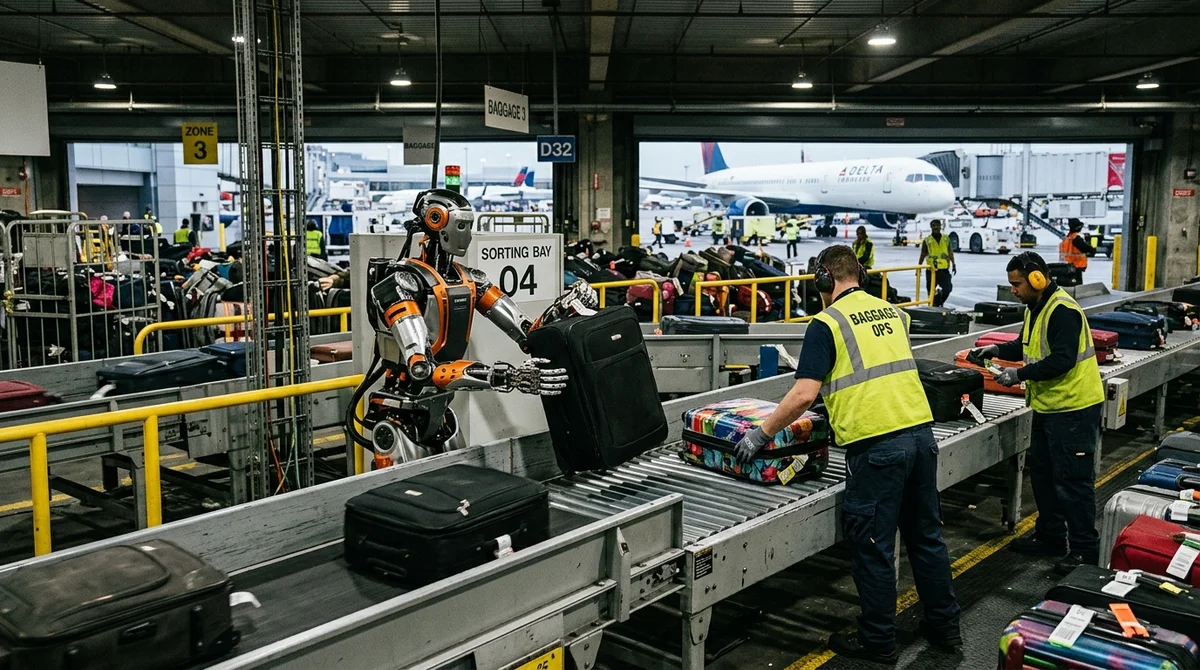
Japan Airlines launches baggage-handling robots at Haneda Airport in response to labor crisis
Japan Airlines is launching a pilot project with humanoid robots in the baggage handling area of Tokyo's Haneda Airport starting in May. The airline views it as a first step toward permanent deployment of humanoid machines—as a response to one of the most acute structural problems in Japan's economy. Japan is facing a double blow.
On one hand, there is a sharp rise in inbound tourism, which is straining airport infrastructure. The number of foreign tourists in the country has been setting records in recent years: Japan's popularity has grown several-fold, partly due to the weakening yen. Haneda and Narita are unable to cope with the flow—queues, delays, and overstaffed personnel have become the norm.
On the other hand, there is a structural labor shortage that has accumulated over decades due to an aging population and traditionally low immigration levels. The country is losing working-age citizens faster than it can adapt. Baggage handlers have turned out to be among the most vulnerable professions.
The work is physically demanding, shift-based, in tight technical zones—and not particularly attractive in terms of wages. Young people are increasingly choosing not to pursue such specialties, and Japan is not yet ready to compensate for the shortage through foreign labor on the necessary scale: it is a politically sensitive issue. Japan Airlines, one of the country's two flagship carriers, decided not to wait for a demographic turnaround and bet on technology.
The robots that will appear at Haneda in May are humanoid machines capable of performing tasks that traditionally require hands and feet: moving suitcases, loading and unloading carts, working in spaces originally designed for people. It is precisely the humanoid form that has practical value here: such robots fit into existing infrastructure without costly redesign. The pilot is being launched with clear limitations.
Robots need regular charging breaks—their autonomy is currently measured in hours, not full shifts. The airline is not setting out to replace all employees: it is about an assistant that takes on the most monotonous and physically demanding operations, while people focus on tasks requiring judgment, communication, and non-standard solutions. If the experiment proves viable, Japan Airlines plans permanent deployment of robots as a long-term solution to staffing issues.
Haneda is one of the world's busiest airports. Even partial automation of baggage handling could reduce the workload on staff and speed up flight turnaround during peak hours. Japan as a whole is moving toward widespread robot use—not out of love for technology, but out of necessity.
The country has been leading in industrial robot density in manufacturing for decades, and is now gradually extending this experience to the service sector. Restaurants, hotels, hospitals, shops—humanoid and specialized machines are appearing where people are physically lacking or where they do not want to work. Japan Airlines' experiment sends a signal not just to Japan's industry.
Labor shortages at airports are a global problem, familiar to Europe, the US, and the Gulf states. If baggage-handling robots prove reliable in real conditions—with peak-hour overloads, non-standard luggage, and unexpected situations—the technology will gain a strong argument for scaling worldwide. Tokyo risks becoming not just a pioneer, but also setting a new operational standard for aviation.
Want to stop reading about AI and start using it?
AI News is a curated feed of AI/tech news. Hamidun Academy teaches you to use AI systematically in your work.