How to Build a Netflix Void Pipeline for Object Removal from Video Using CogVideoX
A new guide shows how to build a Void pipeline for removing objects from video based on CogVideoX. The material covers environment setup, loading the base…
AI-processed from MarkTechPost; edited by Hamidun News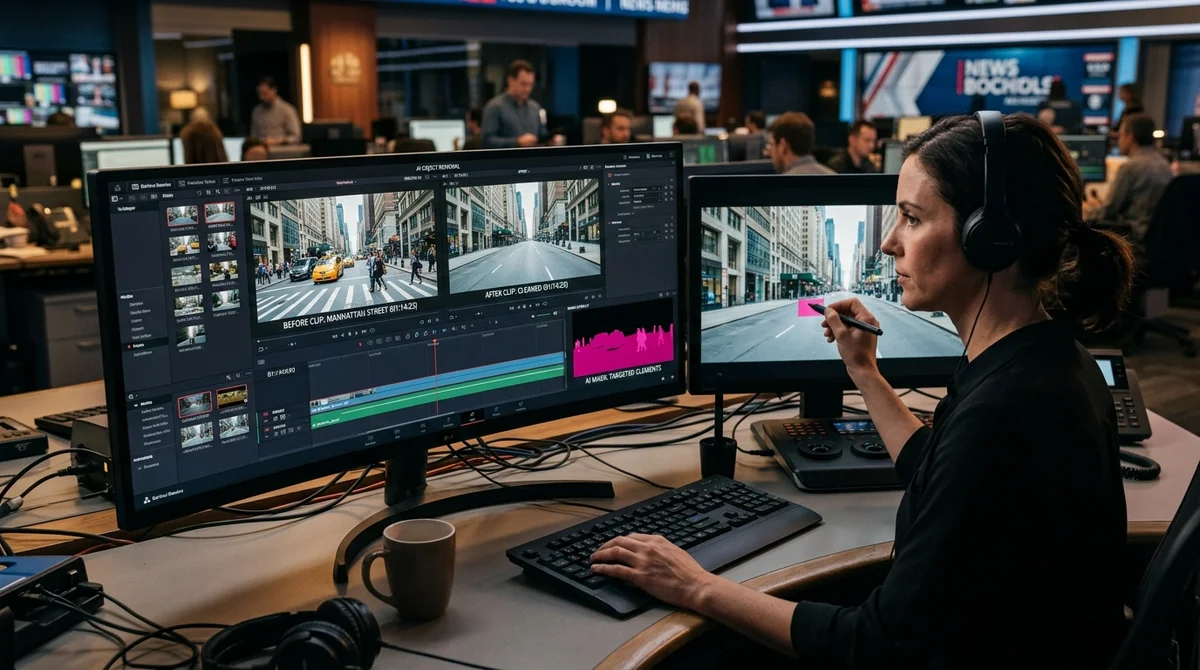
The article discusses a step-by-step guide to building a working pipeline for video object removal based on Netflix's Void model, covering everything from dependency installation and weight loading to running a complete inference chain with custom prompts and ready examples. For teams dealing with post-production, generative editing, and video editing, the focus is not on demonstrating quality itself, but on a reproducible process that can be set up locally, tested on sample data, and adapted for their own production needs. At the core of the material is the Void model, designed for video object removal and inpainting tasks—that is, removing unwanted objects from frames while reconstructing the background and motion to look natural from frame to frame.
In such scenarios, it's not enough to restore a single frame: if the background flickers, textures float, and lighting changes abruptly, viewers immediately notice the manipulation. This is why the guide uses a combination with CogVideoX and a separate checkpoint. The base video model handles the overall scene dynamics, while specialized fine-tuning helps solve local editing tasks more precisely without corrupting the rest of the video.
From a practical standpoint, this is a complete engineering instruction. It first suggests preparing the environment, installing all necessary dependencies, and cloning the repository. Then you need to download the official base model and Void checkpoint, after which you prepare sample inputs for a test run: the source video, mask, or other input artifacts that show which object should be removed.
This sequence matters not just formally but practically. In video inference, most failures don't arise from the model architecture itself, but at the junction of library versions, directory structures, file formats, video memory constraints, and incorrectly specified paths to weights. Special emphasis is placed on custom prompts and complete end-to-end sample inference.
This is critical because the final video quality depends not only on the mask but also on how the model interprets the scene after editing: what background should appear where the object was removed, how camera movement should continue, which elements must be preserved unchanged, and how carefully small details should be restored. The material also highlights a more practical way to interact with the pipeline through safe terminal-style parameter input. For an engineering team, this means more predictable runs, less manual routine, and more convenient automation in repetitive video editing tasks.
Interest in such systems is growing for a reason. Video has become the key format for marketing, education, media, and product demonstrations, and with it has grown demand for tools that allow quick removal of unwanted objects, reflections, logos, random passersby, or technical artifacts from frames without frame-by-frame manual retouching. Even more importantly, generative models are gradually transitioning from impressive demos to production tools.
In this context, what matters is not only output quality but also result reproducibility, clear installation, transparent configuration, and the ability to integrate the solution into an existing content processing pipeline. These kinds of instructions accelerate adoption far more than loud announcements. The key takeaway is that this guide presents not an abstract research idea but an almost ready-to-use production video editing scheme based on AI.
When installation steps, dependencies, weights, execution logic, and test examples are all described together, the technology becomes noticeably closer to real-world use. If the ecosystem around Void and CogVideoX continues to develop, the barrier to entry for high-quality video object removal will lower for studios, product teams, and automated editing services. For the market, this is a clear signal: video inpainting is increasingly transforming from an experimental feature into a working tool.
Want to stop reading about AI and start using it?
AI News is a curated feed of AI/tech news. Hamidun Academy teaches you to use AI systematically in your work.