Google Released Edge Eloquent for Offline Speech Transcription Without Internet
Google released AI Edge Eloquent — an iOS application that transcribes speech to text completely offline. Processing occurs on the device, so the service…
AI-processed from 3DNews AI; edited by Hamidun News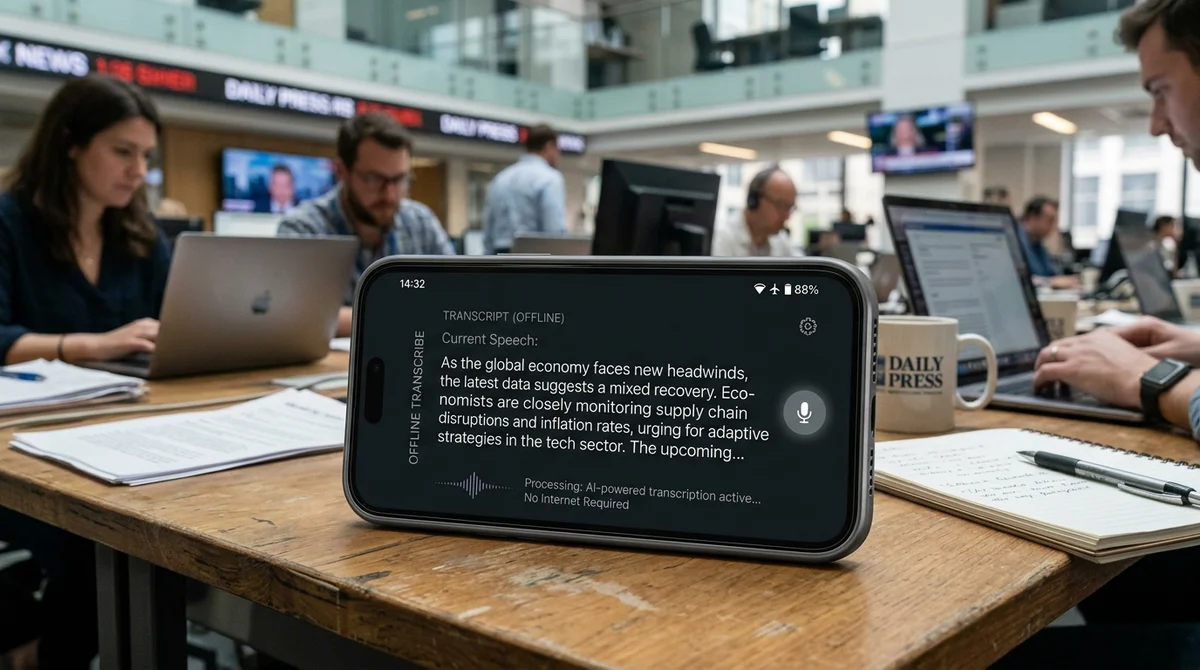
Google quietly released AI Edge Eloquent — an app that converts speech to text completely offline. It's not just another AI voice recorder, but a clear signal: speech recognition is gradually moving back onto the device itself, without obligatory audio upload to the cloud and without a subscription for basic functionality. For users, this means more private dictation, stable work with poor internet, and fewer unnecessary steps between a spoken phrase and finished text.
For now, the app is only available on iPhone and iPad, but the release format itself looks indicative. Google didn't make a big presentation around it, even though the use case is extremely mainstream: quick notes, fast transcriptions, work drafts, voice input on the road or at home. The key idea is that text is created locally, right on the device.
This approach means less dependence on connection quality, lower latency, and fewer reasons to worry that short voice fragments constantly go to external servers. The practical value of offline mode is higher than it might seem at first glance. It's not just trips, airplanes, or places without signal.
Voice input is often needed in the metro, in a car, in an overloaded network at events, in conference rooms with unstable signal, or simply when a user doesn't want to wait for audio upload. For journalists, students, managers, doctors, field specialists, and everyone who captures thoughts by voice, this format eliminates unnecessary friction: open the app, dictate a phrase, immediately get text. The fewer technical intermediate steps, the higher the chance that the tool becomes part of daily routine.
Separately important is the promise of an Android version with deep system integration. If Google really embeds this technology not just in a standalone app but in a broader set of OS functions, the potential will become noticeably greater. This could include system dictation, text input in messengers, search, notes, forms, and accessibility tools.
On Android, Google has more room for such implementation than on iOS, where third-party app behavior and access to system scenarios are traditionally more restricted. This is precisely why the future Android version could be even more important than the current Apple release. This launch fits well into the industry's overall shift toward local AI.
For several years, the market has been accustomed to almost all smart functions living in the cloud: there's more computing power there, models are easier to update, telemetry is easier to collect, and quality scales better. But the local approach has too many advantages to ignore further. These are privacy, savings on server infrastructure, lower latency, and predictable operation where the network fails.
For Google, it's also a way to show that useful AI doesn't have to look like a big universal chat assistant every time. Sometimes a small specialized tool that solves one task quickly and without extra noise hits harder. Of course, offline recognition doesn't solve everything.
Quality can significantly depend on device power, background noise level, accent, language mixing, and dictation length. Cloud services are still more convenient where speaker tagging, deep formatting, long transcripts, or further content analysis are needed. But for the basic scenario "you speak — you get text" a local app is often sufficient.
And it's exactly such frequent and simple scenarios that usually determine whether a technology becomes a daily habit or remains a demonstration of capabilities. The main conclusion here is that Google is testing not just another app, but a more convenient model of interaction with speech. If AI Edge Eloquent turns out to be fast and accurate in real-world use, users will start perceiving offline transcription as a norm, not as a rare bonus.
And then competition will shift from the mere fact of having voice input to more important parameters: how private it is, how instantly it works, and how naturally it's integrated into daily actions.
Want to stop reading about AI and start using it?
AI News is a curated feed of AI/tech news. Hamidun Academy teaches you to use AI systematically in your work.