TAPe achieves RF-DETR and YOLO level detection on COCO with under 100K parameters
TAPe detection reached the level of strong models on COCO while fitting in under 100 thousand parameters. Authors report mAP50 at RF-DETR-2XL level, 7-8 ms…
AI-processed from Habr AI; edited by Hamidun News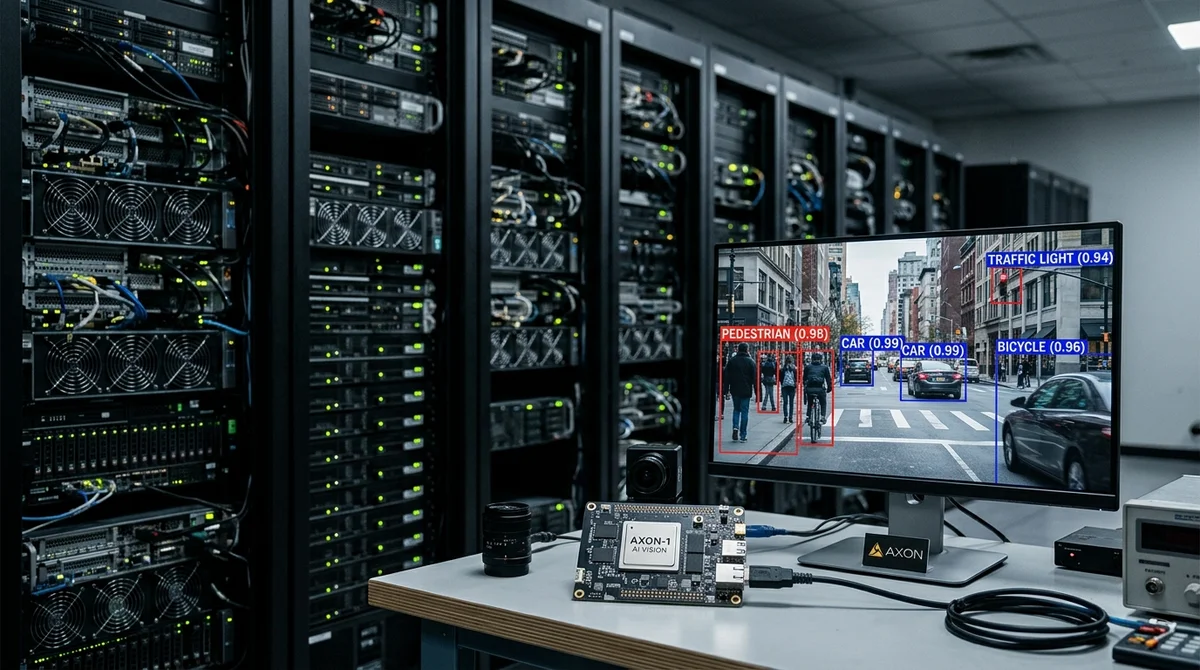
TAPe has demonstrated that object detection at the level of top models can be achieved without giant networks with hundreds of millions of parameters: on the COCO benchmark, the system achieved accuracy comparable to strong RF-DETR and YOLO solutions, while maintaining a model size under 100 thousand parameters and inference time around 7–8 milliseconds per image. The key takeaway from the experiment is that the authors achieved TAPe detection at the level of modern SOTA approaches not through simple scaling, but through the architectural idea itself. For computer vision, this is an important signal: the race for ever-larger models is not always necessary if the problem is formulated so that the network extracts the required structure from data with fewer weights.
The COCO dataset was used as a benchmark — one of the most popular and challenging datasets for evaluating object detection, on which serious industrial and research solutions are typically compared. Therefore, the result on this dataset is immediately perceived as substantive rather than laboratory-based. According to the stated metrics, the final TAPe model maintains mAP50 at the level of RF-DETR-2XL, while remaining several orders of magnitude more compact.
While TAPe has fewer than 100 thousand parameters, the nearest lightweight models in the YOLO class have roughly an order of magnitude more parameters, and strong DETR approaches like RF-DETR already have around 127 million. The difference here is not cosmetic but systemic. A smaller model means not only memory savings, but also a lower threshold for deployment on standard hardware, simpler delivery in edge scenarios, and lower costs for training, retraining, and debugging.
The authors separately emphasize speed: approximately 7–8 milliseconds per image, with model behavior being nearly equally fast on both GPU and CPU. For applied scenarios, this is particularly important because not every team can afford dedicated GPU infrastructure for inference. Equally important is the data question.
Typically, high accuracy in detection is purchased not only through the model, but through a huge volume of labeled examples, complex training schemes, and long experiment cycles. TAPe emphasizes that their approach significantly reduces requirements for data, computational resources, and development time. If this is consistently reproduced beyond a single experiment, smaller teams have a chance to compete in areas where the entry ticket was previously too expensive.
This applies to startups, research groups, and product teams implementing vision in cameras, robots, warehouse systems, or mobile devices. In this logic, model value is determined not only by absolute accuracy, but also by how many people and infrastructure are needed to bring it to production. Against a market where success is often measured by checkpoint size and GPU-hours consumed, such a result looks almost counterintuitive.
But that's precisely what makes it interesting. TAPe essentially proposes a different thesis: performance in detection tasks can be increased not only through scale, but also through a more efficient way of encoding visual dependencies. For industry, this could mean shifting focus from scaling resources to optimizing the problem formulation itself.
For the open-source community, it represents a chance to get models that are easier to run, deploy, and fine-tune without heavy infrastructure. If the authors' conclusion is confirmed in further independent tests, TAPe could become an important argument in favor of compact vision models of a new generation. The point of this news is not that another system outperformed competitors in a table, but that comparable quality was achieved at a radically lower cost in parameters, data, and computation.
This is the case where efficiency gains themselves become the main technological result. And these kinds of stories more often change practice faster than record-breaking but prohibitively expensive capability demonstrations.
Want to stop reading about AI and start using it?
AI News is a curated feed of AI/tech news. Hamidun Academy teaches you to use AI systematically in your work.