Christine Lagarde praised Anthropic for cautious release of new AI model
Christine Lagarde publicly backed Anthropic's cautious approach to releasing the new AI model. The ECB head believes that limited release and additional…
AI-processed from Bloomberg Tech; edited by Hamidun News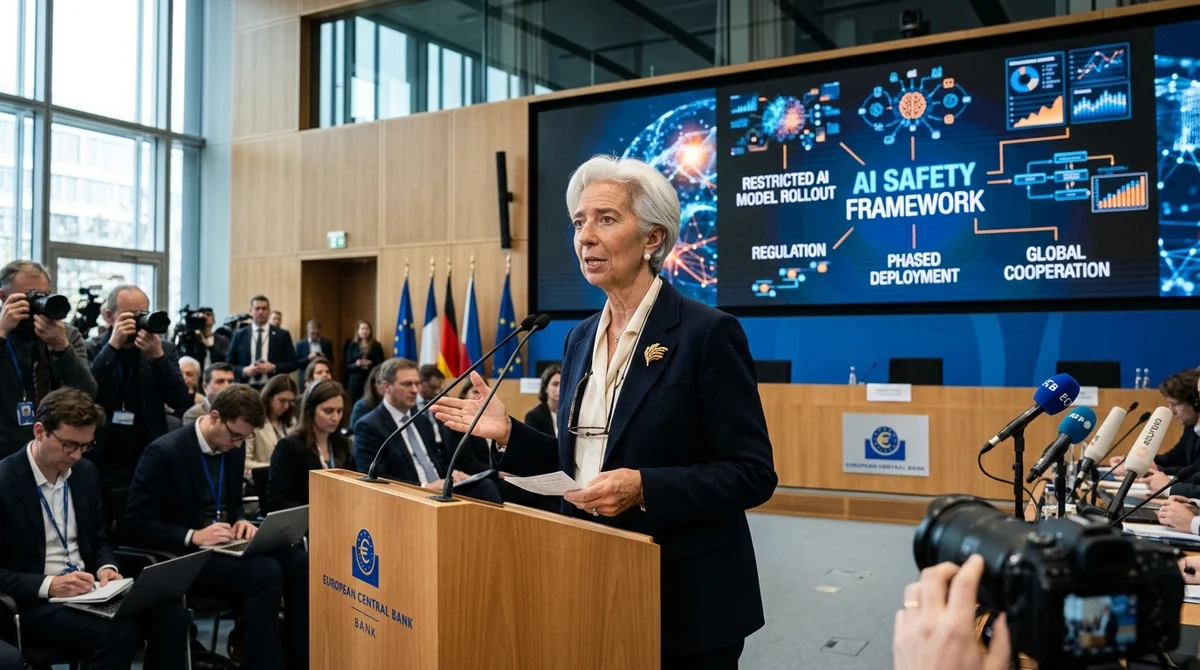
Major regulators are beginning to assess artificial intelligence not as an abstract technology of the future, but as a source of quite concrete risks to the economy and institutions. Christine Lagarde, President of the European Central Bank, publicly backed Anthropic's decision to limit the release of its new AI model, thereby marking an important turn in the discussion: cautious launch is now perceived not as a sign of product weakness, but as an example of responsible behavior against the backdrop of growing system power. This statement is particularly significant because of who is making it.
The ECB is one of Europe's key financial institutions, and its head by definition views technologies through the lens of systemic resilience, trust and risk management. For central banks, AI is not simply a convenient tool for automation. The issue is about technologies that already influence data analysis, customer service, fraud detection, cybersecurity and decision-making in sensitive sectors.
If such systems scale faster than control mechanisms emerge, errors, bias or abuse can extend far beyond a single company. Against this backdrop, Anthropic received rare industry praise precisely for its restraint. The logic of Lagarde's position is simple: when a developer does not open maximum access to a new model immediately, but limits its distribution, they buy time to verify the system's behavior in real conditions and reduce the probability of instant widespread damage.
This approach is important not only because of technical failures. The more powerful the model, the higher the risk that it will be used for manipulation, generation of false information, automation of fraud schemes, or too-rapid deployment in processes where the cost of error is particularly high. In this case, a limited release looks like an element of risk management, not a marketing pause.
For Europe, this story fits neatly into already understood regulatory logic. Brussels has consistently pushed stricter rules for AI over several years: an emphasis on risk assessment, transparency, developer responsibility and control of application in sensitive areas. Lagarde's words fit well within this line.
Essentially, she is sending a signal to tech companies: the question is no longer only about how impressive a new model is, but how convincingly a company can demonstrate protective measures before large-scale launch. Public praise for Anthropic is important here also as a market benchmark. Regulators are demonstrating which behavior they are ready to consider mature and deserving of trust.
For the industry itself, this may prove no less important than the next leap in model quality. For a long time, the main measure of success was the speed of releases, growth of user base and the ability to outpace competitors in a public race. But if major institutions begin to encourage precisely cautious launches, the balance of incentives will change.
Companies will need to explain not only the model's capabilities, but also its boundaries of use, failure scenarios, testing methods and the reasons why access is granted gradually, not all at once. This is particularly sensitive for players operating at the intersection of AI and industries with high cost of error — finance, medicine, education, government services and corporate analytics. In these areas, trust in launch mechanics is gradually becoming part of the product itself.
The main conclusion is that the debate around AI is entering a new phase. The focus shifts from the question "who made the model more powerful" to "who is capable of safely controlling its distribution and application". Support from Lagarde strengthens Anthropic's position as a company betting on more careful technology release to market.
For others, this is a warning: the era when speed itself was considered an unconditional advantage is ending. The next field of competition becomes trust in release rules.
Want to stop reading about AI and start using it?
AI News is a curated feed of AI/tech news. Hamidun Academy teaches you to use AI systematically in your work.