Anthropic Updates Claude Code: Routines, Parallel Sessions, and Autonomous Tasks on Mac
Anthropic has updated Claude Code: the service now includes Routines for recurring tasks and a new desktop interface with parallel sessions. Automations can…
AI-processed from 3DNews AI; edited by Hamidun News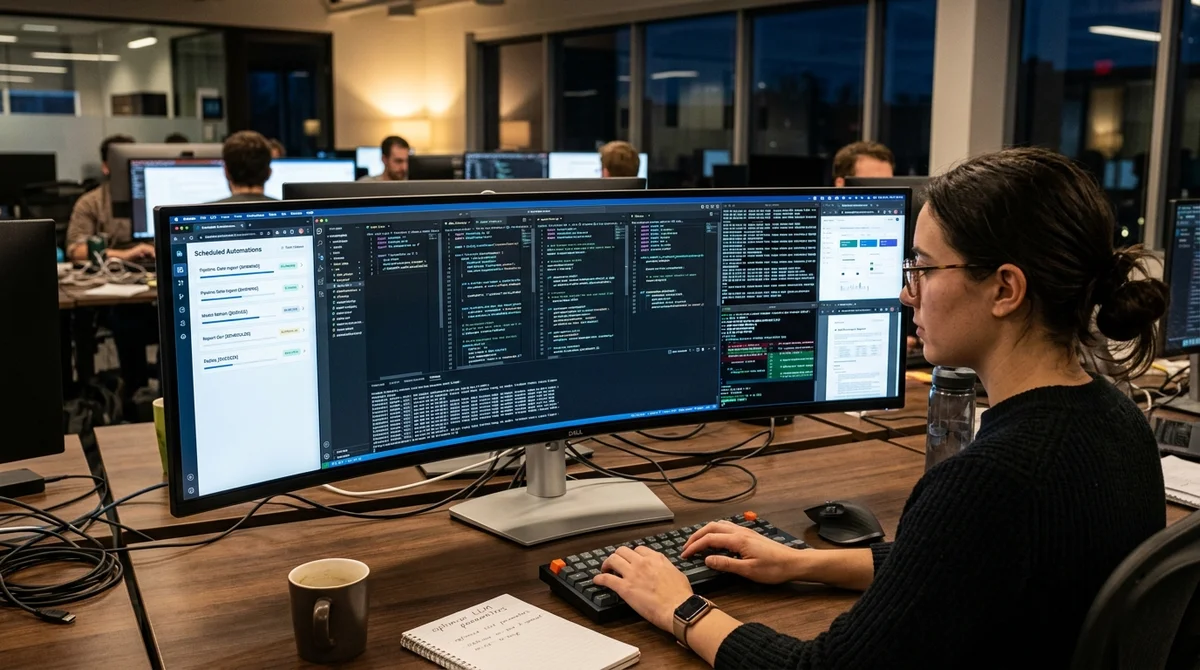
On April 14, 2026, Anthropic unveiled two major Claude Code updates: the service gained Routines for recurring tasks and a completely redesigned desktop interface. The core idea is straightforward: Claude Code is gradually evolving from an assistant for one-off requests into a continuously running tool that can launch agent scenarios on a schedule, respond to events, and manage multiple work sessions in parallel. The new Routines feature is currently in research preview mode—essentially an early-access research preview.
In essence, these are saved Claude Code automations: a user defines a prompt once, connects a repository and required connectors, and then the scenario can run on a schedule, via API call, or triggered by an event. The important shift is that such tasks execute not on a local computer, but on Anthropic's web infrastructure. This means the laptop doesn't need to stay on, and the team no longer needs to separately maintain cron jobs, trigger infrastructure, and supporting tooling.
The company also provides quite practical use cases. Routines can be used for regular backlog work, nightly triage of new bugs, and drafting pull requests, for API processes, deployment checks, alert triage, and automated code review. Anthropic particularly emphasizes GitHub scenarios: a routine can trigger on repository events, open a new session for each matching pull request, and continue working as comments arrive or CI fails.
In other words, this is no longer just a "scheduled request to a model," but a permanently available agent embedded in the team's engineering workflow. Access has subscription-based limits. Pro users can run up to five routines per day, Max users up to fifteen, and Team and Enterprise users up to twenty-five.
These routine executions consume subscription limits the same way interactive sessions do, and you can purchase additional usage beyond the daily limit. This approach shows that Anthropic is not yet positioning Routines as a completely unlimited background orchestrator, but rather as a managed automation layer on top of existing Claude Code. In parallel, Anthropic also updated the desktop client itself.
The new interface features a sidebar for managing multiple active and recent sessions, so you can now keep several tasks in one window: for example, refactoring in one project, debugging in another, and generating tests in a third. The application includes a built-in terminal, file editor, accelerated diff viewer, and HTML and PDF preview. The workspace has become customizable: panels can be dragged and arranged to fit your workflow.
The idea here mirrors Routines: Claude Code is being increasingly adapted not for single-chat use, but for scenarios where a developer simultaneously orchestrates multiple streams of agent work. This update fits well within Anthropic's broader direction. In March, the company already added auto mode, which allows Claude Code to work with greater autonomy within pre-set boundaries, and in early April expanded enterprise capabilities for Claude Cowork.
Against this backdrop, the Routines release and desktop redesign don't look like isolated cosmetic improvements, but rather as a sequential assembly of a unified work environment where Claude can execute tasks on demand, operate in semi-autonomous mode, and integrate into team processes through repositories, connectors, and remote events. For the AI tools market, this is an important signal. Competition in code assistants is shifting from the quality of a single response to the system's ability to embed itself into real team processes: live alongside repositories, connect to GitHub, work on events, and not require constant manual triggering.
If Anthropic can maintain the reliability and transparency of such automations, Claude Code will be perceived not as a convenient CLI wrapper, but as a fully-fledged environment for semi-autonomous development.
Want to stop reading about AI and start using it?
AI News is a curated feed of AI/tech news. Hamidun Academy teaches you to use AI systematically in your work.