ASML Raises 2026 Sales Forecast Amid Demand for Nvidia AI Chips
ASML raised its sales forecast for 2026 to €36–40 billion, demonstrating that AI investments continue to drive demand across the semiconductor supply chain…
AI-processed from Bloomberg Tech; edited by Hamidun News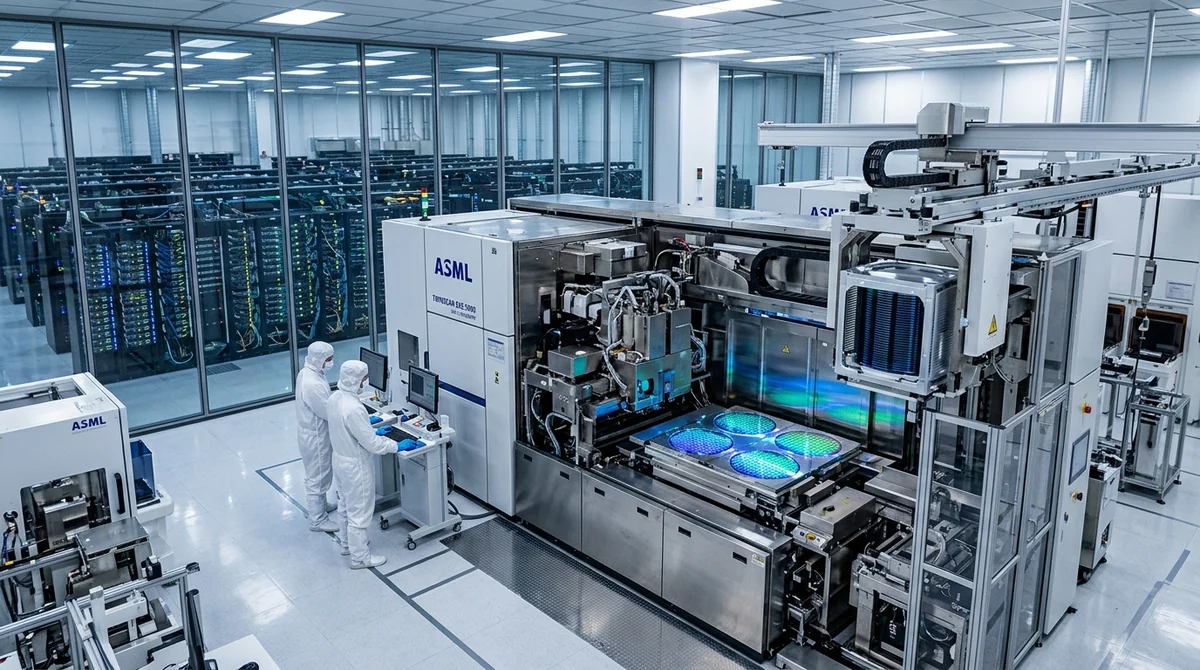
ASML raised its 2026 sales forecast to the €36–40 billion range, another signal that the AI boom continues to directly support manufacturers of critical equipment. While the market typically watches Nvidia, model developers, and cloud platforms, ASML's forecast update shows: money is still flowing into deeper layers of the technology stack — where the physical foundation for AI infrastructure is created. Dutch ASML is a key supplier of lithography systems, without which mass production of the most complex modern chips is impossible.
Such equipment is used by semiconductor manufacturers when creating processors and accelerators for data centers. It's worth noting ASML's connection to Nvidia chip production: the company's machines are critical for manufacturing the components on which AI models are trained and deployed. This is an important nuance, because ASML itself doesn't make chips and doesn't build data centers, but sits at that point in the supply chain without which further AI growth simply runs into physical limitations.
It's no accident that the company is called one of the world's most strategically important semiconductor suppliers, and its status as Europe's most expensive publicly traded company only heightens market attention to each forecast update. The new sales target — from €36 billion to €40 billion per year — means management sees stronger demand than previously expected. For the semiconductor equipment market, such revisions are particularly telling: customers don't buy such installations on impulse; these are expensive, long-term investments tied to plans for factory expansion and capacity utilization years ahead.
If chip makers are willing to confirm or increase purchases, it means they expect demand for AI computing to persist not just in the near quarter, but over a longer horizon. In other words, ASML's forecast isn't just a story about quarterly results, but an indirect indicator of how confidently the industry views future advanced computing needs. Growth in AI demand is now driven by more than one category of tasks.
There's training of large models, deployment of finished systems in production, and expansion of data centers for inference, where load runs constantly. All this requires more and more accelerators, memory, network infrastructure, and ultimately new batches of advanced chips. For cloud providers and infrastructure operators, this means one simple thing: without sustained capacity expansion, maintaining the pace of AI service adoption will become increasingly difficult.
That's why ASML's news matters not just to investors in European industrial companies, but to the entire AI ecosystem: if equipment suppliers are raising forecasts, then the capital expenditure cycle isn't exhausted yet. At the same time, the €36–40 billion range itself shows that uncertainty hasn't gone away. The semiconductor market remains cyclical, and delivery schedules, approvals of major orders, and new capacity coming online often shift between quarters.
In such an industry, even strong demand doesn't guarantee a perfectly smooth revenue trajectory. But raising a forecast in this situation is typically read unambiguously: the company sees enough confirmed signals from customers to be more confident in the annual result, despite inevitable volatility in schedules and contracts. For investors, this matters more than the range's lower or upper boundary: an upward revision speaks to demand strength better than any cautious management comment.
The key takeaway is that the AI boom continues to work not only for the most visible players like model developers or ready-made accelerator manufacturers. It's supporting fundamental links in the supply chain, where ASML holds an almost irreplaceable position. For the market, this confirms that the growth story around artificial intelligence hasn't yet reduced to a single brand or single type of company.
For Europe, it's a reminder that one of its most valuable technological assets remains at the center of the global race for computing power. And for the entire industry, it's a signal that scaling AI depends not only on algorithms, but on how quickly the world can produce the necessary quantity of complex chips.
Want to stop reading about AI and start using it?
AI News is a curated feed of AI/tech news. Hamidun Academy teaches you to use AI systematically in your work.