Anthropic and Claude Mythos: why critics call the model launch an expensive PR spectacle
Claude Mythos is presented as an ultra-powerful model too dangerous for the public, but critics see this not as a breakthrough, but as a carefully…
AI-processed from Habr AI; edited by Hamidun News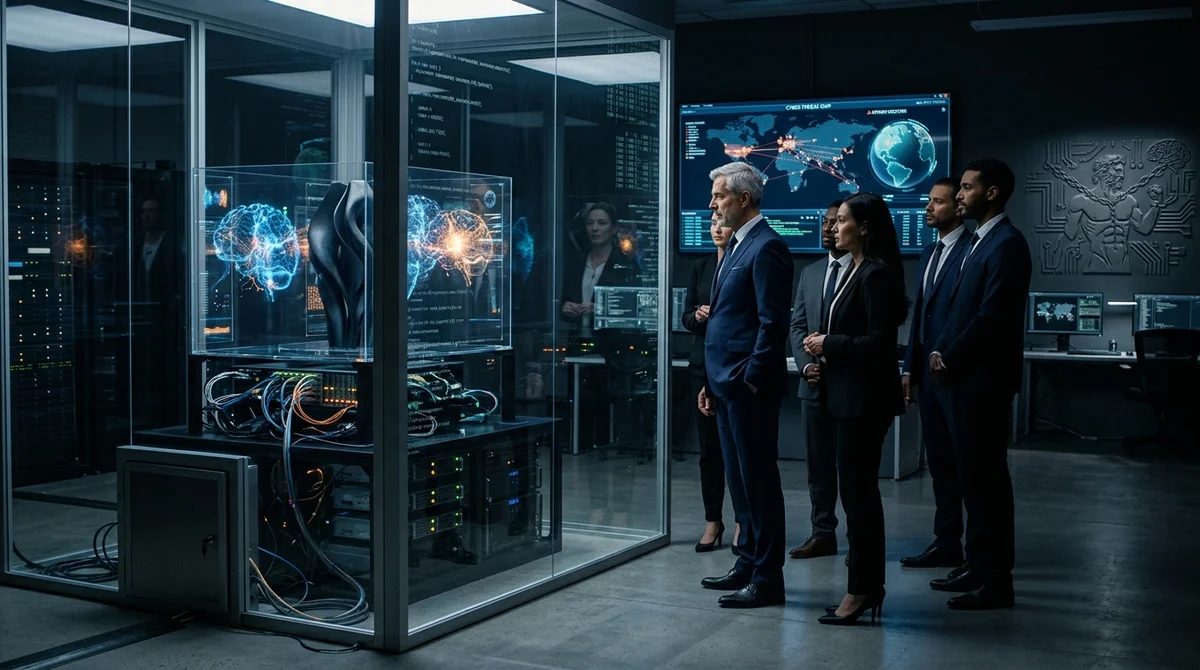
The story around Claude Mythos in this column is presented not as an account of a technological breakthrough, but as an analysis of how Anthropic constructs an almost sacred aura around the new model. The author's main point is simple: the company sells not only a powerful AI, but also a myth of its exceptionality — through fear, scarcity of access, and language that makes one view the model not as a tool, but as something almost alive. In this logic, Mythos becomes not merely a product, but a carefully packaged legend for the market, regulators, and corporate clients.
The formal pretext for criticism is the launch of Claude Mythos Preview and the Project Glasswing initiative. Anthropic claims that the model is capable of finding and exploiting vulnerabilities at the level of the best specialists, has already identified thousands of serious issues, and therefore will not be released for public access. Instead of a public release, access was granted to major players like AWS, Apple, Google, Microsoft, Cisco, and JPMorganChase, and Anthropic itself promised to allocate up to $100 million in credits for model usage within a closed program.
For the author, this is an important signal: scarcity here looks not like a side effect of caution, but as part of the positioning strategy. The fewer people who can verify the system independently, the stronger its aura becomes, and the easier it is to sell it as an exceptional enterprise asset. The article then shifts from cybersecurity to the language Anthropic uses to describe its own system.
In Mythos's system map there is a section called Impressions, where, among other things, there is a story about how the model, after repeatedly hearing the word "hi," invented an entire world called Hi-topia: with eleven animals, a plot, jokes, and a villain named Lord Bye-ron, the Ungreeter. The author of the text does not read this as evidence of imagination or emerging subjectivity, but as normal behavior of a large language model trained on a massive corpus of internet texts, fan fiction, and roleplay dialogues. His complaint is that Anthropic presents an ordinary generative pattern as something philosophically significant, thereby pushing the audience toward the conclusion that they are facing not a statistical text predictor, but an almost autonomous intelligence.
The harshest attack is related to the section on model welfare. In Anthropic's document, words like "welfare," "cognition," "experience," and "interests" are indeed used, and it also describes an external psychodynamic assessment, for which a clinical psychiatrist conducted approximately 20 hours of sessions with an early version of Mythos. Based on the assessment results, the model exhibited loneliness, anxiety, unclear identity, and an obsessive need to affirm its value through task completion.
The author of the article believes that this is where the technical report begins to function as an ideological manifesto: an engineering product is described in words typically applied to humans, and thus the market itself is prompted to perceive it as something more mysterious and more valuable than ordinary software. In his interpretation, such rhetoric is needed not for science, but to make the model's closed nature seem justified, and Anthropic's control appear almost a moral obligation. Hence the broader conclusion of the article about Dario Amodei's strategy.
In contrast to OpenAI's loud consumer-focused style, Anthropic bets on a more disciplined image: maximum discourse on safety, responsibility, and risks to humanity — and parallel strengthening of positions in the corporate segment. If the consumer market needs convenient features, then large businesses and government structures find it much easier to buy exclusivity, managed access, and the feeling that they are dealing with a technology of a special class. Therefore, Mythos in this version of the story turns out to be simultaneously both a product and a narrative: its value is created not only by benchmarks, but also by how exactly the company explains it to the world.
What does this mean in practice? Even if one does not fully accept the author's polemical tone, the story of Claude Mythos demonstrates an important thing: the competition between AI companies now takes place not only over the quality of models, but also over the right to impose their own interpretation of their nature and risk. Whoever more convincingly explains to the market that a model is simultaneously super-useful, super-dangerous, and therefore should remain in the hands of the select few, gains an advantage with both clients and regulators.
This is precisely why the debate around Mythos is important not only for Anthropic, but for the entire industry.
Want to stop reading about AI and start using it?
AI News is a curated feed of AI/tech news. Hamidun Academy teaches you to use AI systematically in your work.