Claude and Qwen Omni: How a Developer Integrated Video Analysis into a Production Pipeline
A developer showed how to turn Claude into a practical video analysis tool by connecting it to Qwen Omni. Instead of frame-by-frame slicing, which loses…
AI-processed from Habr AI; edited by Hamidun News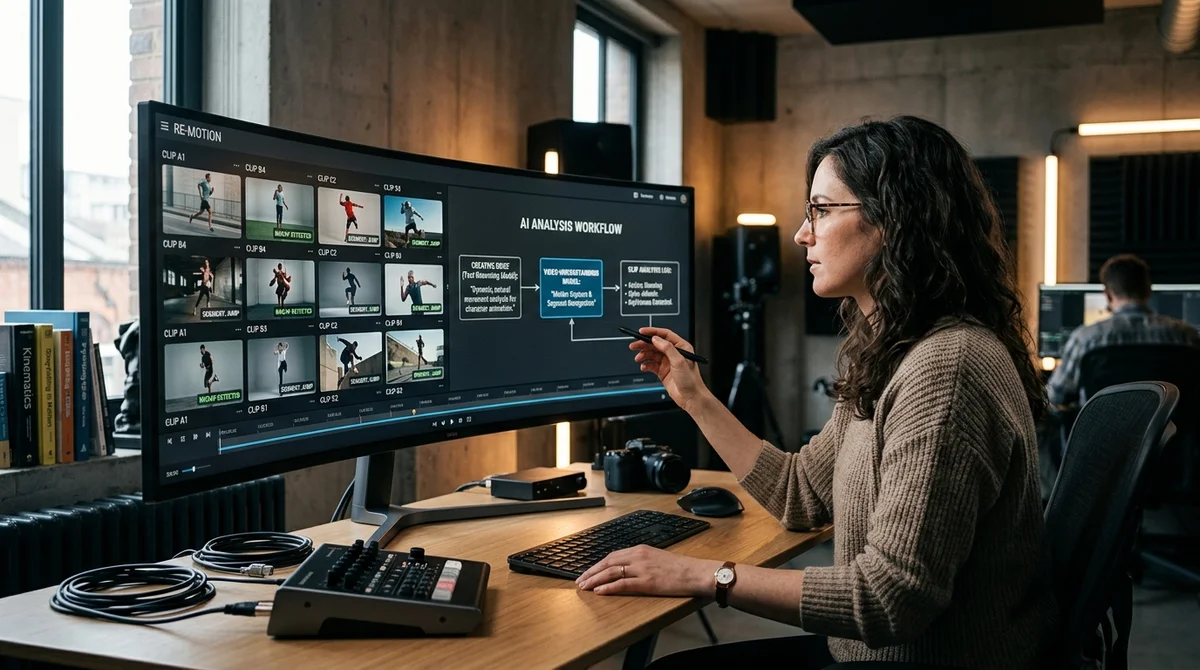
In a recent Habr publication, a developer demonstrated a simple yet effective way to extend Claude's capabilities for tasks requiring video analysis rather than individual image frames. Instead of waiting for native video support from Anthropic, he assembled a combination of two models: Qwen Omni handles multimodal perception, while Claude performs analysis, structuring, and result formulation. In practice, this transformed a tedious manual task into an automated pipeline that saves time and better preserves motion context.
The problem he encountered is familiar to many who work with animation, motion, and visual references. If you split video into frames and send them to the model one by one, you lose the essential element—the connection between states, pace, camera trajectory, transitions between poses, and the overall flow of action. For static scenes, this workaround is tolerable, but for motion analysis, it quickly hits limitations. For tasks like analyzing cinematography techniques, synchronizing gestures, tracking shot changes, and evaluating final character design, such a compromise is nearly useless. As a result, the model sees a set of pictures rather than a complete event, and the human still has to manually reconstruct the meaning.
The concrete task was quite practical: the project folder contained 29 generated character animation video references that needed to be categorized and briefly described from a motion perspective. Doing this manually would have taken the author about an hour or an hour and a half on work with minimal added value: open a file, watch it, understand the motion type, record a description, move to the next one. For creative professionals, such routine is particularly painful because it takes time away from creation and instead goes toward inventorying already created material.
The solution was found in Qwen Omni, which the author had already used in another project—for a real-time digital character assistant. The idea proved logical: if one model understands multimodal input well, and another excels at interpretation and producing clean text, they can be linked into a single workflow. In this scheme, Qwen Omni first receives the video, extracts meaningful features and a description of what's happening, and then Claude uses this material as a basis for more convenient categorization, comparisons, and textual conclusions. After this, you can get not just raw summaries, but uniform descriptions, lists, labels, and brief conclusions for each video in the folder.
This is not a 'magical' transformation of Claude into a full-fledged video model, but a practical composition of specialized tools. From an engineering perspective, what matters here is the approach itself. Instead of trying to find one universal model for all tasks, the author assembles a stack of components with different specializations. For users, this means a more realistic path to multimodality: not waiting for your favorite LLM to learn everything at once, but providing it with external sensors and intermediate layers. This pattern is especially useful where value comes not just from recognition, but from subsequent reasoning: scene analysis, character behavior description, extraction of typical motion patterns, preparation of notes for production or team communication.
Using the same approach, you can analyze storyboards, educational videos, interface recordings, and test generations before final editing.
The story of Claude and Qwen Omni demonstrates that a model's limitation doesn't always mean a dead end for the entire process. If you break down the task into stages—perception, description, classification, and output—it becomes clear which parts can already be addressed with third-party tools right now. For visual content creators, animators, and AI artists, this is a good signal: value increasingly comes not from one 'smartest' model, but from a well-assembled combination where each system does what it's truly strong at.
Want to stop reading about AI and start using it?
AI News is a curated feed of AI/tech news. Hamidun Academy teaches you to use AI systematically in your work.