Accenture invests in General Robotics to unite AI for factory robots
Accenture Ventures invested in General Robotics, developer of GRID, a platform that unites over 40 robots of different brands under a single AI layer. The…
AI-processed from TNW; edited by Hamidun News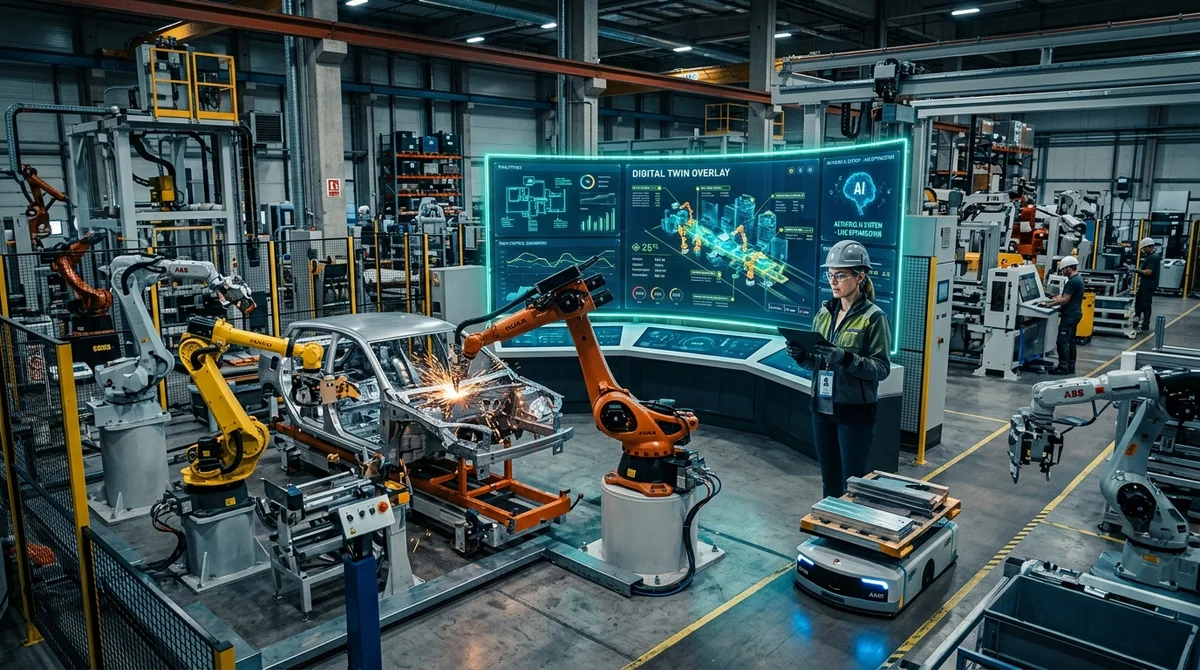
Accenture is betting on the next level of industrial AI: not another model, but a layer that enables robots from different brands to work as a unified system. On April 15, 2026, Accenture Ventures invested in General Robotics startup to jointly advance Physical AI for factories, warehouses, and other capital-intensive industries where automation typically hits a wall not in hardware, but in complex integration, lengthy pilots, and high scaling costs. The key asset in the deal is the GRID platform.
It serves as a universal layer of robotic intelligence on top of equipment from different manufacturers. According to the company, GRID supports over 40 robots and OEM platforms, including FANUC, Flexiv, Ghost Robotics, Galaxea, and Psyonic. The idea is not to program each machine separately in its own stack, but to build modular AI skills that can be transferred across different robot types.
For large-scale manufacturing, this is especially important: on a single facility, manipulators, mobile platforms, inspection robots, and autonomous systems from different vendors often coexist, and their joint operation usually requires expensive custom integration. General Robotics is trying to close exactly this gap. Instead of hardcoded logic, the company offers cloud orchestration, reusable skills, training in simulation, and control over data and intellectual property on the customer's side.
This approach should simplify the transition from pilot to a real fleet of machines. Accenture, for its part, brings what robotic startups often lack — access to major corporate customers and experience implementing solutions in manufacturing, logistics, energy, aerospace, and other industries with demanding operational environments. At Accenture, they directly connect this investment to personnel shortages, productivity pressure, and rising capital and operating costs at factories and warehouses.
General Robotics has a strong technical pedigree. The company was founded by Ashish Kapur, former head of autonomous systems and robotics research at Microsoft and creator of AirSim — a popular open-source simulator for training autonomous vehicles and drones. This explains why GRID is so heavily focused on simulation: the platform is integrated with NVIDIA Isaac Sim, built on Omniverse libraries.
A manufacturer can first train and test AI skills in a digital twin of a factory or warehouse, run safety scenarios, and only then deploy them to physical machines. For robotics, this is critical because an error in a real facility costs much more than a software error. For Accenture, this investment doesn't look like a solo bet.
As recently as October 28, 2025, the company launched Physical AI Orchestrator — its own solution for software-defined factories and warehouses based on NVIDIA Omniverse, Mega blueprint, and Metropolis. Before that, Accenture had already invested in Sanctuary AI and in 2025 worked with Schaeffler on industrial humanoid robots. Against this backdrop, the partnership with General Robotics fills a missing layer: if Physical AI Orchestrator coordinates processes at the facility level, then GRID handles intelligence at the level of individual robots — perception, decision-making, and task execution.
The parties did not disclose the terms of the deal, which is typical for venture investments of this kind. The main takeaway here is that competition in industrial robotics increasingly has less to do with who builds the best individual robot. What matters far more is the infrastructure that allows a mixed fleet of machines to learn quickly, update safely, and operate as a single system.
If Accenture and General Robotics can prove this not in demos but on real factories and warehouses, the winners won't be just them: for the market, it will be a signal that Physical AI is moving out of the stage of beautiful pilots into scalable industrial operation.
Want to stop reading about AI and start using it?
AI News is a curated feed of AI/tech news. Hamidun Academy teaches you to use AI systematically in your work.