Nvidia Chief Calls for US-China Dialogue on AI Safety After Mythos
Jensen Huang linked Anthropic's Mythos breakthrough to the need for direct US-China dialogue on AI safety. According to Nvidia's CEO, as model capabilities…
AI-processed from Bloomberg Tech; edited by Hamidun News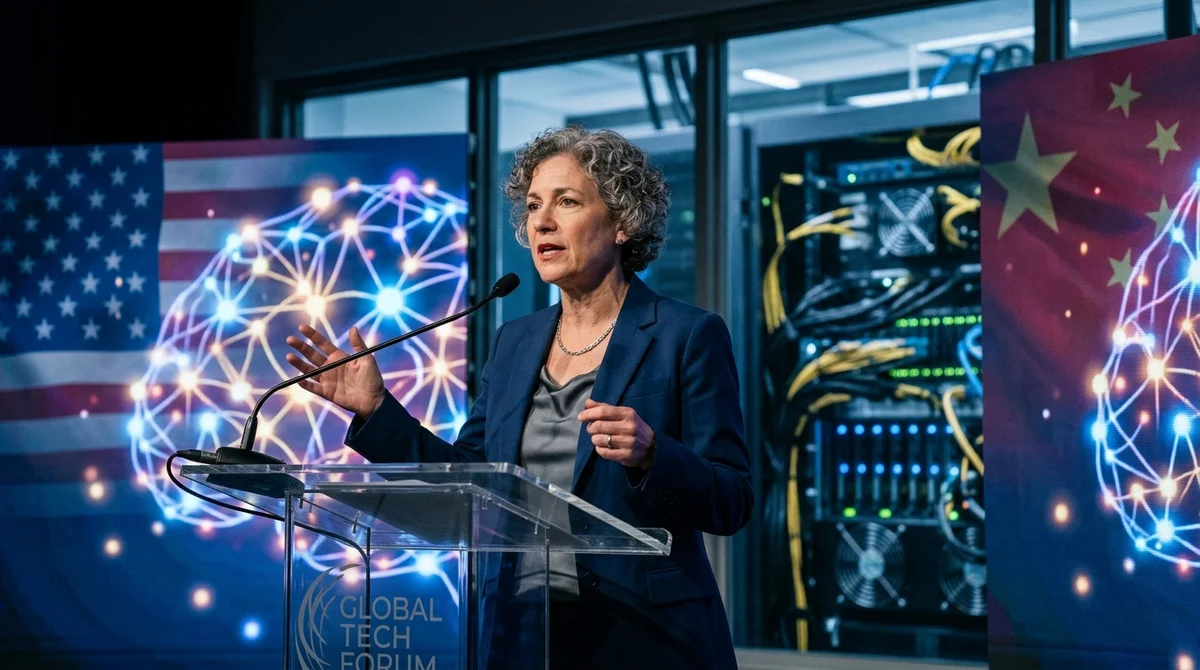
Nvidia's chief Jensen Huang used Anthropic's Mythos breakthrough not for another round of AI leadership rivalry, but for a broader political thesis: the US and China need direct dialogue on how to safely develop and deploy increasingly powerful models. By his logic, advances in generative AI and research systems have reached a level where competition alone is insufficient. If the largest players don't agree on at least basic safety principles, the pace of progress will start to outrun the ability of governments and companies to manage risks.
The catalyst for this statement was Mythos—Anthropic's breakthrough, which Huang cited as an example of how rapidly the upper bound of AI capabilities is shifting. He effectively linked technical progress to diplomatic agenda: the stronger models become, the more critical it is to discuss not just computational power, but usage rules. This involves questions that can no longer be kept within a single country or company: how to test systems before release, what constraints are needed for dangerous scenarios, how to prevent misuse, and where to draw the line between open research and sensitive technology.
Huang's point is straightforward: if the US and China remain locked in mutual deterrence logic, reaching agreement on such rules will be far more difficult. For Nvidia, this topic is particularly sensitive. The company sits at the center of the global AI boom because its accelerators and software ecosystem remain the key infrastructure for training and running large models.
At the same time, Nvidia has worked with customers worldwide, including China, for many years, and Washington-Beijing tensions over chips, exports, and access to advanced computing have long been part of a larger geopolitical game. Against this backdrop, Huang's words can be read in two ways simultaneously. On one hand, it's the position of a tech leader who needs predictable rules.
On the other, it's a signal that a purely coercive approach to AI regulation may be too narrow if technologies themselves are becoming global faster than national restrictions. The practical meaning of such dialogue isn't to create a single global regulator, but to try to fix at least a minimum of compatible approaches. These could include common principles for assessing dangerous capabilities, exchanging stress-testing methodologies, rules for labeling synthetic content, and incident response procedures.
Even partial alignment of standards can reduce the risk that companies will accelerate releases without sufficient checks simply because they fear falling behind in the international race. Notably, the focus wasn't on Nvidia's own product, but on Anthropic's achievement—a company actively building its reputation around AI safety. This shifts emphasis from commercial competition to questions of trust in the next generation of systems.
When major market players begin talking not just about performance but about shared safety rules, it signals that the industry is increasingly viewing risk not as an abstraction for researchers but as a practical challenge for business and governments. For the US and China, the conversation is particularly difficult: they compete simultaneously for leadership, restrict each other's access to critical technologies, and yet face identical challenges—from disinformation and autonomous code to AI applications in defense, education, and public administration. The core meaning of Huang's statement is that the next phase of the AI race will be defined not only by who shows the next breakthrough first, but by whether the world's largest powers can agree on minimal coexistence rules.
For the market, this is a significant signal: safety ceases to be an add-on to a product and becomes part of international policy. If such dialogue truly begins, the winners won't just be model developers and chip suppliers, but users who will have to live with the consequences of increasingly autonomous AI systems.
Want to stop reading about AI and start using it?
AI News is a curated feed of AI/tech news. Hamidun Academy teaches you to use AI systematically in your work.