Federal Court of Australia warns lawyers of sanctions for AI errors in cases
Federal Court of Australia issued recommendations on the use of generative AI in court proceedings. The court does not prohibit such tools, but directly…
AI-processed from Guardian; edited by Hamidun News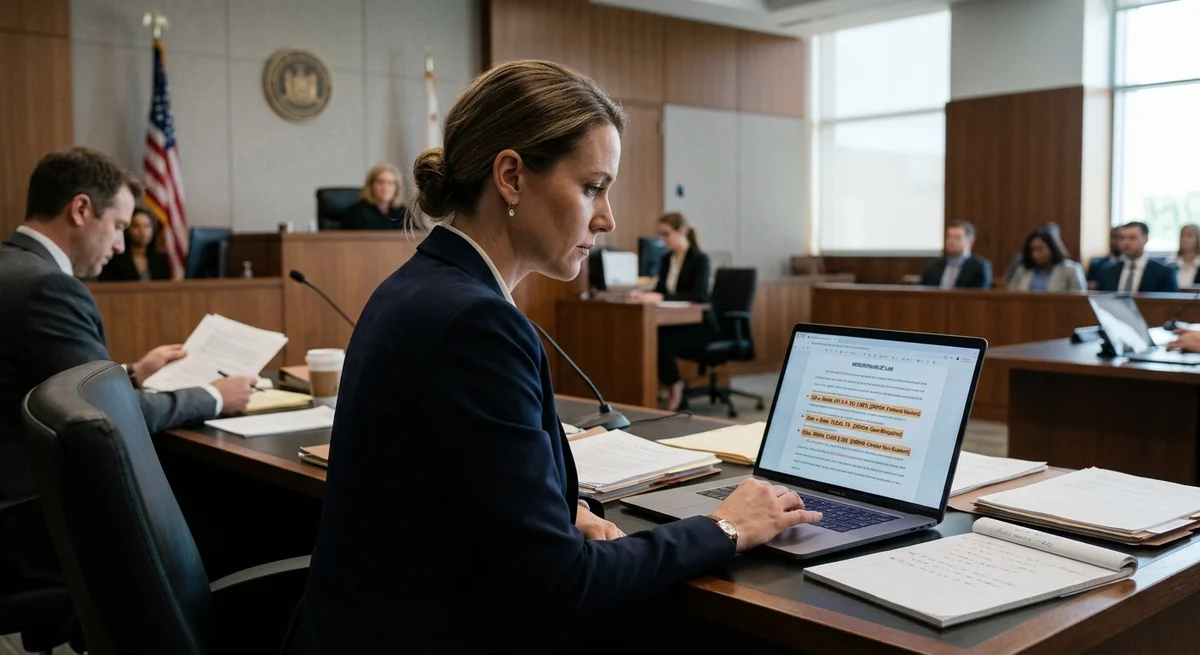
The Federal Court of Australia has sent an unambiguous signal to the legal community: generative AI in courts is acceptable, but human responsibility for every word in submitted materials remains unchanged. The court's new clarification does not introduce a ban on the technology; however, it warns that errors, fabricated references, and other malfunctions arising from neural networks can result in financial sanctions or other legal consequences for lawyers if they disrupt the normal consideration of the case. The court issued a separate practical clarification on how exactly generative AI can be used in judicial proceedings.
The occasion was triggered by a growing number of documents containing false quotations, nonexistent rulings, incorrect references to norms, and other errors created by the model and missed by a person. The problem has long ceased to be local: such cases are being recorded not only in Australia but also in other countries where lawyers, litigants, and even experts are beginning to incorporate AI into everyday work faster than they manage to establish rules for verifying results. The key meaning of the new guidelines is that the court is not at war with the technology as such.
On the contrary, the document emphasizes that the legal profession can use modern tools if it does so in good faith and does not substitute professional judgment with machine-made boilerplate. AI can accelerate draft preparation, assist with finding formulations, summarize arrays of text, or structure case materials. But at the moment when such a tool starts presenting fiction as fact, and the lawyer transfers this into an official procedural document, the problem becomes not technical, but professional and ethical.
The warning about the impermissibility of misleading the court sounds particularly stern. If errors created by AI interfere with the proceedings, increase costs, delay timelines, or force the court and the other party to spend time verifying nonexistent references, the consequences can be quite tangible. It is not just about reputational damage to a particular lawyer or firm, but also about financial or legal measures by the court.
This is an important emphasis: the formula "that's what the neural network generated" is not considered an excuse, because the obligation to verify the accuracy of submitted materials does not disappear anywhere. For Australia, the topic is no longer theoretical. Back in 2025, the country discussed the first notable case when a lawyer was punished for using fictional references generated by AI.
It was precisely such episodes that fostered the feeling that separate reminders about professional integrity were no longer sufficient. The court had to move to a more direct and formalized regime: the technology is permitted, but the boundaries of responsibility are established in advance. This is convenient for the participants in the proceedings and for judges, because it reduces the space for disputes about where permissible automation ends and unscrupulous presentation of materials begins.
The broader meaning of this step is that the judicial system is trying to preserve basic trust in the documents on which the proceedings are built. If model hallucinations begin to massively enter the process, it is not only the quality of individual lawsuits or motions that suffers. The very principle on which the court proceeds—that a text signed by a lawyer has undergone minimum professional verification—becomes blurred.
In practice, this means additional delays, unnecessary costs for the parties, and increased burden on the judicial apparatus, which is forced to spend resources not on assessing the dispute on its merits, but on filtering out machine garbage. This decision is unlikely to stop the use of AI in the legal profession, but it sets more mature rules of the game. Courts need not a rejection of technology, but a clear boundary of responsibility: you can use it, but you cannot shift verification to the model.
For the market, this is yet another signal that the value of a specialist is now determined not by access to AI, but by the ability to filter out errors, confirm facts, and not turn a quick draft into a judicial risk.
Want to stop reading about AI and start using it?
AI News is a curated feed of AI/tech news. Hamidun Academy teaches you to use AI systematically in your work.