US House of Representatives discusses sanctions for AI model copying by Chinese firms
Congress is intensifying pressure on China in the field of artificial intelligence. Republicans in the House of Representatives propose imposing sanctions…
AI-processed from Bloomberg Tech; edited by Hamidun News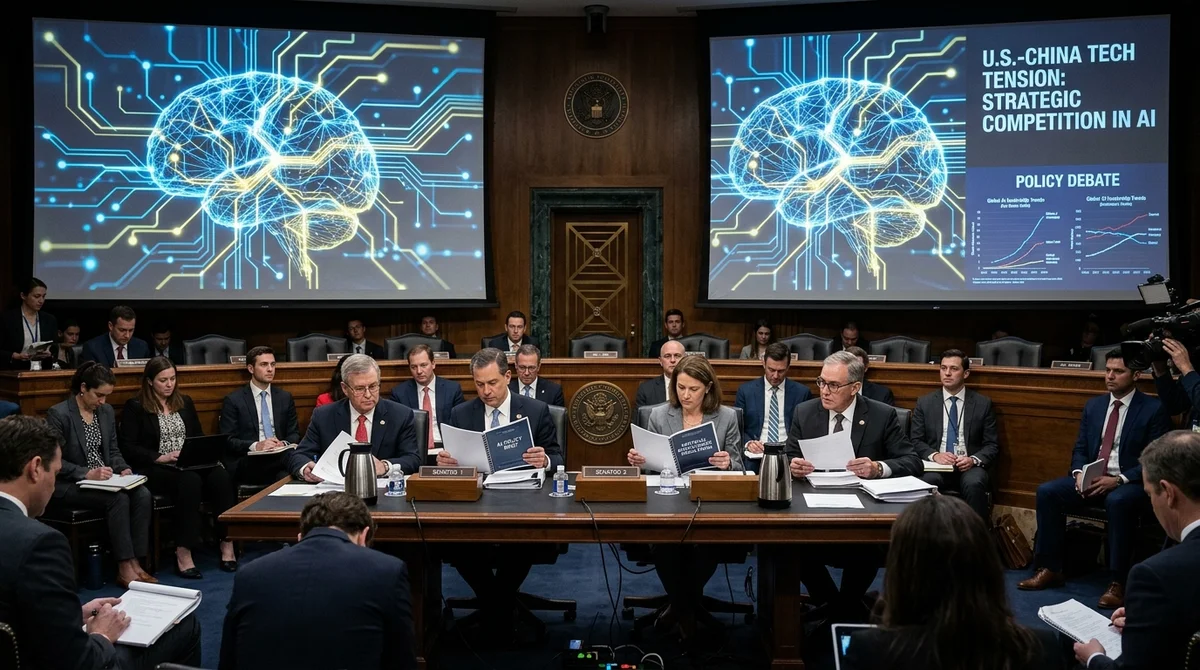
The United States House of Representatives is preparing to discuss new measures against Chinese companies and organizations that, in the opinion of American lawmakers, are copying the capabilities of leading US AI systems through bulk collection of their responses and then using this data to create their own competing models. For Washington, this is no longer just a matter of intellectual property protection, but part of a broader technological strategy: whoever controls advanced models gains an advantage in the economy, defense, and digital infrastructure. The initiative comes from Republicans in the House of Representatives.
They propose considering sanctions against Chinese entities if it is established that they are improperly extracting results from American AI models and turning them into the foundation for their own products. The logic of the claim itself is important here: it is not simply about competition between developers, but about attempting to draw a line between ordinary use of services and systematic copying, when an external player collects a large number of responses from someone else's model, analyzes patterns, and shortens the path to creating an analog. For the industry, this is a painful issue because training large AI models requires enormous computational resources, access to rare chips, strong research teams, and billion-dollar investments.
If a company can bypass part of these costs by using the outputs of an already-ready American system as training material, it gains serious acceleration. In practical terms, lawmakers are speaking of a scheme in which another's model becomes a hidden teacher: it is given thousands or millions of queries, responses are collected, and then a cheaper or more specialized version is trained on this data. It is precisely around such practices that the political dispute is now forming.
For American developers, this is particularly sensitive because the value of a model is increasingly determined not only by architecture, but by the quality of accumulated responses, settings, and user scenarios. The discussion of sanctions fits into the broader course of the US Congress to contain China in the global race for AI leadership. In recent years, Washington has already imposed export restrictions on advanced semiconductors and equipment for their production, tightened control over the transfer of sensitive technologies, and attempted to limit Chinese players' access to critical components of the AI stack.
Now the focus is shifting to protecting the models themselves as strategic assets. At the same time, proving improper extraction of results will be more difficult than documenting the supply of a specific chip: patterns of mass queries, signs of automated collection, and grounds to believe that this data was used to train new systems are needed. That is, the dispute quickly goes beyond politics and bumps up against the question of technical observability.
For American technology companies, such a signal from Congress matters for several reasons. First, the state is showing a willingness to treat unauthorized extraction of results from models not as a gray area, but as a problem of national competitiveness. Second, this could push developers toward more stringent technical protection measures: query limits, monitoring of suspicious activity, watermarks, additional customer verification, and legal restrictions in API contracts.
Third, the market receives a new guideline: the struggle for model quality is increasingly intertwined with questions of data provenance, access control, and international politics. Additionally, this increases the importance of audit logs, compliance, and mechanisms that make it possible to prove who, how, and to what extent interacted with the model. If the initiative gains traction, the dispute over AI model copying will cease to be an internal conflict between companies and will ultimately become a subject of foreign policy pressure.
This means that the AI market is entering a phase where not only research speed and investment scale matter, but also states' ability to protect their technological advantages. For China, this is a risk of new restrictions, and for the US, an attempt to establish the rules of the game at a moment when technological leadership can still be converted into political leverage.
Want to stop reading about AI and start using it?
AI News is a curated feed of AI/tech news. Hamidun Academy teaches you to use AI systematically in your work.