Amazon and Microsoft turn Aragon into a 90 billion dollar AI-datacenter hub
Aragon in northern Spain is rapidly becoming one of Europe's largest AI infrastructure hubs. Amazon has already raised its investment plan for local data…
AI-processed from Bloomberg Tech; edited by Hamidun News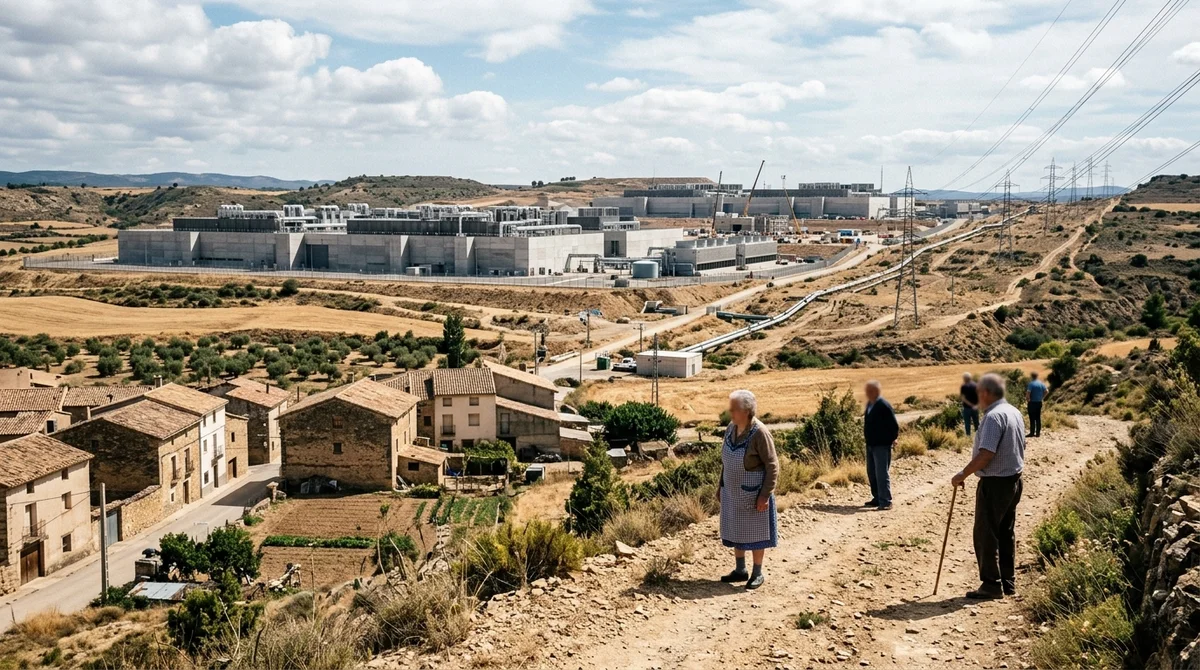
Aragon, a region in northern Spain, is transforming into one of Europe's most notable proving grounds for AI infrastructure, but behind promises of jobs and digital sovereignty, a conflict over land, water, and locals' right to influence what is built near their homes becomes increasingly visible. The dispute is not only about the scale of investments, which collectively amounts to more than 80 billion euros, or roughly 90 billion dollars, for announced projects in the region. For many residents, things became personal when letters started arriving offering to purchase land for projects of "common interest."
One family in Aragon received an offer to sell a plot they had owned for nearly half a century, with just four days to respond. For authorities and corporations, this is an accelerated procedure. For people, it is a signal that decisions have already been made without them.
From the perspective of tech giants, the logic is clear. Aragon offers a rare combination of available land, relatively cheap renewable energy, good fiber optic connectivity, and bureaucracy designed for the rapid launch of strategic facilities. Through the PIGA mechanism, projects receive priority status, pass approvals noticeably faster, and can claim tax benefits.
This is why the region is increasingly named a candidate for the role of a new European hub for cloud services and computing necessary for generative AI. Amazon Web Services already operates three hyperscale data centers in Aragon and in March 2026 increased its overall investment plan for Spanish infrastructure to 33.7 billion euros by 2035.
The company promises nearly 30,000 full-time equivalents across the country and more than 13,000 jobs in Aragon itself, when counting direct, indirect, and induced effects. Microsoft is simultaneously advancing its own cluster of three campuses around Zaragoza, La Muela, and Villamayor de Gállego. Just the construction budget for these sites is estimated at approximately 5.
3 billion euros, and the company's previously announced commitments in the region approached 9 billion. A broader list includes dozens of other facilities by other operators and funds. But the main question for local residents is not how many billions have been announced, but who will pay the real price.
Data centers require not only capital, but also stable energy, water for cooling, new power transmission lines, and enormous plots of land. In 2025, AWS requested a 48% increase in water availability for its three complexes in Aragon, citing hotter periods and climate risks. Environmental groups view such requests as evidence that official impact assessments are too optimistic.
Against the backdrop of droughts and growing competition for resources, even a relatively modest increase in consumption becomes a political issue. Disputes also surround energy. Local media has already warned that if all major announced projects are realized, the load on the region's power grid could increase to a level that forces Aragon to import more electricity and redesign network infrastructure to meet data center needs.
Municipalities fear that the priority given to digital infrastructure will limit their own industrial development. Additional irritation is caused by the fact that loud employment estimates are composed mostly of construction and indirect effects, while the number of permanent jobs at already operational facilities is noticeably more modest than headlines might suggest. Companies are trying to ease tensions with promises.
Amazon speaks of investments in local social programs, water conservation and replenishment projects, and supplying centers with renewable energy. Microsoft bets on the "good neighbor" narrative, closed-loop cooling systems, and community funds for local initiatives. But the structure of the conflict itself does not disappear: the more important data centers become to the AI race, the stronger the temptation to accelerate permits and make decisions at higher levels, reducing the role of local communities.
Aragon's story shows that cloud and AI infrastructure is no longer perceived as something abstract and invisible. These are no longer just servers somewhere far away, but a very material industry that changes land use, water consumption, energy systems, and local politics. If Europe truly wants to build its own AI capacity, it will have to answer not only the question of where to get computing power, but also the question of who controls the price of this acceleration.
Want to stop reading about AI and start using it?
AI News is a curated feed of AI/tech news. Hamidun Academy teaches you to use AI systematically in your work.