Sygaldry raised $139M for quantum-classical servers to accelerate AI
Sygaldry raised $139M for servers combining classical computation with quantum accelerators. The round includes $105M Series A from Breakthrough Energy Ventures and $34M seed from Initialized Capital. The bet is straightforward: capture a share of the emerging AI infrastructure wave, a market that could reach trillions of dollars by 2030, but the company must now deliver a working product.
AI-processed from TNW; edited by Hamidun News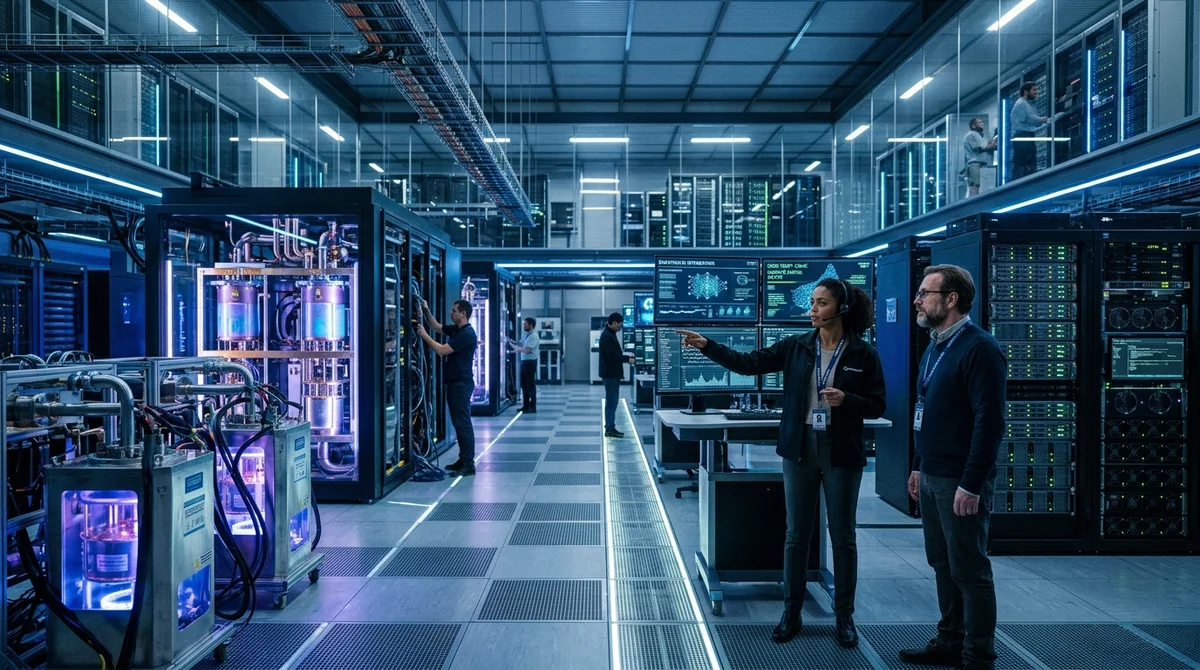
The push toward the next wave of AI infrastructure is shifting from GPUs alone to more hybrid schemes: Ann Arbor-based startup Sygaldry Technologies has raised $139 million to build servers where classical computing works in tandem with quantum accelerators. For the market, this is a notable signal: investors are ready to fund not abstract quantum research, but a concrete attempt to embed quantum technologies into future AI datacenters. The company closed a Series A round of $105 million led by Breakthrough Energy Ventures, and previously raised $34 million in a seed round from Initialized Capital.
In total, this amounts to $139 million, which for a startup at the intersection of quantum computing and AI looks like a particularly strong result. The funds will go toward developing quantum-classical servers—systems in which traditional processors, accelerators, and the software layer should complement each other in training and running models. This volume of capital matters because at the early stage, the discussion concerns not just laboratory prototypes, but an attempt to assemble a full-fledged infrastructure platform.
Sygaldry's idea rests on a simple thesis: if AI infrastructure spending does reach $5.2 trillion by 2030 as the market expects, then the competition will unfold not just over the size of computing clusters, but over the architecture of the servers themselves. Today the industry faces challenges with energy costs, chip availability, heat dissipation, and limited efficiency for certain types of tasks.
The quantum component in such a scheme is presented not as a replacement for existing accelerators, but as an additional layer that could potentially handle some narrow and resource-intensive operations where standard scaling becomes too expensive or slow. A separate point of interest in the project is the involvement of Chad Rigetti—one of the most prominent entrepreneurs in the quantum industry. His name has long been associated with attempts to turn quantum computing from a lab topic into a commercial product, and now he appears again at the center of a high-profile infrastructure project.
For investors, this matters not only as a media factor: in such bets, the team capable of explaining where scientific ambition ends and engineering suitable for real customers begins is of great importance. In such a market, the reputation of founders helps attract not only money but also the first partners who need access to new architectures before their competitors. For now, the talk is not that quantum servers will displace familiar AI stacks tomorrow.
Rather, Sygaldry is selling the market an idea of early access to the next computing platform: companies that first learn to combine classical and quantum resources may gain an advantage in speed, cost, or the types of tasks they can solve. At the same time, the model carries high risks. The quantum industry has already gone through periods of inflated expectations, and now new players will be required to deliver not beautiful promises, but working systems, clear use cases, and proven economic benefit.
That's why the next stage for Sygaldry—not the fact of raising money itself, but demonstrating that a hybrid server can be integrated into real AI development workflows. The main takeaway here is that the race for future AI infrastructure is becoming broader than the market for video chips. If Sygaldry can show that a quantum-classical server delivers practical acceleration in at least some AI workloads, the industry will gain a new class of equipment and a new scenario for capital allocation.
And if not, this round will still remain an important marker: investors are already searching for the next major architectural shift after the GPU boom, and are ready to bet on teams that promise to bring that shift.
- Oct 24, 2026Google Releases EmbeddingGemma 2: Five Modalities in a 768-Dimensional Space
- Oct 24, 2026Lovable builds GPT-Live, Claude and Gemini Omni into its chat: 9 AI tools in one place
- Oct 24, 2026Vercel Takes Python to GA and Launches Daemons for Background Workers
- Oct 24, 2026OpenAI bans Russian and Iranian influence networks: 7 fake journalists and ~100 articles
Build & Ship Production AI Apps with Vibe Coding
Join Zhemal Khamidun's hands-on Vibe Coding Intensive at hamidun.com/vibecoding — master Claude Code, Cursor, and autonomous agentic workflows.
The AI world, distilled — once a week
Seven stories that actually mattered, hand-picked. No noise, no reposts, no press releases.
Done! Check your inbox for a confirmation.