Cadence and Nvidia Expand Partnership for Training Robots on More Accurate Simulations
Cadence and Nvidia have expanded their physical AI partnership to close the gap between how robots learn in simulation and how they perform in the real…
AI-processed from TNW; edited by Hamidun News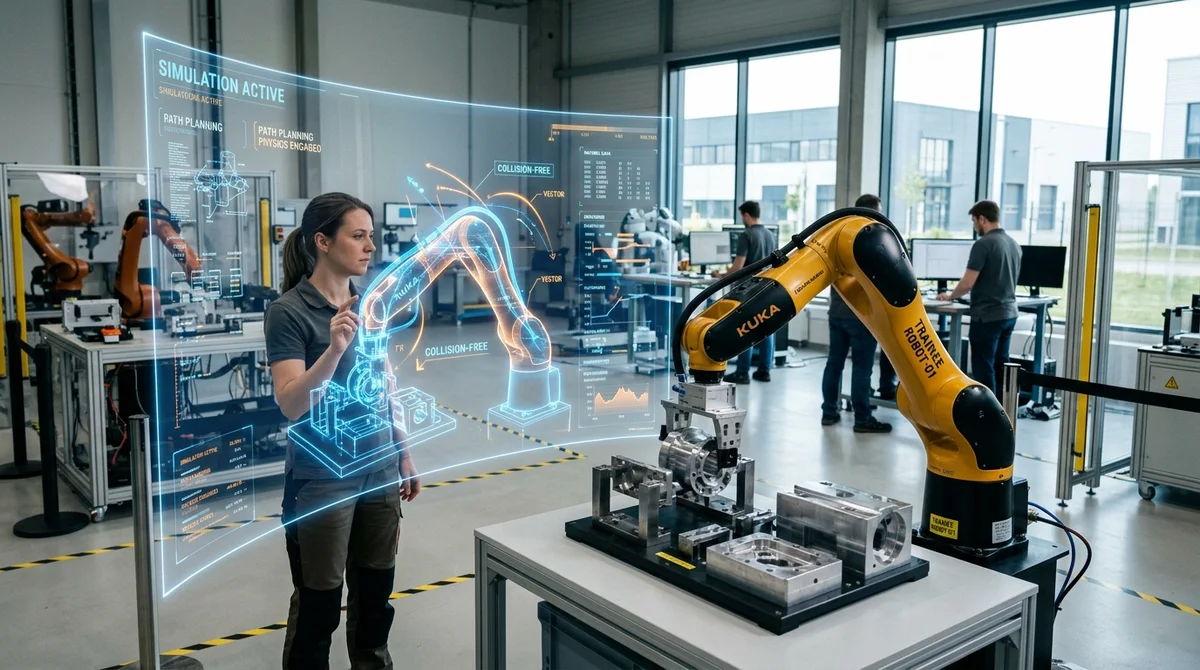
Cadence and Nvidia have decided to tackle one of robotics' most painful points: the gap between what a robot learns in simulation and how it actually behaves in the real world. The companies announced the expansion of their partnership on April 15, 2026, at the CadenceLIVE Silicon Valley conference in Santa Clara. Their goal is simple to state but complex to execute: make training data for robots so realistic that physical AI reaches real deployment faster, rather than getting stuck between the lab and production.
For Nvidia, this is a continuation of its bet on physical AI—a class of systems that should not just generate text or images, but act in space, work with objects, move, account for material resistance, friction, collisions, and mass. For Cadence, this is a logical extension beyond the company's familiar image as a supplier of software for chip design. Beyond EDA tools, it has powerful physics engines and multiphysics simulators that can model metal deformation, fluid flow, surface contact, and other processes that matter enormously in robotics.
These are precisely the models that the partners want to embed in the robot learning loop. The problem they're trying to solve is well known across the entire industry. Training a robot in the real world is slow, expensive, and often unsafe: you need hardware, space, engineers, protection from failures, and an enormous amount of repetition.
Simulation allows scenarios to run faster and cheaper, but only as long as the virtual environment accurately reflects the physics of the real world. If an object in simulation slides differently than in reality, if the surface is too perfect, or if gripper contact is calculated simplistically, the model will learn incorrect behavior. As a result, a robot that looked convincing on screen starts making mistakes in a warehouse, workshop, or assembly line.
The more accurate the synthetic data, the more useful the training—this is the entire logic behind the deal. Technically, the joint stack should link several layers into one working pipeline. On Nvidia's side, this includes the open Isaac libraries for robot simulation and training, Cosmos models for world modeling, and Jetson hardware for deploying systems at the edge and to devices themselves.
On Cadence's side—high-precision multiphysics simulations and additional testing environments like VTD and VTDx for complex scenarios. In the official description of the partnership, the companies speak of an orchestrated AI-agent pipeline: such agents will coordinate stages from training preparation and orchestration to policy optimization, validation, field data, and feedback after deployment. In other words, it's not about a pretty 3D picture, but about a closed loop where virtual training is continuously validated against the actual behavior of the machine.
At a broader level, this is also a signal about how the market for AI infrastructure is changing. Nvidia is consistently building connections between computing, simulation, digital twins, and industrial software: the company has already deepened partnerships with Siemens and Dassault Systèmes, and now is strengthening robotics through Cadence. For Cadence itself, this is a chance to occupy a place not only in the microchip development chain, but also in the growing layer of tools for physical AI.
In the press release about the expanded partnership, the companies also discuss agentic AI and digital twins for AI factories; in some engineering tasks, Cadence promises workflow acceleration up to 100 times, though in robotics the key factor still remains not speed in itself, but the fidelity of simulation and confidence when deploying systems to a real environment. The main takeaway here is this: the race in robotics is increasingly less about the model alone and more about data quality, simulation physics, and continuous feedback after deployment. If the Cadence-Nvidia combination truly allows narrowing the sim-to-real gap, robot manufacturers will be able to test new skills faster, less often break hardware in early stages, and more confidently release systems to real-world tasks.
This doesn't mean the problem is solved once and for all: the real world is still dirtier, noisier, and more unpredictable than any digital copy. But the partnership shows where the market is heading: toward more accurate simulations, tighter integration of software and hardware, and a more practical path from model training to a working robot.
Want to stop reading about AI and start using it?
AI News is a curated feed of AI/tech news. Hamidun Academy teaches you to use AI systematically in your work.