Niantic Shows How Pokémon Go Turns Player Actions Into AI Datasets
Niantic uses Pokémon Go not only as a game but also as a spatial data collection mechanism. reCAPTCHA, Strava Metro, Waze, and even StarCraft II game replays…
AI-processed from Habr AI; edited by Hamidun News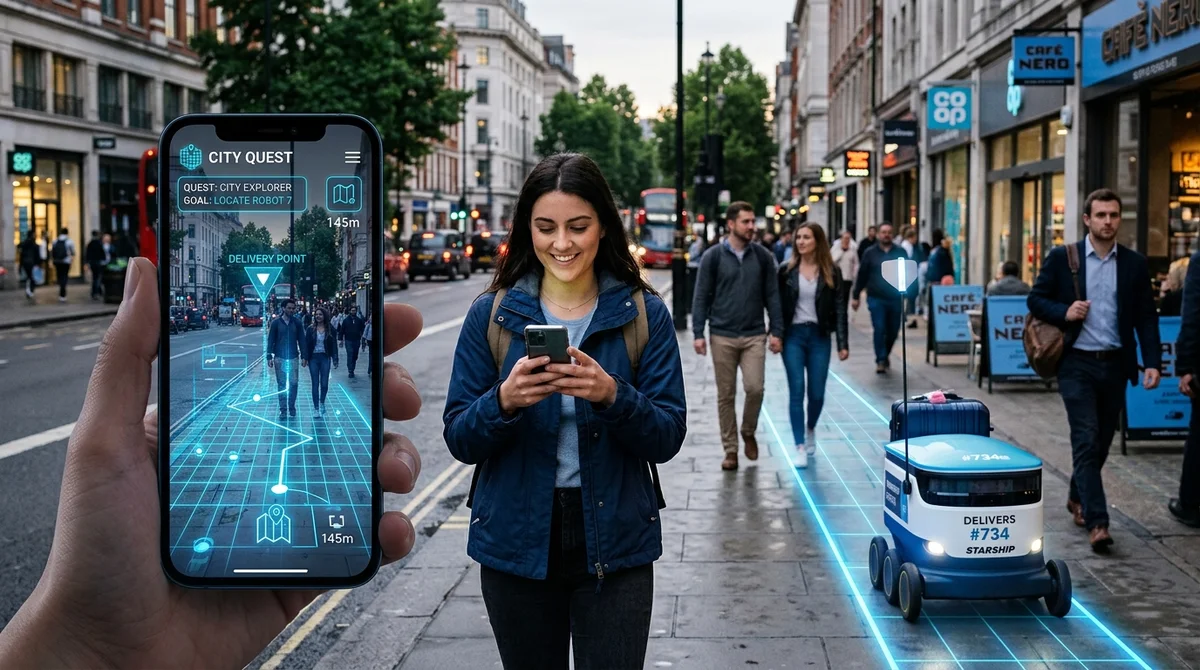
The main conclusion is simple: the most valuable dataset for AI is often collected not in a laboratory, but at the moment when a person simply plays, drives through a city, solves a captcha, or plots a route in a familiar app. The Pokémon Go case demonstrates this particularly clearly. Niantic has spent years building augmented reality infrastructure around the game: visual positioning, 3D maps of locations, and collection of real-world images through user smartphones.
At first, this looked like a convenient way to scan the surrounding environment, but it later became a full-fledged system for creating spatial datasets. As a result, Pokémon Go became not just a mobile game with geotags, but an environment where the actions of millions of people help models better understand physical space. Later, this data began to be used for large geospatial models and spatial AI systems that need not just to recognize an image, but to correlate a specific point with a global map of the area.
That's why Niantic's partnership with Coco Robotics makes sense: the technologies created for AR scenarios proved useful for delivery robots, which also need to confidently navigate the city. The mechanics here are universal. A user performs an action useful for themselves—scanning an object, navigating around traffic, cycling a familiar route, or confirming that they are not a bot—while the system simultaneously receives structured observations: images tied to coordinates, movement trajectories, road events, or human answers where automation fails.
After cleaning and aggregation, all of this becomes datasets for vision, navigation, planning, and decision-making. A classic example of this approach appeared long before the generative AI boom: reCAPTCHA. For users, it was a simple verification, but in reality, people were helping the system recognize words that OCR struggled with when digitizing old books and newspapers.
As early as 2008, reCAPTCHA was running on more than 40 thousand websites and helped correctly recognize over 440 million words. This is an early but very clear demonstration of how a routine action becomes part of a machine learning production pipeline. In urban services, this principle becomes even more important, because the data directly describes the physical world.
Strava Metro aggregates and anonymizes user tracks so that urban planners better understand how people actually move through streets, rather than just how the road network is drawn. Waze collects traffic, accident, repair, and closure information in real time, turning a map from a static layer into an almost continuous stream of events. For navigation AI, robotics, and delivery, such data is particularly valuable: it describes not a theoretical city, but a city in motion.
However, there is a limitation: the audience of a particular service doesn't always match the structure of the entire population, so even useful datasets may not be fully representative and require careful interpretation. Games have long served as an environment for training AI, even if they have nothing to do with streets and maps. In StarCraft II, researchers use replays of human matches as records of complex decisions under incomplete information, where resources must be distributed, plans changed, and opponent behavior accommodated.
In one dataset, after filtering, approximately 1.4 million games, 2.8 million episodes, and 3.
5 billion training observations remained—a scale difficult to obtain manually in any other environment. And GTA V and similar virtual worlds provide synthetic scenes for computer vision and navigation: you can quickly change weather, lighting, traffic density, and camera position, collecting large datasets without expensive field trips and manual annotation. Therefore, modern AI learns either from traces of human behavior or from realistic digital worlds specifically adapted for data collection.
What does this mean in practice: competition in AI increasingly depends not only on the quality of the model, but on who has managed to embed data collection into natural user behavior. The winner is not necessarily the one who talks loudest about a new neural network, but the one who created a service where people themselves, almost imperceptibly, produce data for the next generation of AI.
Want to stop reading about AI and start using it?
AI News is a curated feed of AI/tech news. Hamidun Academy teaches you to use AI systematically in your work.