Elon Musk Accelerates Terafab: Chip Equipment Suppliers Urged to Speed Up
According to Bloomberg, Elon Musk is rapidly accelerating the Terafab project: teams from SpaceX and Tesla have already requested prices and delivery…
AI-processed from TNW; edited by Hamidun News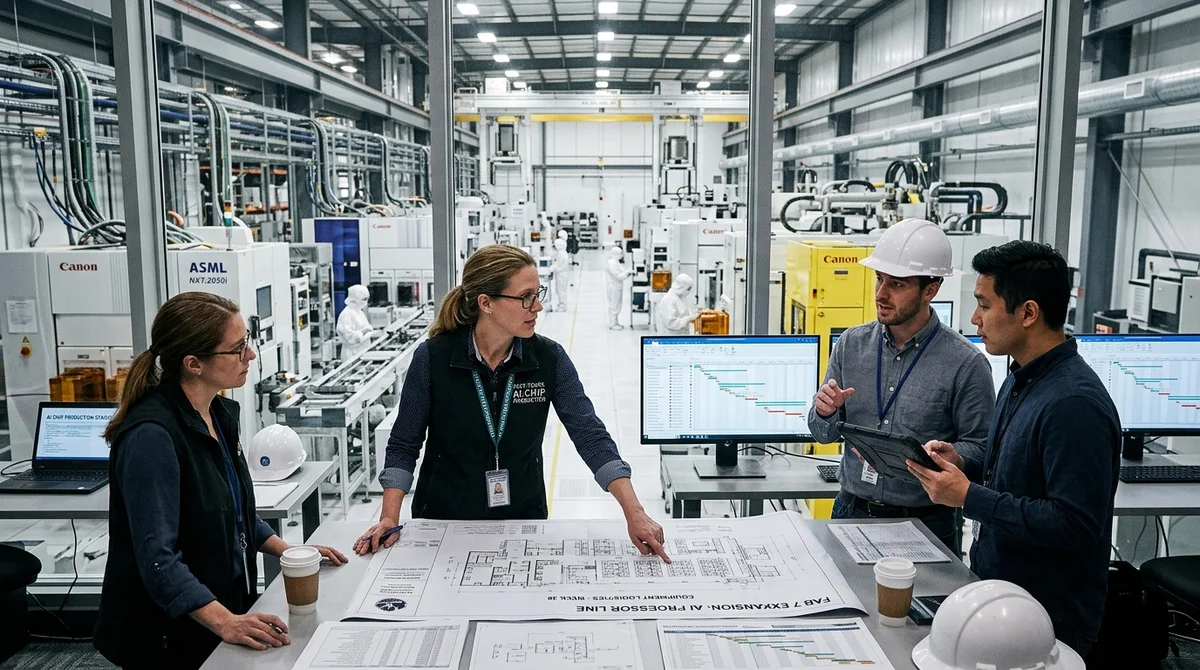
Based on new information about the Terafab project, Elon Musk appears to be pushing the race for computational power to the next phase: rather than simply buying accelerators and leasing production, he is rapidly building his own industrial base for AI chips. According to Bloomberg, teams from SpaceX and Tesla have already reached out to the largest suppliers of semiconductor equipment and requested prices and delivery timelines.
For such a project, timelines become the key indicator of seriousness: when a customer asks to move at lightning speed, it's not about distant market research, but about an attempt to assemble a production circuit as quickly as possible. The publication mentions Applied Materials, Tokyo Electron, Lam Research, and Samsung.
The first three companies are among the key suppliers of equipment for manufacturing microchips, without which it is impossible to deploy modern production. Samsung, for its part, already figures as a manufacturing partner in Musk's chip supply chain. The fact that Musk is turning to these specific players shows the scale of his ambitions.
This is not a story about an experimental laboratory or a small pilot project. If negotiations are indeed taking place with this composition, then this is likely about an attempt to build infrastructure that can handle high AI workloads and support long-term plans of several companies in Musk's orbit.
Why is speed so important here? Because the semiconductor equipment market has long been operating under conditions of overload. Supply lines are complex, equipment is expensive, and production windows are booked months and even quarters in advance. Anyone who wants to quickly launch a new chip facility faces not only financial constraints but also limited availability of machines, modules, service teams, and production capacity from contractors.
In the AI sector, this pressure is even greater: demand for computing power is growing faster than the industry can build new capacity. Therefore, in this case, a request for prices and timelines is as important as the investment volume itself. It shows whether the project is trying to fit into the existing queue or obtain priority execution.
Musk's own logic in this move reads quite clearly. His companies have long been dependent on computational infrastructure: Tesla develops autonomous driving systems and proprietary chips for vehicles, SpaceX works with massive datasets and complex engineering models, and Musk's broader AI ecosystem requires increasingly specialized hardware. Against this backdrop, the desire to control not only the software layer but also critical elements of the hardware supply chain appears quite rational.
The higher the competition for accelerators and production capacity, the stronger the incentive to break free from dependence on external suppliers and reduce bottlenecks. But here begins the main difficulty: chip manufacturing is not a data center that can be scaled relatively quickly through server purchases. It is a capital-intensive, slow, and technologically demanding process where the cost of mistakes is enormous and the launch of any stage depends on dozens of contractors.
For the market, this is an important signal. If the Terafab project truly transitions from the request phase to the execution phase, the competition for AI will increasingly shift from the level of models and applications to the level of industrial infrastructure. Winners will not only be those with stronger algorithms, but also those who can secure equipment, manufacturing, and supply chains faster.
For Musk himself, this is an attempt to take the next vertical step and bring another critical piece of the technology stack within his own ecosystem. Whether such a plan can be executed without major delays and cost overruns remains unclear, but the vector is already visible: the AI business is increasingly becoming a competition not only of engineers but also of factories.
Want to stop reading about AI and start using it?
AI News is a curated feed of AI/tech news. Hamidun Academy teaches you to use AI systematically in your work.