Why ServiceNow, Atlassian and BMC are reshaping the ITSM market and the platform debate in 2026
ITSM with AI stops being a set of point features and becomes an architectural choice. The review compares platform approaches from ServiceNow, Atlassian and…
AI-processed from Habr AI; edited by Hamidun News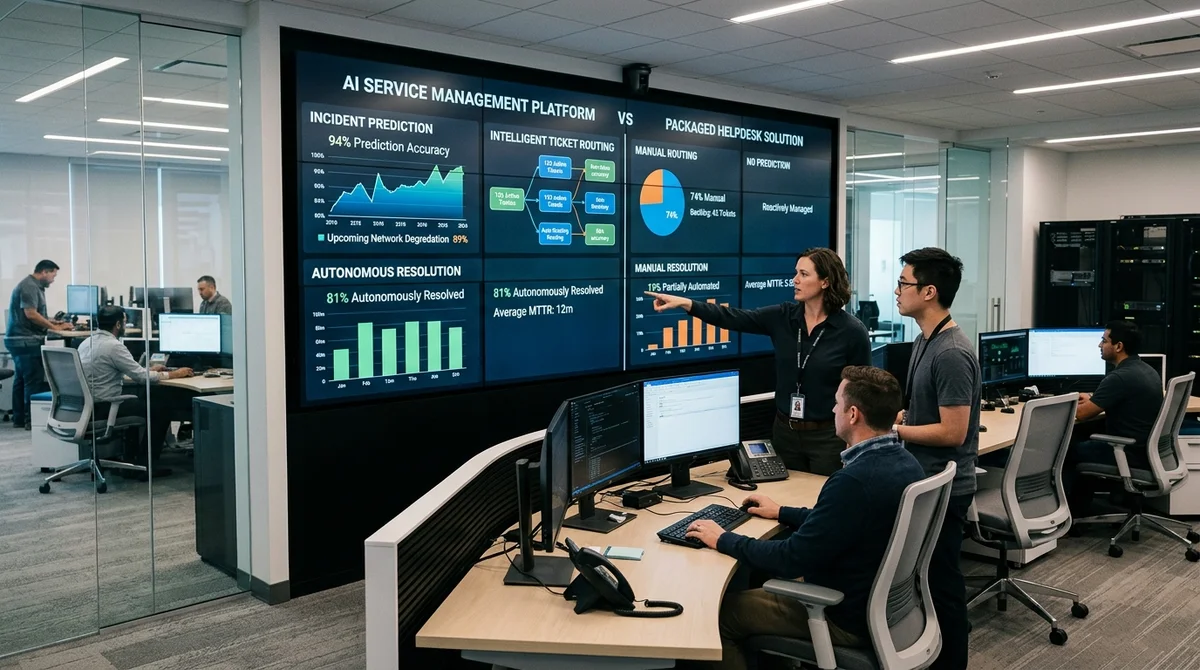
The debate over what AI-ready ITSM should look like in 2026 is no longer about choosing a chatbot for first-line support, but about architecture. The market has developed two approaches: boxed tools that quickly deliver results on standard tasks, and platforms where AI becomes a separate managed layer with audit, access policies, model selection, and the ability to run autonomous agents within business processes. Over the past three years, the role of AI in service systems has changed noticeably.
If earlier it was more often used for classifying requests and providing operator suggestions, now ITSM vendors are talking about predictive routing, automatic closure of standard requests, postmortem generation, and scenarios where the agent not only responds but also performs actions within assigned permissions. This is precisely why the focus has shifted from individual features to the question of how manageable, secure, and scalable this entire AI infrastructure is. The article highlights two basic scenarios.
The boxed approach is designed for quick deployment: the company gets built-in functions like ticket summarization, answer suggestions, a virtual assistant, and auto-classification, and implementation typically takes only weeks. The downside is that customization options are limited, and development depends on the vendor's roadmap. The platform approach requires more time and resources to launch, but in return offers tools for building custom agents, connecting different LLMs, API integrations, detailed action audits, and in some cases, operation within a local contour.
This option is more attractive to large organizations where AI needs to serve not just one service desk but multiple departments with different requirements. Among global players, ServiceNow, Atlassian, and BMC Helix are discussed as the most mature platform examples. ServiceNow builds an AI layer on top of its entire ecosystem and offers tools for creating custom skills and agents, but extended capabilities require separate payment, and implementation can be lengthy and complex.
Atlassian is betting on Rovo—an overlay to Jira, Confluence, and Jira Service Management, where value emerges from a unified data graph and tight integration with existing workflows. BMC Helix occupies a middle ground: it has both a developed platform component and a rich set of ready-made agents, plus the ability to work both in the cloud and within the company's perimeter. At the other end of the spectrum are more boxed solutions like Freshservice.
Their main advantage is the speed of achieving results: standard processes are automated quickly, and built-in AI can be enabled without heavy architectural preparation. But simplicity comes at the cost of limited context: the system works well with data already within the product, but is less suitable for complex cross-system scenarios and deep customization for corporate policies. Ivanti is presented in this overview as a player at the intersection of both models: the company combines ITSM, endpoint management, and security, but its agentic AI direction is still in development and does not appear as mature as the market leaders.
A separate layer of discussion concerns the Russian market. Here, the choice is often determined not only by budget and implementation timeline, but also by requirements for local deployment, sensitive data storage, and independence from a specific Western model provider. Therefore, for Russian customers, the arguments in favor of the platform approach sound particularly strong: on-premise is important, audit of requests and responses, limit management, role-based access model, and the ability to swap one LLM for another without rewriting processes.
As a local example, the author cites SimpleOne, where the emphasis is precisely on this architecture: local contour, logging of every model call, abstraction over different LLMs, and visual AI processes for standard service desk scenarios. The main conclusion of the article is that the ITSM market with AI is moving away from showcasing individual "smart" features toward discussing mature infrastructure. For a small or medium service desk, a boxed solution may still be the best choice if quick deployment is needed and standard automation is sufficient.
But for large companies, especially in regulated industries, the decisive factor becomes not the mere presence of AI, but the ability to manage it: understand which model is being used, where data is processed, who is responsible for agent actions, and how easily the system can be adapted to new requirements.
Want to stop reading about AI and start using it?
AI News is a curated feed of AI/tech news. Hamidun Academy teaches you to use AI systematically in your work.